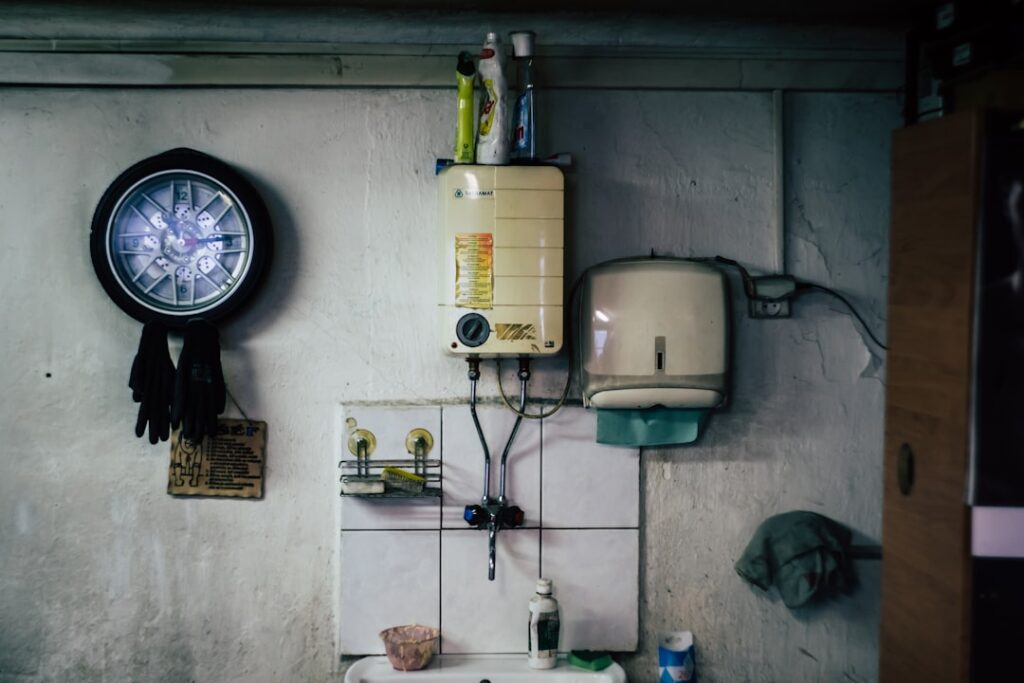
Straight to the numbers: expect to pay roughly $900 to $2,500 installed for a standard tank water heater, and $2,500 to $5,500 installed for a tankless unit. So how much does a water heater cost for your specific house? It comes down to four things — fuel type, capacity, the technology you pick, and how ugly the install is once the plumber opens up the space. Below is how those pieces stack up, with real 2026 price ranges I quote from every day.
- Quick Answer: Typical Installed Prices
- Cost Breakdown: Where the Money Goes
- Tank vs. Tankless
- Gas vs. Electric
- Factors That Move the Price
- Capacity: Sizing Without Overpaying
- Installation and Replacement Timeline
- Brand and Price Snapshot
- Lifespan and Long-Term Cost of Ownership
- How to Keep the Cost Down
- Bottom Line
Quick Answer: Typical Installed Prices
Here is the range most homeowners land in, unit plus professional installation:
- Electric tank (40-50 gal): $900 to $1,800
- Gas tank (40-50 gal): $1,200 to $2,500
- Electric tankless: $1,800 to $3,500
- Gas tankless (condensing): $3,000 to $5,500
- Heat pump (hybrid) tank: $2,000 to $3,800
The unit itself is often less than half the total. A $600 gas tank can easily carry $700 to $1,200 in labor, permits, venting, and code upgrades once it is bolted in.
Cost Breakdown: Where the Money Goes
Split any water heater quote into these buckets and it stops feeling like a mystery:
- The unit — $400 to $2,500. A basic Rheem or A.O. Smith 40-gallon gas tank runs $500 to $900. A premium Bradford White tank or a condensing Rinnai/Navien tankless runs $1,200 to $2,500.
- Labor — $500 to $1,500. Two to four hours for a straight tank swap; a full day or more for a tankless conversion.
- Permits and inspection — $50 to $500. Required in most jurisdictions; skipping it bites you at resale.
- Venting and gas/electrical — $150 to $2,000. The biggest wildcard, especially on conversions.
- Code upgrades and parts — $100 to $600. Expansion tank, new shutoff, drain pan, seismic straps, updated connectors.
Tank vs. Tankless
A conventional tank stores 40 to 80 gallons of hot water, ready to go. It is cheaper to buy and simpler to install, but it burns energy keeping that water hot around the clock and it runs out during back-to-back showers. A tankless (on-demand) unit heats water as it flows, delivering endless hot water and saving 10 to 30 percent on energy, but it costs two to three times as much to install.
Run the timeline: a tank lasts 8 to 12 years; a tankless commonly lasts 20-plus. If you are staying in the house, the tankless premium often pays back. If you are selling in two years, the tank is the rational money. A gas tankless like a Rinnai RU199 or Navien NPE also frequently needs a larger gas line and new venting, which is exactly why its installed cost jumps.
Gas vs. Electric
Fuel type swings both purchase price and running cost. Gas units cost more up front — you are paying for a sealed burner, venting, and gas connections — but natural gas is usually cheaper per BTU than electricity, so they cost less to run in most regions. Electric units are cheaper to buy and install (no venting) but can cost more monthly unless you go with a heat-pump model.
The heat-pump (hybrid) electric water heater changes that math. A Rheem or A.O. Smith hybrid costs $1,500 to $2,500 for the unit but uses roughly 60 percent less electricity than a standard electric tank, and it often qualifies for federal and utility rebates worth several hundred dollars. If your utility bill matters and you have the headroom and warm air around the unit, it is the efficiency play.
Factors That Move the Price
Two identical houses can get quotes $1,500 apart. Here is why:
- Capacity. Jumping from a 40-gallon to a 75- or 80-gallon tank adds $300 to $800.
- Fuel conversion. Going electric-to-gas, or tank-to-tankless, means new venting, gas line, or a beefed-up electrical circuit — easily $1,000 to $2,500 extra.
- Install complexity. A tight attic or crawlspace, a long carry, or removing an old unit through a finished basement all add labor.
- Code upgrades. Many areas now require an expansion tank, a drip pan with drain, and updated seismic strapping. Budget $150 to $500.
- Region. Labor rates in a coastal metro can double what a rural install costs. Permit fees vary just as widely.
- Emergency vs. planned. A burst-tank emergency on a weekend carries a premium. Replacing before it fails saves you the rush rate.
Capacity: Sizing Without Overpaying
Buying too big is one of the most common ways homeowners waste money on a water heater. For a tank, match the first-hour rating to your peak demand, not your total daily use. Rough guidance by household size:
- 1-2 people: 30-40 gallon tank, or a 7 GPM tankless.
- 3-4 people: 40-50 gallon tank, or an 8-9 GPM tankless.
- 5+ people: 60-80 gallon tank, or a 9-11 GPM tankless.
For tankless, the metric that matters is flow in gallons per minute at your incoming water temperature. A cold-climate home needs a bigger burner to hit the same GPM as a warm-climate one, because the unit has to raise the water further. Size to how many fixtures you actually run at once — a shower plus a kitchen sink is about 3.5 to 4.5 GPM — rather than buying the biggest box on the shelf.
Installation and Replacement Timeline
A like-for-like tank swap — same fuel, same location, same venting — is usually a two-to-four-hour job and the cheapest scenario. The plumber drains the old unit, disconnects it, sets and connects the new one, and fires it up. Anything that changes the picture adds time and money: moving the unit to a new spot, upsizing the tank, or converting from tank to tankless can turn it into a full-day or multi-day job with new gas, venting, or electrical work. Build that reality into your quote comparison. A bid that is $800 cheaper often skips venting upgrades or a code-required expansion tank that the higher bid included.
Brand and Price Snapshot
Unit-only pricing so you can gauge quotes:
- Rheem / A.O. Smith tank (40-50 gal): $500 to $1,100 — mass-market, widely stocked.
- Bradford White tank: $700 to $1,400 — contractor favorite for durability.
- Rinnai / Navien gas tankless: $1,000 to $2,200 — the tankless leaders.
- Rheem / A.O. Smith hybrid heat pump: $1,500 to $2,500 — best efficiency.
Lifespan and Long-Term Cost of Ownership
Sticker price is only half the story. A standard tank lasts 8 to 12 years, so over a 30-year stretch in the house you may buy three of them. A tankless commonly runs 20-plus years, meaning one unit covers the same span. Factor that replacement cadence into the comparison and the tankless premium looks smaller than it does on day one.
Running costs stack on top. A conventional tank loses heat around the clock keeping stored water hot — “standby loss” — while tankless and heat-pump units sidestep most of that. Over a decade, the efficiency difference between a plain electric tank and a heat-pump model can add up to $1,500 or more in electricity. When you compare quotes, add roughly ten years of energy cost to each option and the cheapest unit to buy is often not the cheapest to own.
How to Keep the Cost Down
A few moves that actually save money: get three itemized quotes, not one; replace on your schedule before the old tank fails, so you are not paying emergency rates; and match capacity to your household instead of oversizing — a two-person home rarely needs an 80-gallon tank. Check for rebates, especially on heat-pump and high-efficiency condensing units, where utility and federal incentives can knock $300 to $600 off. And do not skip the permit; an unpermitted install can cost you far more when it surfaces during a home sale.
Bottom Line
For most homes, budget $900 to $2,500 for a straightforward tank replacement and $2,500 to $5,500 if you move to tankless or convert fuel types. The unit is only part of it — venting, code upgrades, and install difficulty decide where you land in the range. Price it before the old heater quits, and you get to shop the number instead of paying whatever the emergency truck charges.