The 40 gallon hot water heater is the quiet workhorse of American homes — the size that fits most two- to three-person households, slides into a standard closet, and won’t overwhelm a modest gas line or electrical panel. It’s popular for good reason, but “40 gallon” alone doesn’t tell you whether a given unit will actually keep up with your household. Recovery rate, fuel type, and first-hour rating all matter as much as the tank size on the label.
- Who a 40 Gallon Tank Is Right For
- First-Hour Rating vs Tank Size
- Gas vs Electric in a 40 Gallon Unit
- Dimensions and Fit
- Recovery Rate and Efficiency
- What a 40 Gallon Heater Costs
- Installation and Safety Basics
- Signs Your Current Heater Is Failing
- Gas or Electric: Running Cost Over Time
- Maintenance to Get Your Money’s Worth
- The Bottom Line
Who a 40 Gallon Tank Is Right For
Tank size should match how much hot water your household draws at once, not just how many people live there. As a rough guide:
- 1 to 2 people, one bathroom: a 40 gallon unit is comfortable
- 2 to 3 people, one to two bathrooms: 40 gallons works if showers are staggered
- 4-plus people or two simultaneous showers: step up to 50 gallons
The real question is your peak. A morning where two people shower back-to-back while the dishwasher runs can drain a 40 quickly. If that’s your routine, look at the first-hour rating, not just the gallon number.
First-Hour Rating vs Tank Size
Here’s the spec most shoppers overlook. The first-hour rating (FHR) tells you how many gallons of hot water the unit can deliver in a busy first hour of use, combining what’s in the tank with what it can reheat on the fly. A gas 40 gallon heater often has an FHR of 60 to 70 gallons because it reheats fast; an electric 40 gallon unit might only rate 50 to 58 gallons because its elements heat more slowly.
So a 40 gallon gas heater can out-deliver a 40 gallon electric one during a busy morning, even though the tanks are identical. Match the FHR to your peak-hour demand and you’ll avoid cold-shower complaints.
Gas vs Electric in a 40 Gallon Unit
Gas models heat with a burner underneath the tank and recover quickly — a typical natural gas 40 gallon unit recovers around 40 to 44 gallons per hour at a 90°F rise. They need venting and a gas line but cost less to run in most regions where gas is cheaper than electricity.
Electric models use two 240V elements and recover slower — roughly 20 to 22 gallons per hour. They’re simpler to install where there’s no gas, produce no combustion byproducts, and need no venting, just a dedicated 30A double-pole breaker. In an all-electric home, or where running a gas line and flue is impractical, electric is the sensible pick.
Dimensions and Fit
A standard 40 gallon tank is roughly 18 to 20 inches in diameter and 46 to 62 inches tall depending on whether it’s a “short” or “tall” model. That variation matters:
- Tall models (around 58 to 62 inches) have a smaller footprint — good for tight closets with headroom.
- Short/lowboy models (around 46 to 50 inches) fit under stairs, in crawlspaces, or in low utility rooms.
Measure your space including clearance for the flue on gas units and room above for the T&P discharge and connections. Leave at least a few inches around the unit for service access.
Recovery Rate and Efficiency
Efficiency is expressed as UEF (Uniform Energy Factor). A standard atmospheric gas 40 gallon runs around 0.60 to 0.64 UEF; an electric model sits higher at 0.90 to 0.93 because there’s no flue loss, though electricity often costs more per BTU delivered. Heat-pump (hybrid) electric 40 gallon units push UEF above 3.0 by pulling heat from the air, cutting water-heating costs by half or more — worth considering if you have a warm mechanical room with headroom for the taller cabinet.
What a 40 Gallon Heater Costs
- Standard gas or electric tank: $500 to $900
- High-efficiency or power-vent gas: $900 to $1,400
- Hybrid heat-pump 40 gallon: $1,400 to $2,000
- Professional installation: $500 to $1,200
- Typical installed total: $1,200 to $2,200
Solid mainstream models include the Rheem Performance, A.O. Smith Signature, and Bradford White RG240 series. Bradford White in particular has a strong reputation for tank longevity and is sold mainly through plumbers rather than big-box stores.
Installation and Safety Basics
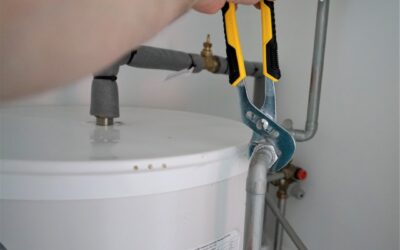
Whether you install it yourself or hire out, a few things are non-negotiable. The temperature and pressure (T&P) relief valve must have a discharge pipe running down to within 6 inches of the floor — never capped or reduced. Gas units need proper venting; after firing, check the draft hood pulls smoke inward, and if it rolls out you have backdrafting and need a pro. Set the thermostat to 120°F to balance scald safety, bacteria control, and standby loss. In a garage, gas units usually need the burner elevated 18 inches unless FVIR-rated.
An electric like-for-like swap is DIY-friendly if you’re comfortable with 240V wiring and permits. A gas installation with any venting or gas-line change is the one to hand to a licensed plumber. And never energize an electric tank until it’s completely full — dry elements fail in seconds.
Signs Your Current Heater Is Failing
Before you shop, make sure you actually need a new tank — and catch a failing one before it floods. Watch for these:
- Rusty or discolored hot water that clears on the cold side points to a corroding tank interior.
- Rumbling or popping is sediment boiling under the burner — sometimes fixable with a flush, but a warning sign in an older unit.
- Water pooling around the base means the tank is weeping, and there is no repair for a cracked steel tank.
- Running out of hot water faster than it used to often means sediment is stealing tank volume.
- Age past 10 to 12 years — even a working tank on borrowed time is worth replacing on your schedule, not during a 2 a.m. flood.
Gas or Electric: Running Cost Over Time
The purchase price is only part of the picture. A gas 40 gallon unit typically costs $200 to $300 a year to run where natural gas is cheap; an equivalent electric standard tank runs $350 to $500 depending on local electric rates. Over a 12-year life that gap adds up, which is why gas usually wins on operating cost where it’s available.
The hybrid heat-pump 40 gallon flips the math on electric. By moving heat rather than making it with resistance, it runs as little as $110 to $150 a year — often the cheapest to operate of any option. The trade-offs are the higher purchase price, a taller cabinet, a nearby condensate drain, and a mechanical space that stays above roughly 40°F. In a warm garage or basement, it’s a genuinely smart long-term buy.
Maintenance to Get Your Money’s Worth
A 40 gallon tank rewards a little attention. Flush a few gallons from the drain valve once a year to clear sediment that otherwise insulates the burner and steals capacity. Check the sacrificial anode rod every three to four years and replace it once it’s corroded down to the wire — a $30 part that can add years to the tank. Test the T&P valve annually by lifting its lever; water should discharge and then stop cleanly. These three habits routinely push a 40 gallon heater past 12 years.
The Bottom Line
A 40 gallon hot water heater hits the sweet spot for a large share of U.S. homes: enough capacity for small to mid-size households, a footprint that fits standard spaces, and modest demands on your utilities. Choose gas for faster recovery and lower running cost where gas is available, electric or hybrid for simpler installation and all-electric homes, and always buy on first-hour rating and recovery — not the gallon number alone. Get those right and a good 40 gallon hot water heater will serve you reliably for a decade or more.