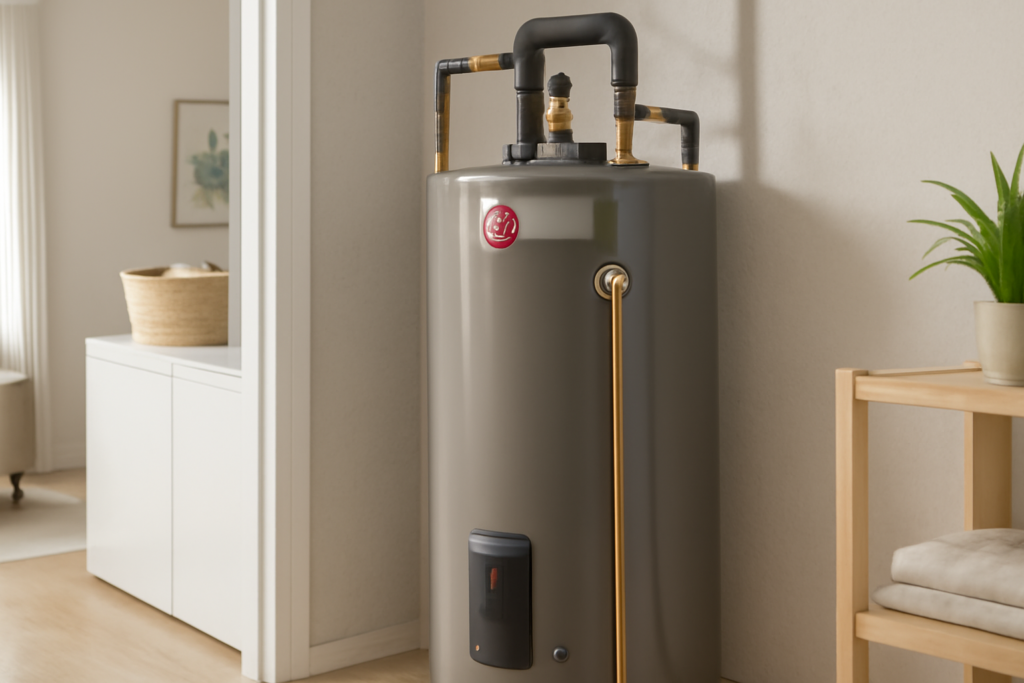
A Rheem hot water heater shows up in more American basements and garages than almost any other brand, and for good reason: the company builds tank, tankless, and hybrid units across a wide price range, and parts are stocked at both Home Depot and independent supply houses. That availability matters at 6 a.m. when you have no hot water and need a thermostat or gas valve today, not next week. This guide walks through picking the right size and fuel type, what installation actually costs, the maintenance that doubles a tank’s lifespan, and the point where you stop turning wrenches and call a licensed plumber.
Which Rheem lines you’ll actually see
Rheem sells under a few names, and knowing them helps you shop. The Performance line is the entry-level tank series at Home Depot, sold as Rheem or Ruud (a sister brand that is mechanically the same unit). Performance Platinum is the premium tank tier, and it includes the hybrid heat-pump models. Professional-grade units — Prestige, Classic, Classic Plus — move through plumbing wholesalers and usually carry longer warranties and better service parts.
- Standard tank (gas or electric): 30, 40, 50, 65, and 80-gallon capacities. The workhorse for most homes.
- Tankless (gas): the RTGH condensing and RTG non-condensing series, delivering endless hot water at 7 to 9-plus gallons per minute.
- Hybrid heat pump: the ProTerra and Performance Platinum electric units that pull heat from the surrounding air and can cut water-heating power use by roughly 60 to 70 percent.
- Point-of-use electric: small 2.5 to 20-gallon tanks for a remote sink or wet bar.
Sizing: match the tank to how you actually shower
Undersizing is the most common regret. For a storage tank, size by “first-hour rating” (FHR) — how many gallons the unit can deliver in a busy hour — not just raw capacity. A 40-gallon gas tank often carries a 70 GPH first-hour rating because the burner reheats fast; a 40-gallon electric might only manage 50 to 58 GPH.
- 1 to 2 people: 30 to 40-gallon tank, or a 40 to 50 GPH first-hour rating.
- 3 to 4 people: 40-gallon gas or 50-gallon electric, roughly 60 to 70 GPH.
- 5-plus people, or a big soaking tub: 50-gallon gas, 65 to 80-gallon electric, or a tankless unit.
For a Rheem tankless, size by flow and temperature rise instead. In a cold northern climate where incoming water sits near 40°F, you need a large condensing unit to push two showers at once to 120°F. In Florida or Texas, where groundwater runs 65 to 70°F, a smaller unit handles the same demand. Undersize a tankless and you get lukewarm water when the dishwasher and shower run together.
Gas, electric, or hybrid
Fuel type decides both your monthly bill and your install complexity. Match it to what your house already has before you fall in love with a spec sheet.
- Natural gas or propane: cheaper to run in most regions, faster recovery, and it keeps working in a power outage (standing-pilot models). It requires a gas line, combustion air, and proper venting — this is where permits and pros come in.
- Standard electric: lower upfront cost, simpler install, no venting, but slower recovery and higher operating cost where electricity is expensive. Needs a dedicated 30-amp 240-volt circuit for most tanks.
- Hybrid heat pump (ProTerra): the cheapest to operate by far, and it often qualifies for federal and utility rebates. The catch: it needs about 700 to 1,000 cubic feet of surrounding air space, pulls heat (and coolness) from that room, and makes a low hum. A cramped closet is a poor fit; a basement or garage is ideal.
What installation costs
Budget realistically. A same-fuel, same-location swap is straightforward; anything that changes fuel, venting, or location climbs fast.
- Standard 40 to 50-gallon tank, unit only: roughly $450 to $900.
- Professional install of a like-for-like tank: another $500 to $1,200 in labor, permit, pan, and connectors.
- Gas tankless, installed: $3,000 to $5,500, more if you upsize the gas line or add stainless venting.
- Hybrid heat pump, installed: $2,000 to $3,500 before rebates, which can knock off $600 to $2,000.
Most jurisdictions require a permit for a water heater replacement, and the inspector will check the temperature-and-pressure (T&P) relief valve, its discharge pipe, seismic strapping in earthquake zones, an expansion tank on closed systems, and correct venting. Skipping the permit can void your homeowner’s insurance if a failure causes damage.
Maintenance that adds years
A tank that gets ignored fails in 8 to 10 years; a maintained one runs 12 to 15. The routine is simple.
- Flush yearly. Drain a few gallons through the bottom valve to clear sediment. In hard-water areas, do it twice a year — sediment insulates the burner and makes the tank rumble.
- Check the anode rod every 2 to 3 years. This sacrificial magnesium or aluminum rod corrodes so the tank doesn’t. Replace it when it’s chewed down to the core wire, and you can double tank life.
- Test the T&P valve annually. Lift the lever, let it spit water, and confirm it reseats. A stuck relief valve is a genuine safety hazard.
- Rinse the tankless. Descale a Rheem tankless with white vinegar through its service ports every 12 months, or more often on well water.
- Vacuum the hybrid’s air filter. The ProTerra has a washable filter that chokes with dust and kills efficiency.
Set the thermostat to 120°F. That’s hot enough to kill bacteria at the tap, safe against scald injuries, and easier on the tank than the factory-default 140°F.
Common problems and error codes
Rheem tankless units and the smart tanks throw numbered codes on a display or a blinking status light. A few you’ll meet:
- Code 11 (tankless): no ignition. Usually a closed gas valve, empty propane tank, or air in the line after service.
- Code 12: flame loss during operation — often low gas pressure or an undersized gas line.
- Code 76: communication fault with the remote controller; check the wiring.
- No hot water, electric tank: a tripped high-limit reset button behind the upper access panel, or a failed heating element.
- Pilot won’t stay lit, gas tank: usually a bad thermocouple, a $15 part, or a dirty flame sensor.
Rusty or metallic-smelling hot water almost always means the anode rod is spent and the tank interior is now corroding — plan a replacement soon. Popping or rumbling means sediment; flush it.
When to call a licensed plumber
You can flush a tank, swap an anode rod, or replace an electric element with the power off. Draw the line at anything touching gas, venting, or a fuel change. Cutting into a gas line, sizing combustion air, running stainless tankless vent, or converting electric to gas is licensed-plumber and sometimes licensed-gasfitter territory — a bad joint or a backdrafted flue can leak carbon monoxide. New tankless and hybrid installs almost always need a permit and inspection anyway, and a pro’s workmanship warranty is worth the labor. If you smell gas, leave and call the utility from outside; don’t flip any switch.
Tank vs. tankless vs. hybrid: which Rheem fits
Beyond fuel type, the tank style shapes your life for the next decade, so weigh it against how your household behaves.
- Standard tank: lowest upfront cost, dead-simple to service, and the parts are everywhere. The downside is a finite reservoir — run it dry with back-to-back showers and you wait 30 to 60 minutes for recovery. Best for tight budgets and average demand.
- Tankless: endless hot water, a 20-plus year lifespan, and a wall-mounted footprint that frees up floor space. It costs more to install and needs annual descaling, and hard water is its enemy. Best for large households and long-shower families.
- Hybrid heat pump: by far the cheapest to run and rebate-friendly, but it needs air volume, adds a hum, and cools the room it sits in. Best for a basement or garage where the operating savings stack up year after year.
Run the ten-year math rather than the sticker price. A hybrid that costs $1,500 more up front but saves $350 a year on power pays for itself in under five years and keeps saving after that. A tankless that outlives two standard tanks can win on total cost even though the install stings.
Is a Rheem worth it?
For most homeowners, yes. A Rheem hot water heater balances price, parts availability, and a solid warranty — typically 6, 9, or 12 years depending on the tier, with the difference usually being a beefier anode and better gas valve rather than a fundamentally different tank. Buy the longest warranty you can justify, size it a notch generously, set it to 120°F, flush it every year, and it will quietly hand you hot showers for well over a decade.