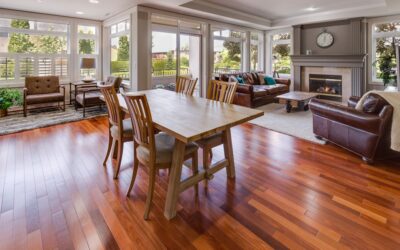
If you’ve admired the clean, linear look in high-end modern homes and wondered how the floors stay so calm and uniform, the answer is often rift sawn white oak flooring. This premium cut takes the same durable white oak used everywhere and mills it at a specific angle to the growth rings, producing tight, dead-straight grain with none of the swirling cathedral patterns of ordinary boards. The result is a sophisticated, contemporary floor that also happens to be one of the most dimensionally stable wood floors you can buy. It costs more, but for the right project it’s worth every dollar.
Here’s a straight-talking look at what rift sawn white oak is, its advantages and drawbacks, how it compares to other cuts, and what you’ll pay.
What “Rift Sawn” Actually Means
How a log is cut determines the grain you see on the finished board. Rift sawing mills each board so the growth rings meet the face at roughly a 30- to 60-degree angle. That angle produces a consistent, linear grain that runs straight down the length of every plank with virtually no flecking or wild figure.
Because the cut has to be made radially around the log, rift sawing wastes a lot of wood, more than any other method, which is the main reason it commands a premium. But that same geometry is what gives rift sawn white oak flooring its signature look and its exceptional stability. White oak itself brings a 1,360 Janka hardness rating and closed-cell grain that naturally resists water, making it a favorite for both floors and boatbuilding.
The Pros of Rift Sawn White Oak Flooring
- Straight, uniform grain: The clean linear look reads modern, minimal, and expensive, with no busy cathedral arches.
- Outstanding stability: Rift sawn boards expand and contract less across their width than plain sawn, so you get fewer gaps and less cupping through seasonal humidity swings.
- Durability: White oak’s hardness and tight grain stand up to heavy foot traffic, kids, and pets.
- Takes stain evenly: The consistent grain accepts stain and finish uniformly, so custom colors look intentional rather than blotchy.
- Timeless appeal: It works in modern, Scandinavian, and transitional interiors and rarely looks dated.
The Cons to Consider
No floor is perfect, and the very things that make this cut desirable also drive its downsides.
- Higher cost: The wasteful milling process makes it one of the more expensive solid and engineered wood options available.
- Less character for some tastes: If you love rustic knots, mineral streaks, and dramatic figure, rift sawn’s uniformity may feel too plain.
- Limited availability: Not every supplier stocks it, and wide planks or long lengths may require a special order and lead time.
- No dramatic flecking: Unlike quarter sawn, it deliberately avoids the ray-fleck figure, which is a plus or minus depending on your style.
Rift Sawn vs. Quarter Sawn vs. Plain Sawn
Understanding the three cuts helps you choose with confidence, because they come from the same species but look and behave differently.
Plain (Flat) Sawn
The most common and affordable cut. Boards show the familiar cathedral or “flame” grain pattern. It’s beautiful and traditional but the least stable of the three, expanding and contracting more with humidity.
Quarter Sawn
Cut so rings meet the face at 60 to 90 degrees, producing straight grain plus dramatic silvery ray flecks unique to white oak. Very stable and prized for Arts and Crafts and mission-style interiors.
Rift Sawn
The straightest, most uniform grain of all, with the flecking deliberately avoided. The most stable and the most expensive because of milling waste. Many premium floors are sold as “rift and quartered,” blending the two cuts to balance cost, stability, and that clean linear look.
- Most stable: Rift sawn, then quarter sawn, then plain sawn.
- Most affordable: Plain sawn, then quarter sawn, then rift sawn.
- Straightest grain: Rift sawn wins outright.
Solid vs. Engineered Rift Sawn
You can buy rift sawn white oak flooring in both solid and engineered forms. Solid boards are a single piece of oak, can be sanded and refinished many times, and suit above-grade rooms with stable humidity. Engineered versions layer a rift sawn white oak veneer over a plywood core, giving you the same surface look with better stability over concrete slabs, radiant heat, and basements. For below-grade or wide-plank installations, engineered is often the smarter, more forgiving choice.
What Rift Sawn White Oak Flooring Costs
Expect to pay a premium over standard oak. Here are realistic material ranges:
- Solid rift sawn white oak: $8 to $16 per square foot.
- Engineered rift sawn white oak: $7 to $14 per square foot.
- Rift-and-quartered blends: often slightly less, around $6 to $12 per square foot.
- Professional installation: $4 to $10 per square foot, more for intricate patterns.
- Sand and finish (unfinished boards): $3 to $6 per square foot.
For a 400-square-foot living room, budget roughly $5,000 to $10,000 installed for a quality rift sawn white oak floor. Wide planks (7 inches and up) and long lengths push toward the top of that range because they require larger, cleaner logs.
Finishing and Design Tips
The straight grain is a designer’s dream for stains. Natural or white-washed finishes let the clean lines shine and lean Scandinavian. A wire-brushed texture adds subtle depth without disrupting the linear look. Because the grain is so uniform, even a deep espresso or gray stain applies evenly instead of blotching, which is a real advantage over plain sawn.
For the most seamless modern result, run planks in the same direction across the whole floor and choose the widest board your budget allows. Wide, long rift sawn planks emphasize the straight grain and make a room feel calm and expansive.
Sheen matters too. A matte or satin finish suits the understated character of rift sawn oak far better than high gloss, which fights the calm look and shows every footprint. Hardwax oils and low-VOC water-based polyurethanes both let the grain read clearly while giving the surface a soft, natural feel. If you want warmth without a yellow cast, ask your installer about a UV-cured finish, since white oak’s neutral base tone stays truer over time than red oak, which ambers noticeably as it ages.
Maintenance and Longevity
One of the quiet advantages of white oak is how gracefully it ages. The closed-cell grain that makes it water-resistant also helps it shrug off everyday spills, and its tight surface hides minor scuffs better than softer woods. Day-to-day care is simple.
- Sweep or vacuum regularly: Grit is what actually scratches a finish, so keep it off the floor.
- Damp-mop, don’t wet-mop: Use a barely damp microfiber pad with a pH-neutral wood cleaner, never a soaking mop.
- Protect from furniture: Felt pads under legs and rugs in traffic lanes preserve the finish for years.
- Refinish when needed: A solid rift sawn floor can be sanded and refinished several times, so a floor that looks tired at year 20 can be reborn rather than replaced.
With basic care, a solid rift sawn white oak floor can realistically last 50 to 100 years, which is a big part of why it holds its value so well. That longevity helps offset the higher upfront cost when you spread it over the life of the floor.
The Bottom Line
Rift sawn white oak flooring is the choice when you want a clean, modern, ultra-stable floor and you’re willing to pay for the premium cut. Its straight grain, even stain acceptance, and resistance to seasonal movement set it apart from ordinary plain sawn oak. If you crave rustic character or you’re on a tight budget, plain sawn may serve you better. But for a sophisticated, long-lasting floor that looks intentional in any contemporary home, few materials rival a well-installed rift sawn white oak floor.
Prefer to explore on your own?
See how new flooring looks in your actual room in seconds — free, no signup.
Try the free Floor Studio →