If you have ever admired a floor that looked impossibly clean and linear and wondered why it cost so much, you were probably looking at this. Rift and quartered white oak flooring is milled by a special sawing method that produces long, straight grain and eliminates the wavy cathedral pattern of ordinary plainsawn oak. The result is a refined, modern look with exceptional dimensional stability, and a premium price to match. This buying guide explains what the cut actually is, why it behaves so well, how it looks, and where it is worth the extra money, so you can decide if this upgrade belongs in your home.
What “Rift and Quartered” Means
The terms describe how the log is cut relative to its growth rings, which changes everything about the resulting board. Most flooring is plainsawn, cut tangentially, which is efficient and yields the familiar arched cathedral grain. Rift and quartered boards are cut differently to expose the grain more vertically.
- Quartersawn: The log is quartered and cut so the growth rings meet the face at a steep 60 to 90 degree angle, producing a straight grain plus dramatic flecks called medullary ray fleck or tiger fleck.
- Rift sawn: Cut at roughly a 30 to 60 degree angle, giving the straightest, most uniform linear grain with almost no fleck.
- Sold together: The two are commonly blended and sold as “rift and quartered” for a consistent straight-grained look with some fleck character.
The Straight-Grain Look
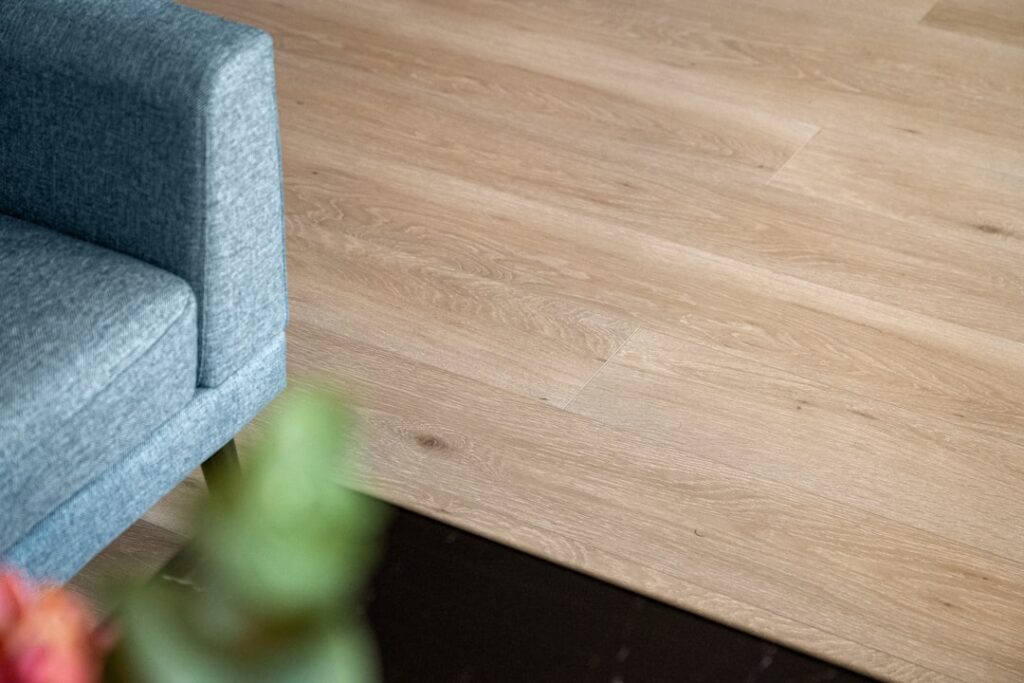
Visually, this is the whole point. Rift and quartered white oak has long, parallel, linear grain lines running the length of each board, with none of the busy swirls and arches of plainsawn wood. The effect is calm, clean, and distinctly upscale, a favorite in modern, contemporary, and high-end transitional interiors where a quiet, uniform floor lets the rest of the room speak. Quartersawn boards mixed in add subtle ray flecking for texture, while rift boards keep things purely linear. Together they read as sophisticated and intentional.
Why It’s So Stable
Beauty aside, the cut delivers a genuine performance benefit. Because the growth rings run more vertically through the board, rift and quartered oak expands and contracts far less across its width than plainsawn wood. Wood moves most in the direction of its rings, and orienting them vertically minimizes that seasonal movement. The practical payoff is a floor that cups, gaps, and warps less as humidity swings through the seasons. That stability makes it a strong choice for wide planks, radiant heat, and drier or more variable climates where plainsawn boards would move more noticeably.
Why It Costs More
The premium price is not marketing; it is math. Rift and quartered cutting is far less efficient than plainsawn milling. The saw orientation wastes more of each log and yields fewer usable boards, so more raw timber is consumed per finished square foot. The process is also more labor-intensive. All of that pushes the cost well above standard plainsawn oak, often significantly so. You are paying for both the distinctive look and the extra wood and labor required to produce it, which is why this floor sits at the premium end of the oak market.
Where It Shines
Given the cost, it helps to know where the investment pays off most. This flooring earns its price in specific situations:
- Modern and contemporary interiors that want a clean, linear, minimalist floor.
- Wide-plank installations, where the added stability keeps big boards flat and tight.
- Radiant-heated floors, which benefit from wood that moves less with temperature cycling.
- Whitewashed and light finishes, since the straight grain looks especially crisp under natural and pale stains.
- High-end renovations where a refined, designer-grade floor supports the home’s value.
Finishing Considerations
White oak’s neutral, slightly cool undertone is part of why designers love it, and rift and quartered stock takes finishes beautifully. It works wonderfully with natural matte finishes, wire-brushed textures, and modern light stains that show off the linear grain. Because the grain is so uniform, stains apply evenly with less blotching than some other woods. The straight lines also pair naturally with contemporary wide planks and herringbone layouts, both of which are popular ways to showcase this cut.
Rift and Quartered vs. Plainsawn: A Quick Comparison
Seeing the two side by side clarifies what your money buys. Each cut has its place, and the right choice depends on your priorities:
- Grain look: Rift and quartered gives straight, linear grain; plainsawn gives wavy cathedral arches.
- Stability: Rift and quartered moves far less with humidity; plainsawn expands and contracts more across its width.
- Cost: Rift and quartered is significantly more expensive due to wasteful milling; plainsawn is the economical standard.
- Character: Quartersawn adds distinctive ray fleck; plainsawn shows more varied, busy figure.
- Best use: Rift and quartered for modern, wide-plank, and radiant floors; plainsawn for budget-conscious traditional looks.
Solid vs. Engineered Options
You can buy rift and quartered white oak as solid planks or as engineered flooring with a rift and quartered veneer over a stable core. Solid gives you the full thickness for multiple refinishes and a lifetime of wear, ideal over a wood subfloor. Engineered pairs the cut’s already-excellent stability with a dimensionally stable core, making it a superb choice over concrete or radiant heat where you want maximum resistance to movement. Since the straight grain shows only on the surface, both versions deliver the same refined look, so let your subfloor, climate, and budget guide the decision between them.
Layout Patterns That Show It Off
Because the grain is so uniform and directional, rift and quartered white oak looks stunning in patterns that a busy plainsawn floor would overwhelm. Wide straight-lay planks let the long, parallel lines run uninterrupted across a room for a serene, modern effect. Herringbone and chevron patterns are especially striking, since the consistent linear grain keeps the geometry crisp rather than chaotic, which is exactly why designers reach for this cut on their most detailed floors. Even a simple running-bond layout gains a tailored, high-end quality from the straight grain. If you are investing in the material, choosing a layout that highlights its uniformity makes the premium worthwhile.
Is It Worth It for You?
Choose rift and quartered white oak flooring if you want a clean, straight-grained, distinctly high-end look and you value the superior stability the cut provides, especially for wide planks or radiant heat. Accept that it carries a real premium over plainsawn oak because of the wasteful, labor-heavy milling. If your budget allows and you love the refined, linear aesthetic, this is one of the most sophisticated hardwood floors you can install, and its stability means it will look as sharp in a decade as it does the day it goes down.
Prefer to explore on your own?
See how new flooring looks in your actual room in seconds — free, no signup.
Try the free Floor Studio →