
When the afternoon sun turns your covered porch into a greenhouse, few upgrades give you more relief per dollar than roll-up patio shades. They hang from the edge of a porch roof, pergola, or overhang and lower on a cord or spring to block sun, cut glare, and add privacy, then roll back up out of the way when you want the view. I have installed dozens of these across porches and patios, and the difference between a shade that lasts a decade and one that fails in a season comes down to picking the right type and mounting it correctly. This guide walks you through both.
Part of our Decks & Outdoor guide — explore the full guide →
How Roll-Up Shades Work
The concept is simple and time-tested. A shade panel is mounted at the top of an opening, and a cord-and-pulley or spring mechanism lets you raise and lower it. Cord-operated models use a cleat you wrap the cord around to hold the shade at any height. Spring-roller models, similar to an old window shade, pull down and lock, then retract with a gentle tug. Both keep the fabric or slats rolled tightly at the top when not in use, protecting them from weather and UV.
Because they mount to an existing structure, roll-up shades are a genuine DIY project for most homeowners. No foundation work, no motors required, and standard sizes install in under an hour with a drill and a level.
Bamboo and Reed Roll-Up Shades
Natural bamboo and reed shades are the classic porch look, and they are the budget-friendly entry point. Woven from thin bamboo slats or reed, they filter sun, cut glare, and bring a warm, textured appearance. Expect to pay $25 to $80 for common sizes up to 6 feet wide.
- Pros: inexpensive, attractive, good airflow through the natural gaps.
- Cons: the least weather-durable option; sun and rain degrade untreated bamboo in two to four seasons.
- Best for: covered porches with limited direct rain exposure and homeowners who like the natural look.
To stretch their life, choose bamboo treated with a UV-resistant finish and roll them up during heavy storms. On a well-protected porch they can last surprisingly long; hung in the weather, they will not.
Solar Mesh Roll-Up Shades
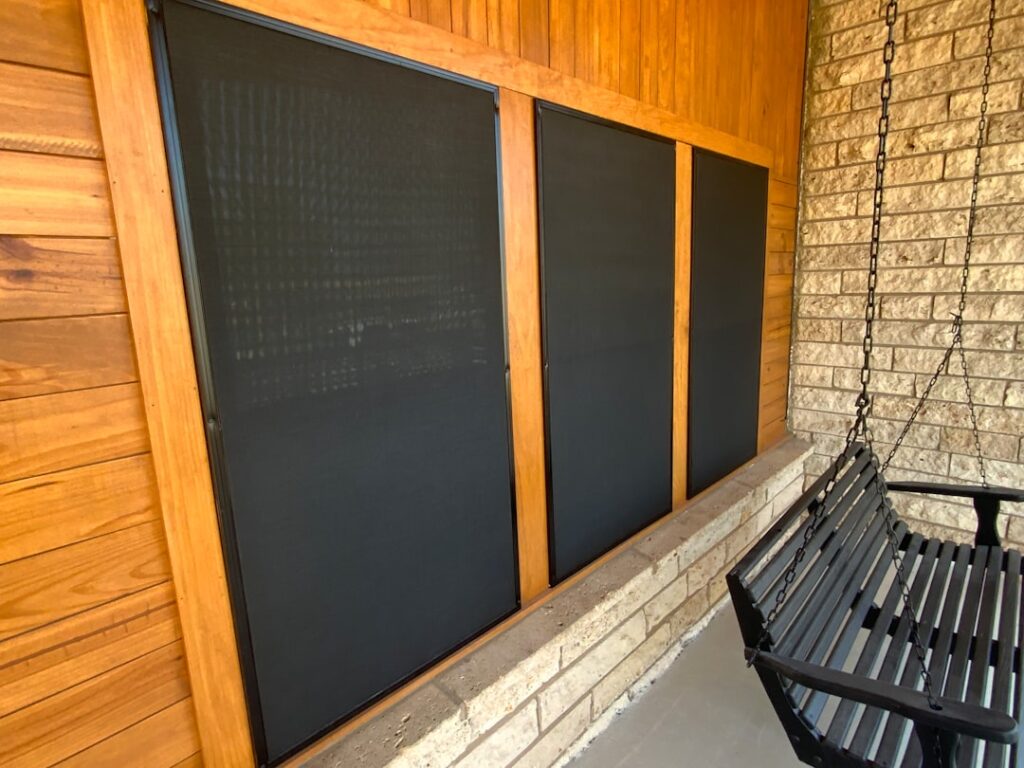
Solar mesh, sometimes called sunscreen fabric, is the workhorse of modern roll-up shades and the type I recommend most often. Made from PVC-coated polyester woven in an open mesh, it blocks UV and heat while preserving airflow and an outward view. The mesh is rated by openness factor, the percentage of open space in the weave.
A 5 percent openness mesh blocks about 95 percent of the sun and gives strong privacy, while a 10 to 14 percent mesh blocks less but keeps a clearer view. For a hot western exposure, go tighter; for a shaded eastern porch where you want the view, go more open. Solar mesh roll-up shades run $60 to $250 depending on size and openness, and they shrug off rain and UV for years.
Vinyl and Clear Roll-Up Shades
Solid vinyl and clear vinyl roll-ups serve a different purpose: full weather protection rather than just sun control. Solid vinyl blocks sun completely and adds privacy, while clear vinyl acts like a temporary storm panel, blocking wind and rain while keeping the view and letting light through. Clear vinyl porch enclosures are popular for extending the season on a screened porch.
Vinyl shades cost $80 to $300 for standard sizes. The tradeoff is airflow: solid vinyl traps heat underneath in summer, so it is better suited to blocking wind and rain in cooler seasons than to cooling a hot patio. Match the material to the job and you will not be disappointed.
Sizing and Mounting Done Right
Measure the opening width and drop height before you shop, and order a shade an inch or two narrower than the opening so it clears the sides as it rolls. For the drop, measure from your intended mounting point down to where you want the shade to end, then add a foot so you are never short.
Mount the headrail into solid framing, not just into soffit or trim. Use lag screws or heavy-duty anchors rated for outdoor use, and hit the header beam or rafters. Add hold-down brackets or side tracks at the bottom in windy locations; without them, a gust turns your shade into a sail and rips it loose. A level headrail matters more than people think, because a crooked mount makes the shade roll unevenly and bind.
Manual vs. Motorized
Most roll-up patio shades are manual, operated by cord or spring, and for a porch or two that is all you need. But if you are shading a wide opening, a hard-to-reach span, or several bays at once, motorized roll-up shades are worth considering. A motorized tubular kit adds $200 to $600 per shade over a manual version, and remote or smart-home control lets you lower everything at the touch of a button.
For homeowners with an outdoor living space they use daily, motorization removes the friction that makes people leave shades up when they should come down. For an occasional-use porch, manual cord operation is perfectly fine and far cheaper.
Cord vs. Spring vs. Crank Operation
The mechanism you choose affects daily convenience more than most buyers expect. Cord-and-cleat operation is the simplest and cheapest: you pull a cord to raise the shade and wrap it around a cleat to hold it at any height. It is reliable and repairable, but the exposed cord can tangle and is a strangulation hazard around young children, so many homeowners now avoid it in family spaces.
Spring-roller operation works like a classic window shade, pulling down and locking, then retracting with a tug. It is clean and cordless but offers less precise height control. Crank or gear-driven roll-ups, common on larger and higher-end shades, use a hand crank that raises and lowers the shade smoothly with no dangling cords. For a wide or heavy shade, a crank is far easier than wrestling a cord, and it holds any position without a cleat. Weigh the convenience against the cost: cord is cheapest, crank is smoothest, and spring sits in between.
Seasonal Care and Storage
Roll-up shades live outdoors and take a beating, so a little seasonal maintenance pays off. Rinse solar mesh and vinyl shades with a hose a few times a season to clear pollen and dust, and spot-clean vinyl with mild soap. Bamboo and reed shades should be kept as dry as possible and rolled up during heavy rain, since repeated soaking is what breaks them down fastest.
In climates with real winters, take down or securely roll and cover shades before the snow flies. Ice and snow load can stretch fabric, and freeze-thaw cycles crack aging vinyl. Store bamboo shades indoors over winter and they will last years longer than ones left hanging in the weather. Before rehanging in spring, check the cords, springs, and mounting brackets for wear and replace anything frayed or corroded. Ten minutes of inspection prevents a shade from failing mid-season, and it keeps the mounting hardware from rusting loose and letting the whole assembly drop. Treated this way, even inexpensive shades deliver several good seasons.
What to Budget
Roll-up patio shades span a wide price range, so match the spend to the job. A single bamboo shade for a modest porch might cost $40. A quality solar mesh shade for a sun-blasted patio runs $100 to $250. A motorized solar shade for a large opening can reach $600 to $1,000 installed. For most porches, a mid-grade solar mesh shade in the $120 to $200 range hits the sweet spot of durability, sun control, and price.
Whatever you choose, do not skimp on the mounting hardware or the fabric grade. The shades that fail early almost always failed at a cheap bracket or a bargain-bin fabric that could not handle the sun it was hired to block. Buy the right type for your exposure, anchor it into solid wood, and a set of roll-up patio shades will keep your outdoor space cool and usable for years.
If you are shading several openings, consider buying all the shades at once in a matching fabric and color so the porch reads as one cohesive design rather than a patchwork. Order a spare or two if the model is prone to discontinuation, since matching a shade years later can be difficult. And measure twice before you order, because outdoor shades are often cut to size and cannot be returned once customized. A little planning at the buying stage saves both money and the frustration of a shade that does not fit or match the ones beside it.


