The first thing showrooms rarely mention is the weight: a true 54-inch concrete top can weigh 250 to 400 pounds, and that single fact should shape every other decision you make. A round concrete dining table earns its popularity honestly — the material is heatproof, scratch-resistant, works indoors or out, and its matte mineral surface flatters everything from farmhouse to modern interiors. But “concrete” on a product page can mean four very different constructions at four very different price points, and the wrong choice ends with a stained top, a cracked edge, or a delivery crew that cannot get the thing through your door.
- Why Round Works for Concrete
- The Four Constructions Sold as "Concrete"
- Weight, Bases, and Your Floor
- Sealing, Stains, and Daily Care
- Outdoor Use: What Actually Survives
- Styling: Chairs, Rooms, and Rugs That Work With Concrete
- Repairs: Chips, Hairlines, and Etch Marks
- What You'll Pay, and Where the Value Is
Why Round Works for Concrete
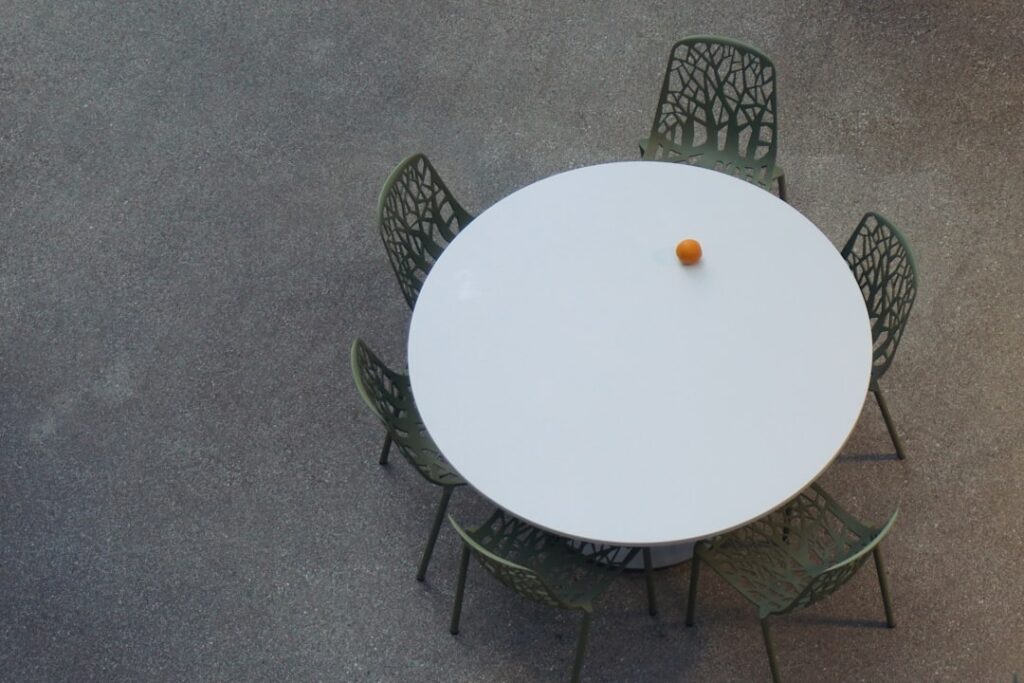
Round tops and concrete are a structurally happy pair. Concrete is strong in compression but weak in tension, and corners are where cast tops chip and crack first — a circle has none. Round tables also solve the social geometry of the material’s visual mass: a heavy rectangular concrete slab can dominate a room, while a round top on a sculptural pedestal reads lighter than its weight. Practically, a 48-inch round seats four with elbow room, a 54 to 60-inch round seats six, and pedestal bases (the near-universal pairing) eliminate leg conflicts so you can squeeze in a seventh chair when family shows up.
- 42 to 45 in.: 2 to 4 people, breakfast nooks
- 48 in.: 4 comfortably
- 54 in.: 5 to 6
- 60 in.: 6 to 8 — confirm your room allows 36 in. of chair clearance all around
The Four Constructions Sold as “Concrete”
Read spec sheets carefully, because the label covers a wide range.
Cast concrete. A full-thickness wet-cast top, usually 1.5 to 2 inches thick. Maximum authenticity, maximum weight — a 60-inch round approaches 400 pounds. Artisan makers and brands like Zachary A. Design’s cast lines live here. Expect $1,500 to $5,000.
GFRC (glass-fiber reinforced concrete). The modern sweet spot: a 3/4 to 1-inch shell of concrete reinforced with alkali-resistant glass fibers, often over a foam or hollow core. It cuts weight by half or more while keeping a genuine concrete surface. Most quality retail “concrete” tables from Crate & Barrel, CB2, and Restoration Hardware are GFRC or a similar composite. Typical range $900 to $3,000.
Concrete-topped composite. A thin real-concrete skin bonded to fiberboard or fiberglass. Lighter and cheaper ($400 to $900) but vulnerable at edges and to moisture intrusion — an indoor-only construction regardless of what the listing implies.
Faux concrete. Resin, MgO board, or painted MDF with a concrete look. $200 to $600. Fine for a rental or a look-first buyer; just do not expect concrete’s heat or scratch behavior.
Weight, Bases, and Your Floor
Before buying, trace the delivery path: doorway widths, stair turns, and whether two or four people can carry the top flat. GFRC 54-inch tops at 120 to 180 pounds are a two-person carry; cast tops need four people or professional white-glove delivery, which is worth every dollar of its typical $150 to $300 fee. Bases must be rated for the top — a proper concrete table ships as an engineered pair with a steel, cast-concrete, or hardwood pedestal designed for the load and bolted or epoxied to the top. Never improvise a base from a standard dining pedestal rated for a 60-pound wood top.
Think about what sits under the table, too. Point loads from a 300-pound table on small metal feet can dent vinyl plank and mark oiled hardwood over time; wide felt or rubber load-spreading pads under each foot solve it. On outdoor decks, confirm joist capacity if the table plus six guests concentrates near a cantilevered edge — a full dinner scene can put 1,500 pounds in a 5-foot circle.
Sealing, Stains, and Daily Care
Concrete is porous, and everything depends on the sealer. Quality makers ship tops sealed with a penetrating densifier plus a food-safe topical sealer or wax; even so, treat the surface like honed marble rather than quartz. Wipe up wine, coffee, citrus, and oil promptly — acidic liquids etch and oils shadow if left overnight. Use trivets for pans over 300°F; the concrete itself shrugs off heat, but topical sealers can scorch or cloud. Daily cleaning is mild dish soap and water; skip vinegar, bleach, and abrasive powders, all of which attack sealer.
Plan on renewing protection periodically: a food-safe wax (butcher-block conditioner or a maker-supplied carnauba blend) every 2 to 3 months for the first year, and a reapplication of topical sealer every 1 to 3 years depending on use. Ask any seller two questions before purchase: what sealer system is on the top, and what is the recommended renewal product. A seller without crisp answers is selling you a stain magnet.
Outdoor Use: What Actually Survives
Cast concrete and GFRC are legitimately outdoor-capable — with caveats. Freeze-thaw climates are the stress test: water absorbed into an under-sealed top expands when frozen and spalls the surface, so northern owners should reseal annually, cover the table or store the top for winter, and never let water pool on it. Sun fades integral pigments slowly; darker charcoal tops show it most, developing a lighter patina over three to five years that some owners like and some do not. Composite and faux tops, whatever the listing says, belong under a roof. One more outdoor note: bird droppings and leaf tannins etch sealers quickly, so a fitted cover ($40 to $90) pays for itself the first season.
Styling: Chairs, Rooms, and Rugs That Work With Concrete
Concrete’s visual weight wants contrast around it. The pairings designers reach for repeatedly: warm wood chairs (walnut or white oak) against a gray top for the organic-modern look, black metal or leather sling chairs for industrial rooms, and upholstered rounded-back chairs to soften the material in a formal dining room. Avoid surrounding a concrete top with more concrete-gray upholstery — the room goes cold fast. Underneath, a rug needs to be genuinely large: a 54-inch round table wants a rug at least 8 feet in diameter or a 9-foot square so chairs stay on it when pulled out, and a flat-weave or low-pile construction survives chair traffic better than plush. Lighting completes it — a single pendant or a small cluster centered 30 to 34 inches above the top emphasizes the round geometry and grazes the surface’s mineral texture, which is half the reason to own the material.
Repairs: Chips, Hairlines, and Etch Marks
Concrete’s other quiet advantage is repairability. Small edge chips fill with a two-part epoxy or a cement-based patch tinted with pigment to match; makers and custom fabricators sell repair kits for $20 to $40, and a patched chip on a honed top becomes nearly invisible after resealing. Hairline crazing — fine surface cracks from curing — is cosmetic, normal in cast pieces, and generally considered part of the material’s character; it needs no action beyond keeping the sealer current so the lines do not absorb stains. Etch marks from lemon juice or wine dull the sealer rather than the concrete; light etching buffs out with the maker’s wax, and deeper etching disappears with a re-application of topical sealer over the affected zone. What cannot be fixed casually is a structural crack through the top, which usually traces to a base failure or a move gone wrong — one more argument for professional delivery and an engineered base.
What You’ll Pay, and Where the Value Is
The market breaks into clear tiers: $300 to $700 for faux and thin-skin composites, $900 to $1,800 for solid retail GFRC (the best value tier for most buyers), $1,800 to $3,500 for premium GFRC and light cast pieces, and $3,000-plus for artisan cast work with custom pigments and diameters. Custom fabricators — most metro areas have a concrete countertop shop that also casts tables — will make a 54-inch round to your pigment and edge profile for $2,000 to $4,000, often matching or beating premium retail while giving you a locally repairable piece. Whatever tier you buy, the checklist is the same: confirm the actual construction, the actual weight, the base engineering, and the sealer system. Get those four answers in writing, and a round concrete table becomes the sort of purchase that outlives the chairs around it.