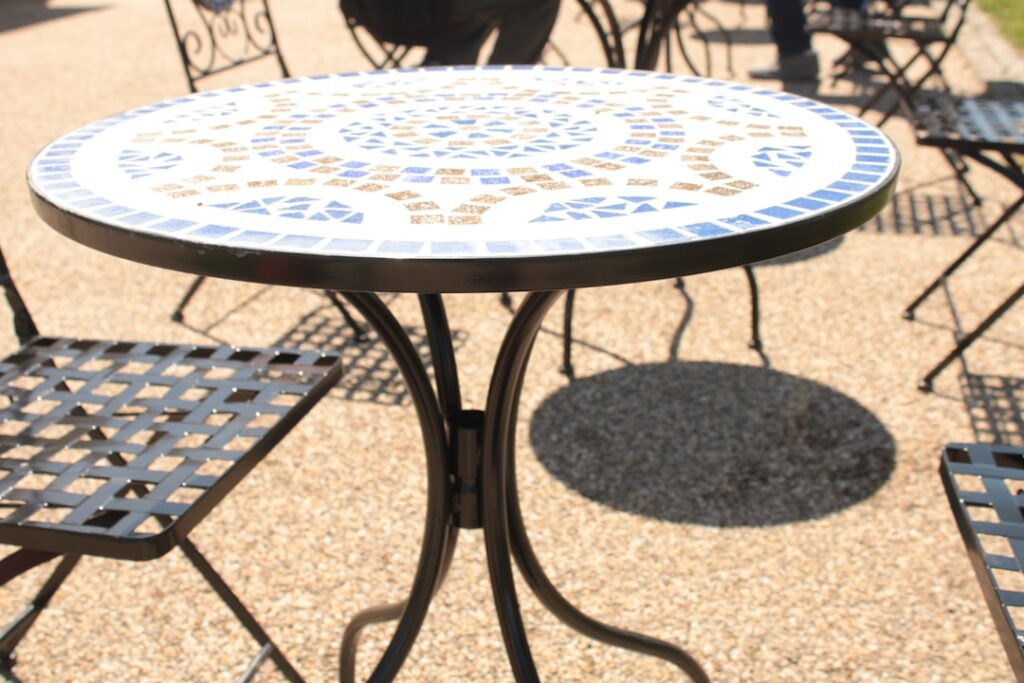
Round tables settle a very old outdoor-dinner problem: nobody sits at the corner, everybody sees everybody, and conversation does not split into two ends. A round patio table also fits small spaces better than its footprint suggests, because a circle tucks into a 10 x 10 patio without the corner collisions a rectangle creates. The whole buying decision comes down to three numbers — diameter, clearance, and umbrella-hole size — and getting each right is simple once you know the chart.
Part of our Decks & Outdoor guide — explore the full guide →
Diameter-to-Seating Chart
Each diner needs roughly 24 inches of table-edge arc to eat without elbow warfare, which converts diameter to headcount cleanly:
- 28–32 inches: bistro territory — 2 people, coffee and croissants, tiny balconies
- 36–42 inches: 3–4 people comfortably; the classic small-patio dining size
- 48 inches: 4 comfortably, 5 in a pinch — the most-sold round dining diameter
- 54 inches: 5–6 people; the family sweet spot
- 60 inches: 6 comfortably, 8 snugly — the entertainer’s size
- 72 inches: 8–10 people; needs a genuinely large patio and long reach to the center
Two honest caveats. Chair arms eat capacity — six armless bistro chairs fit a 54-inch top, but six deep armchairs may not. And beyond 60 inches, the center of a round table drifts out of everyone’s reach, which is exactly why large rounds historically got lazy Susans; a 16-to-20-inch turntable turns a 60-inch table from awkward to brilliant for about $40.
The Clearance Math Everyone Skips
A table that fits the patio is not the same as a table you can dine at. Add 24 inches around the tabletop for seated chairs, and 36 to 42 inches where people must walk behind seated diners. Practical translation: a 48-inch round table wants a clear circle of at least 9 feet — so a 10 x 10 patio handles it with room to serve, while a 60-inch table really wants 11 to 12 feet of clear space. Round geometry is forgiving here, since there are no corners to squeeze past, which is why a 48-inch round often fits where a 36 x 60 rectangle will not. Chalk the actual circle on the slab before you order; thirty seconds with a string and a stick prevents the single most common patio furniture regret.
Umbrella Holes and Bases: The Standards
Most round dining tables 42 inches and up ship with a center umbrella hole, typically 1.75 to 2 inches in diameter with a threaded plastic cap for umbrella-free days. The system has three parts, and mismatches are the top complaint. First, pole diameter: standard market umbrellas run 1.25 to 1.5 inch poles, which pass through the standard hole fine — but check both specs before buying. Second, umbrella size: match the canopy to the table by extending 2 feet past the edge on all sides, so a 48-inch table takes a 9-foot umbrella and a 60-inch table wants 10 to 11 feet. Third — and most safety-critical — the base: an umbrella through a table still needs a weighted base under it, 30 to 50 pounds for a 9-foot umbrella since the table steadies the pole, versus 75-plus freestanding. Skip the base and the first real gust turns the umbrella into a lever and the tabletop into the fulcrum; glass tops have exploded this way. No hole in the table you love? Cantilever umbrellas solve it from the side for $200–$600.
Materials for Round Tops
Round tables come in every outdoor material, but a few behave distinctively at this shape. Cast aluminum is the round-table king — ornate pedestal bases, rustproof, 25–50 pounds so it moves for cleaning; expect $300–$900 for a 48-inch set-quality table. Steel with a tempered-glass top is the budget standard at $120–$300, with the known risk that neglected glass tops shatter in hail or umbrella-lever incidents; if you buy glass, buy tempered and use the umbrella base religiously. Teak and eucalyptus bring warmth at $400–$1,500-plus, weathering to silver-gray unless oiled annually. HDPE poly lumber (Polywood and similar) is the zero-maintenance heavyweight — literally, at 60–100 pounds — from $500. Stone, tile, and concrete-top rounds are gorgeous and effectively permanent installations; put them where they will live forever. Pedestal or four-leg matters too: a center pedestal frees knee room around the full circle, but on windy sites a four-leg base resists tipping better, especially under an umbrella.
Round vs. Other Shapes: When the Circle Wins
Rounds win for conversation, tight square patios, households of four to six, and anywhere traffic flows around the table, since curved edges shed foot traffic without bruised hips. They lose to rectangles for parties of eight-plus, long narrow decks, and buffet-style serving where straight edges hold dishes better. If your patio hosts both weeknight dinners for four and occasional crowds, consider a 48-to-54-inch round plus a folding table in the garage for overflow, rather than living every day around a 72-inch circle you fill twice a year. For a deeper comparison of shapes, bases, and top materials across the whole category, see our guides to the outdoor patio table and the patio dining table — this article stays on the circle.
Height Variants: Dining, Counter, and Bar
Rounds come in three heights, and mixing them up ruins the ergonomics. Standard dining height is 28–30 inches with 17-to-19-inch chair seats. Counter height (34–36 inches) pairs with 24-to-26-inch stools and sightlines over deck railings — the reason it dominates elevated decks. Bar height (40–42 inches) suits standing parties and 28-to-30-inch stools. The 2-foot-canopy umbrella rule and the seating chart above apply at every height, but note that counter- and bar-height rounds rarely exceed 48 inches in diameter, since reach across a tall table gets awkward fast.
Chairs, Spacing, and the Full Dining Set
Tables get the attention, but chairs determine whether the diameter chart holds in practice. Standard dining chairs run 22 to 26 inches wide including arms; multiply by your headcount and compare against the table’s circumference (diameter times 3.14) minus a few inches per gap, and you will know instantly whether “seats six” is honest for the chairs you own. Swivel rockers and deep club-style dining chairs need 4 to 6 extra inches each and push a 54-inch table down to four seats. Buying a boxed set sidesteps the math — manufacturers pair counts correctly — but replacing chairs later is where people go wrong, so keep seat height in the 17-to-19-inch band for a 29-inch table and test that arms slide under the apron. One underrated feature to hunt for: stackable or foldable spare chairs in the same finish, which let a 48-inch table flex from four everyday seats to six party seats without storing two more full-time armchairs on the patio.
Care by Material
Round tops weather exactly like their material, with one shape-specific note: center umbrella holes funnel water and grime to the middle, so keep the cap in when the umbrella is out. Cast aluminum needs only soap-and-water washes and a coat of automotive wax each spring to keep the powder coat bright. Tempered glass wants non-abrasive cleaner and — critically — removal or secure covering in hail-prone regions. Teak can be left to silver naturally or oiled each spring to hold the honey tone; either is correct, but pick one, because reversing gray teak means sanding. HDPE poly needs nothing beyond a wash. For all of them, a vented, properly sized round table cover ($30–$80) through winter beats dragging the table inside, and vented matters — sealed covers trap condensation and mildew the frame they were bought to protect.
Bottom Line
Buy a round patio table by the numbers: 24 inches of edge per diner, 24-plus inches of clearance around the top, an umbrella 2 feet wider than the table on each side, and a weighted base under the pole no matter what. A 48-inch cast aluminum round with a 9-foot umbrella is the configuration that fits the most American patios and lives the longest — and if your gatherings run bigger, a 60-inch top with a lazy Susan beats a 72-inch stretch every time.