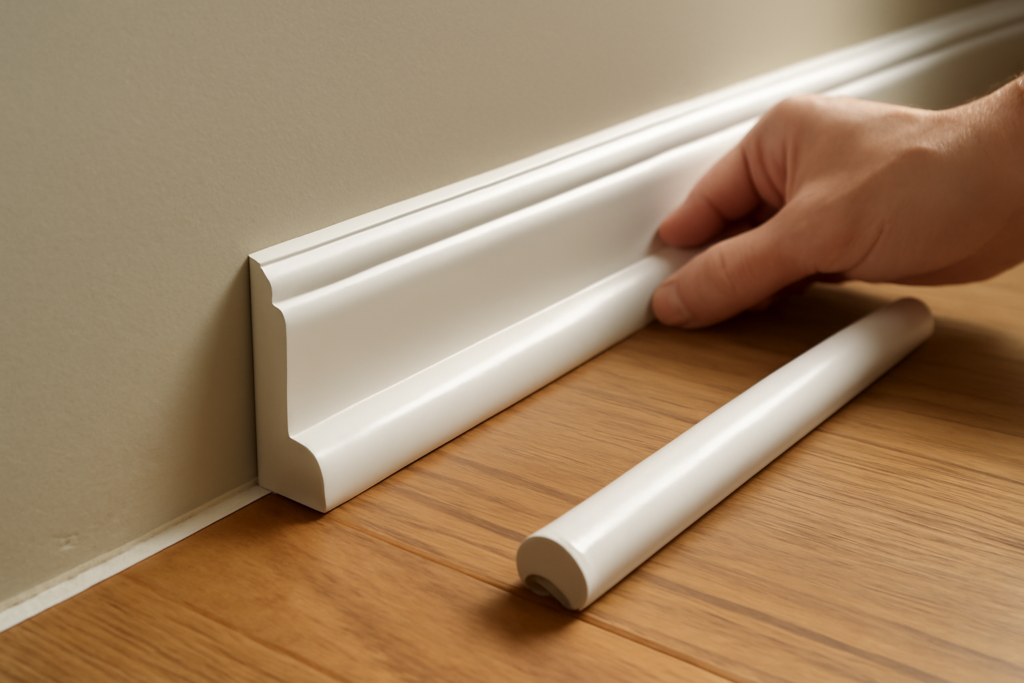
That small strip of trim tucked where your baseboard meets the floor does more work than it gets credit for, hiding gaps, protecting the wall from mops and shoes, and giving a room a finished look. Royal quarter round molding is a popular cellular PVC option in that category, prized because it will not rot, warp, or absorb water the way wood can. This guide explains what makes Royal Building Products’ quarter round different, the sizes available, how to install and cut it, painting and finishing, costs, and where this waterproof trim earns its place over traditional wood.
- What Quarter Round Molding Does
- Why Choose Royal PVC Over Wood
- Common Sizes and Profiles
- Tools and Materials You Will Need
- How to Install Royal Quarter Round: Step by Step
- Cutting PVC Cleanly
- Painting and Finishing
- Where This Trim Works Best
- What It Costs
- Common Mistakes to Avoid
- A Durable Finishing Touch
- Working With PVC's Expansion and Contraction
- Cleaning and Long-Term Care
What Quarter Round Molding Does
Quarter round is exactly what its name says: a molding whose profile is a quarter of a circle, with two flat sides that meet at a 90-degree angle and a curved face. It is installed along the bottom edge of a baseboard to cover the seam and any gap between the baseboard and the floor. That gap exists on purpose so flooring can expand and contract, and quarter round hides it while still allowing movement. It also protects the base of the wall from impact and makes the transition between wall and floor look intentional and clean.
Why Choose Royal PVC Over Wood
Royal Building Products makes its quarter round from cellular PVC, a dense foamed plastic that looks and cuts much like wood but with critical advantages:
- Waterproof: It will not rot, swell, or degrade when exposed to moisture, making it ideal for bathrooms, kitchens, laundry rooms, and basements.
- Insect and mold resistant: PVC offers no food for termites and does not support mold growth.
- No knots or grain defects: The material is uniform, so there are no knots to bleed through paint or weak spots to split.
- Pre-primed and paintable: It comes ready to paint and holds paint well without the priming steps raw wood needs.
- Dimensionally stable: It resists the seasonal movement that opens gaps in wood trim.
The trade-off is that PVC can expand and contract with large temperature swings and is slightly more flexible than wood, so fastening and adhesive matter.
Common Sizes and Profiles
Quarter round comes in standard cross-sections, and Royal’s line follows familiar dimensions. Typical sizes run from about 1/2 inch by 1/2 inch up to 3/4 inch by 3/4 inch, with lengths commonly sold in 8-foot, 12-foot, and sometimes longer sticks. The larger the profile, the bigger the gap it can cover, so choose based on how much space sits under your baseboard. There is also a related profile called base shoe, which is taller and thinner than quarter round; both do a similar job, and the choice is largely aesthetic. Measure your gap before buying so the molding fully covers it.
Tools and Materials You Will Need
- Miter saw or miter box with a fine-tooth blade
- Tape measure and pencil
- Finish nailer (brad nailer) with 1-1/4 to 1-1/2 inch brads, or hammer and finish nails
- Construction adhesive or PVC-compatible adhesive for extra hold
- Coping saw for inside corners (optional but cleaner)
- Paintable caulk and painter’s caulk gun
- Spackle or PVC filler for nail holes
How to Install Royal Quarter Round: Step by Step
- Acclimate and measure. Let the PVC sit in the room a day so it adjusts to temperature. Measure each wall run.
- Cut outside corners at 45 degrees. Where two walls meet at an external corner, miter both pieces at 45 degrees so they form a clean 90.
- Cope inside corners. For inside corners, the professional method is to cut the first piece square into the corner, then cope the second piece to match the profile of the first, which hides gaps better than mitering as walls are rarely perfectly square.
- Nail into the baseboard, not the floor. Drive brads at a slight downward angle into the baseboard, spaced every 12 to 16 inches. Fastening to the baseboard rather than the floor lets the flooring move freely underneath.
- Add adhesive for security. A thin bead of construction adhesive on the back helps PVC stay put and reduces gapping from thermal movement.
- Fill and caulk. Fill nail holes with PVC-compatible filler and run a thin bead of paintable caulk along the top edge where it meets the baseboard.
Cutting PVC Cleanly
Cellular PVC cuts beautifully with standard woodworking tools, which is part of its appeal. Use a sharp fine-tooth blade on a miter saw for clean, chip-free cuts. Because PVC is softer than hardwood, feed the saw smoothly to avoid melting or gumming the edge. A coping saw handles the profile cuts for inside corners. Wear eye protection, and note that PVC produces fine dust and, if a blade overheats, can smell of melting plastic, so keep your cuts steady and your blade sharp.
Painting and Finishing
Royal quarter round comes pre-primed, so it is ready for a topcoat with minimal prep. Lightly scuff the surface, wipe it clean, and apply a quality acrylic latex trim paint. Two thin coats give the best finish. Because PVC is nonporous, use paints formulated to adhere to it (most modern acrylic trim and enamel paints work well). Avoid dark colors in areas with strong direct sun on the trim, since dark PVC can absorb heat and expand more. After caulking the top seam, a final paint pass blends the molding seamlessly into the baseboard.
Where This Trim Works Best
The waterproof nature of PVC quarter round makes it the smart choice in any moisture-prone space:
- Bathrooms around tubs, showers, and vanities
- Kitchens near sinks and dishwashers
- Laundry rooms and mudrooms
- Basements, especially below grade where humidity is high
- Anywhere a mop or standing water might reach the baseboard
In bone-dry living rooms and bedrooms, wood quarter round works fine too, but there is no penalty to using PVC everywhere for consistency and durability.
What It Costs
PVC quarter round runs roughly $0.80 to $2.50 per linear foot depending on size and retailer, generally a bit more than basic wood or MDF quarter round but comparable to primed hardwood. For an average room with 40 to 60 linear feet of perimeter, expect $40 to $150 in material. It is an inexpensive finishing touch, and doing it yourself over an afternoon saves the labor a carpenter would charge.
Common Mistakes to Avoid
- Nailing into the floor, which locks the flooring and can cause buckling.
- Mitering inside corners on out-of-square walls instead of coping them.
- Skipping adhesive on PVC and letting thermal movement open gaps.
- Using a dull blade that melts the cut edge.
- Forgetting to caulk the top seam, leaving a visible line after painting.
- Choosing a profile too small to cover the actual floor gap.
A Durable Finishing Touch
Working With PVC’s Expansion and Contraction
Cellular PVC’s one quirk is that it moves more than wood with temperature changes, expanding in heat and contracting in cold. In an interior room with stable temperatures this is barely noticeable, but it explains a few installation habits worth following. Acclimate the trim in the room before cutting so it is at its installed temperature. Fasten it securely with brads and back it with a bead of construction adhesive so movement cannot open gaps at the joints. Avoid installing PVC trim in direct, intense sunlight or against a heat source without accounting for movement, and steer clear of very dark paint colors on PVC in sunny spots, since dark surfaces absorb heat and expand more. Handle these small points and the trim stays tight and gap-free through the seasons.
Cleaning and Long-Term Care
One of the joys of PVC quarter round is how little it asks of you once installed. Because it is waterproof and nonporous, it wipes clean with a damp cloth and mild cleaner, and it never needs the periodic resealing or worry about water damage that wood trim demands in a bathroom or kitchen. If the painted finish scuffs over the years, a light sanding and a fresh coat restore it easily. Unlike wood, it will not rot at the base where mopping water collects, and it will not host mold in a humid basement. That combination of easy cleaning and immunity to moisture is exactly why PVC trim has become a go-to for the wettest rooms in the house.
Royal quarter round molding is one of those small upgrades that quietly improves both the look and longevity of a room. Because it shrugs off water, resists rot and insects, and cuts and paints like wood, it delivers a crisp, permanent transition between floor and wall without the maintenance worries of natural lumber. Install it into the baseboard rather than the floor, cope your inside corners, add a bead of adhesive, and finish with caulk and paint, and you will have trim that stays tight and clean for the life of the room.