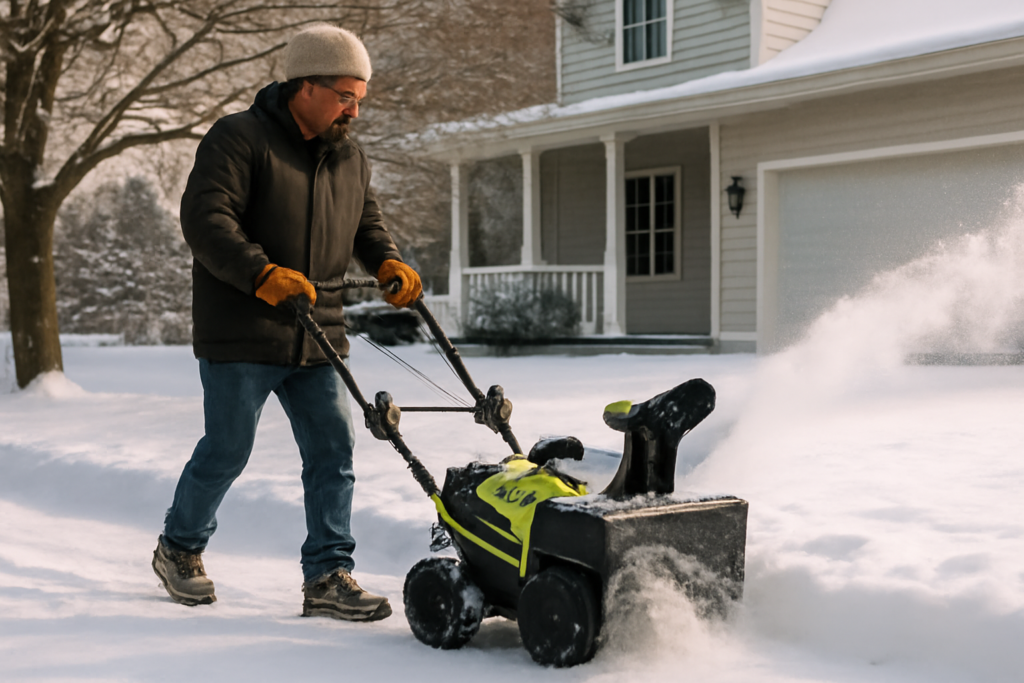
The Ryobi 40V snow blower has become a popular way to skip the pull cord, the gas cans, and the winter engine hassles that come with a traditional two-stage machine. For a lot of homeowners with a short-to-medium driveway and light-to-moderate snowfall, a battery single-stage blower is genuinely all you need. The question is whether your situation fits that profile — so let’s walk through the specs, the run time, and where the limits are.
The Main Models: RY40806 and RY40850
Ryobi’s 40V single-stage lineup centers on two workhorse models. Both run on the same 40V battery platform that powers Ryobi mowers, trimmers, and blowers, so the packs cross over.
- RY40806 — 18-inch clearing width, 8-inch intake height, dual 40V batteries, throws snow up to about 20 feet. Typically $350 to $450 as a kit.
- RY40850 — 21-inch clearing width, 12-inch intake height, dual 40V batteries, throws up to roughly 35 feet with a brushless motor. Usually $450 to $600 as a kit.
The wider RY40850 is the one to buy if you get regular accumulation, since the taller intake handles deeper snow and the extra three inches of width shaves passes off every clearing. Both use two batteries at once for the voltage they need, which is worth remembering when you budget for spares.
Clearing Width and Depth: Sizing to Your Driveway
Clearing width tells you how wide a path the auger cuts, and intake height tells you how deep a snowfall you can take in one pass. An 18-inch machine clears a single-car driveway in a reasonable number of passes; a 21-inch model noticeably speeds up a two-car width. Neither is designed for the packed, waist-high drifts a two-stage gas machine eats through.
The realistic depth limit is where battery single-stage blowers separate from gas. Up to about 8 inches of fresh, fluffy snow, the Ryobi units power through cleanly. Past that, or in wet, heavy snow, you’ll take shallower bites and go slower. For 4 to 6-inch typical snowfalls, they’re excellent. For a foot of dense lake-effect snow, you’ll be working hard.
A useful trick for deep snow is to clear in stages. Rather than plunging the auger into a 14-inch drift, take the top half in one pass and the bottom half on the return trip. This keeps the motor from stalling and preserves battery, since a bogged auger draws a huge current spike. The same logic applies to the end-of-driveway berm the plow leaves behind — that packed, icy ridge is the hardest snow a single-stage machine faces, and slicing it in thin bites beats forcing the whole wall at once.
Run Time: How Long the Batteries Last
Run time is the number everyone worries about, and it depends heavily on snow conditions. On dry, light snow you can expect roughly 30 to 40 minutes of clearing from a fresh pair of high-capacity batteries. In wet, heavy snow that draws more current, that can drop closer to 20 minutes. The included batteries are usually 4.0Ah or 6.0Ah packs.
For most driveways that’s enough for a single clearing session. If you have a longer driveway or want to clear a neighbor’s walk too, buy a second set of batteries and rotate. A pro tip: keep the spare pair indoors at room temperature, because lithium batteries lose noticeable capacity in the cold, and swap to warm ones when the first set fades.
There’s also a timing strategy that stretches every charge. Snow is far easier to move before it packs down or partially melts and refreezes, so clearing during or right after a storm rather than waiting hours later means the auger throws light powder and sips battery. Two shorter clearings during a big snowfall often use less total run time than one grinding session through settled, dense accumulation. If your batteries are also powering a mower and trimmer the rest of the year, remember that using them hard in freezing cold ages them faster, which is another reason to keep a dedicated warm set for snow duty.
What It’s Best For
Set expectations correctly and the Ryobi shines. This is the right tool if you match most of these conditions:
- A driveway up to about two cars wide and moderate length
- Typical snowfalls in the 2 to 8-inch range
- You value push-button starting and zero fuel maintenance
- You already own Ryobi 40V batteries from other tools
- Storage space is tight — these are lighter and more compact than gas two-stage units
It’s the wrong tool for long gravel driveways, deep drifts over a foot, or regions that routinely get heavy wet snow. A single-stage blower also isn’t ideal on gravel, since the rubber-tipped auger contacts the ground and can pick up stones.
Chute Control, Auger, and Build Details
Single-stage blowers like the Ryobi use a rubber-tipped auger that both scoops and throws the snow in one motion, and the rubber paddles contact the ground to scrape pavement nearly clean. That’s why they work so well on flat concrete and asphalt but shouldn’t be run on gravel — the auger will fling stones. Over several seasons those rubber paddles wear down and eventually need replacement, a $30 to $50 part that’s easy to swap yourself.
The discharge chute directs where snow lands, and the RY40850 lets you adjust both direction and pitch so you can throw snow away from cleared areas and off to the side. On a windy day, being able to rotate the chute to keep snow out of your face is a genuine quality-of-life feature. Both models fold or break down reasonably for storage, and an LED headlight on the higher trims helps for early-morning or after-dark clearing before work.
Cold-Weather Battery Care
Lithium batteries are the weak point of any cordless snow tool, and cold makes it worse. Below freezing, a pack can lose 20 to 30 percent of its usable capacity, and very cold cells may refuse to deliver full current until they warm up. The fix is simple: store your batteries indoors at room temperature and only install them when you’re ready to clear.
Bring a second warm pair outside in a coat pocket and swap when the first set fades. Never charge a battery that’s still ice-cold — let it warm to room temperature first, since charging cold lithium cells damages them. Follow that routine and you’ll get consistent run time all winter instead of watching the machine bog down halfway up the driveway.
Battery Blower vs Gas: The Honest Comparison
Here’s how a battery single-stage stacks up against a comparable gas machine. The Ryobi wins on convenience and loses on brute endurance.
- Starting: instant push-button vs pull cord or electric start on gas — a clear win for battery on a cold morning.
- Maintenance: none for battery vs oil changes, fuel stabilizer, and spark plugs for gas.
- Run time: limited by battery capacity vs run-all-day on gas with a full tank.
- Noise: much quieter, no ear protection needed, vs loud two-stroke or four-stroke engines.
- Power ceiling: gas two-stage machines clear deeper, heavier, wider — battery single-stage can’t match that.
For light-to-moderate snow duty, the trade lands squarely in the battery column for most homeowners. You give up top-end capacity you’ll rarely use in exchange for reliability every single storm.
Is the Ryobi 40V Snow Blower Worth It?
If your winters bring manageable snowfalls and your driveway is a normal residential size, a Ryobi 40V snow blower is an easy recommendation. The RY40850 at roughly $500 hits the sweet spot with its 21-inch clearing width and 12-inch intake height, and it pairs naturally with an existing Ryobi 40V tool collection you already own. Buy a spare battery set, store the packs warm, and clear the driveway before the snow packs down. Do that and you’ll wonder why you ever wrestled with a gas engine at 6 a.m. Just be honest about your snow load before you buy — the machine is superb within its intended limits and genuinely frustrating outside them, so size it to your typical storm rather than the worst one you can imagine.