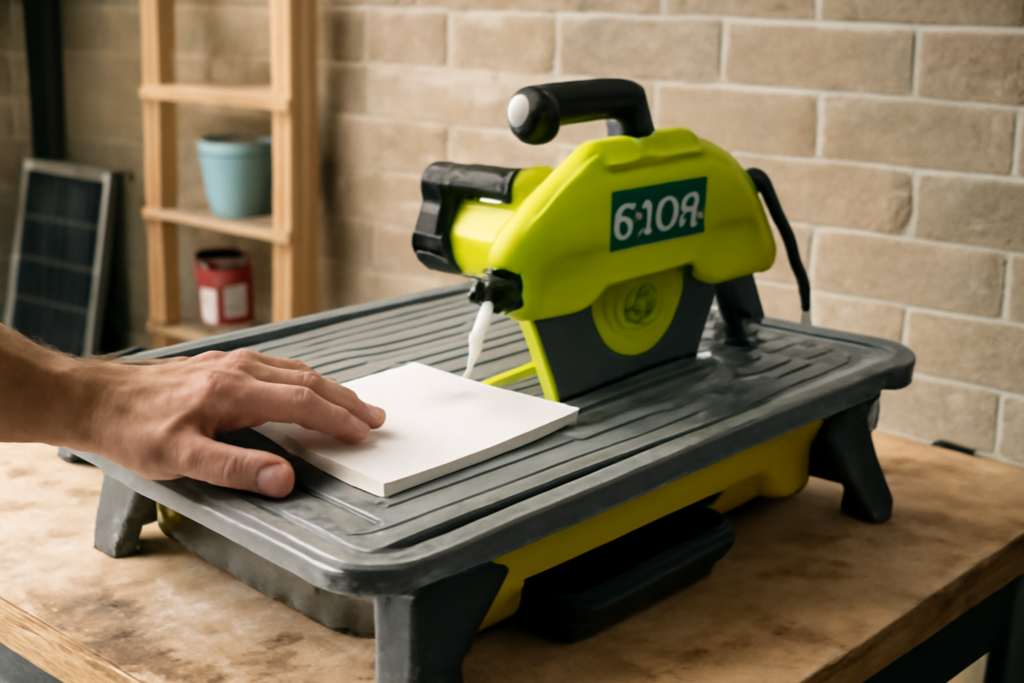
The Ryobi wet tile saw has become one of the most popular tabletop saws for homeowners tackling their first tile project, and for good reason. It sits at a price point that undercuts most contractor saws while still cutting ceramic and porcelain cleanly enough for a bathroom or backsplash. This honest review covers the current models, real specs, water management, and exactly who should buy one and who should look elsewhere.
The Models in the Lineup
Ryobi keeps its tile-saw range simple, which makes the buying decision easy.
WS722 7-Inch Corded Tabletop
The WS722 is the workhorse. It is a 7″ tabletop saw that plugs into a standard outlet and typically sells for about $120 to $150, which is roughly half what comparable name-brand tabletop saws cost. It ships with a 7″ diamond blade, an adjustable rip fence, and a miter guide for angle cuts. For most DIY floors and walls, this is the model people mean when they say “Ryobi tile saw.”
Cordless ONE+ Tile Saw
Ryobi also offers a cordless tile saw on the 18V ONE+ battery platform. It trades some cutting power and runtime for portability, and it makes sense if you already own ONE+ batteries and want to make cuts where an outlet is inconvenient, like an outdoor patio or a job with no nearby power. It is a niche pick compared to the corded WS722.
Key Specifications
- Blade: 7″ diamond blade with a 5/8″ arbor (standard, so replacement blades are easy to find)
- Motor: corded WS722 runs on a roughly 4 to 5 amp induction-style motor spinning near 3,600 RPM
- Rip capacity: around 12 inches, enough to cut a 12×12 tile corner to corner
- Diagonal cut: approximately 8 to 9 inches on the diagonal
- Bevel: table tilts for 22.5 and 45-degree bevel cuts
- Water system: integrated reservoir with a splash guard and a small recirculating supply to the blade
The cut capacity is the number that matters most. Twelve inches of rip handles the vast majority of residential tile. If you plan to cut 24-inch porcelain planks in a single pass, this saw will require you to flip and align the tile, which introduces a chance of a mismatched edge.
Cut Quality and Performance
Within its lane, the WS722 cuts well. On standard ceramic and moderate porcelain it produces clean, straight cuts with minimal chipping, provided you feed the tile slowly and let the blade do the work. The included blade is adequate for ceramic, but the single best upgrade you can make is swapping in a quality continuous-rim porcelain blade in the $30 to $45 range. That one change transforms edge quality on dense porcelain more than any adjustment to the saw itself.
Where the saw shows its price is on very hard, thick porcelain and natural stone. The modest motor can bog if you push, and long rip cuts in dense material go slowly. Patience solves most of it, but a pro cutting stone all day would want a heavier saw with a plunge head and a sliding table.
Water Management
The onboard reservoir keeps the blade wet, which cools the diamond bond and cuts silica dust dramatically compared with dry cutting. The splash guard contains most of the spray, though like every tabletop wet saw, it will throw a fine mist, so set it up in a garage, on a patio, or somewhere you do not mind a little overspray. Keep the water topped off and reasonably clean; a reservoir clogged with slurry starves the blade and leaves a rougher edge. Dumping and refilling the tray partway through a big job keeps cuts crisp.
Setup and First Cuts
Getting good results starts before you touch a tile. Set the saw on a flat, stable surface at a comfortable working height, level it so the water tray drains and fills evenly, and fill the reservoir until the pump or wick reaches the blade. Confirm the blade is mounted with its rotation arrow matching the saw and that the arbor nut is snug. Square the rip fence to the blade with a small framing square; the plastic fence can drift out of true, and a fence that is even a degree off will show up as a tapered cut across a wide tile.
Make a test cut on a scrap piece first. You want to see a smooth kerf with fine spray, not a dry, smoking edge, which means your water is not reaching the blade. Feed the tile at a steady, unhurried pace and let the diamond rim clear the material rather than forcing it. On your first real project, mark cut lines with a pencil or a fine marker and cut just to the waste side of the line so you can sneak up on a perfect fit.
Maintenance and Longevity
A wet tile saw lives a hard life in slurry and grit, so a little upkeep goes a long way. After each session, dump the water tray, rinse the slurry out of the pan and off the blade, and wipe the table dry so mineral deposits do not build up. Check the blade periodically for glazing; if cuts slow down, dress the rim by cutting through a dressing stone or a cinder block to re-expose the diamonds. Keep the pump or water channel clear of debris so the blade stays cooled and lubricated.
Stored clean and dry, a Ryobi tabletop saw holds up for years of occasional use. Because parts like the blade and water pump are standard and inexpensive, keeping one running is cheap compared with buying a premium saw, which is a big part of why these units stay in service through project after project.
Pros and Cons
What It Does Well
- Excellent value at roughly $120 to $150, often half the price of competing tabletop saws
- Standard 5/8″ arbor means cheap, widely available replacement blades
- Light and portable enough to carry to a job and store on a shelf
- Clean cuts on ceramic and standard porcelain with a decent blade
- Bevel and miter capability that beginners can actually use
Where It Falls Short
- Modest motor bogs in thick, dense porcelain and stone if you rush
- Roughly 12-inch rip limits single-pass cuts on large-format tile
- The included blade is basic; budget for an upgrade
- Plastic table and fence lack the rigidity of a contractor saw for perfectly repeatable cuts
- Water tray needs frequent attention on bigger jobs
Who Should Buy It
This saw is built for the homeowner and occasional DIYer. If you are tiling a bathroom floor, a shower surround, a kitchen backsplash, or a small entry, the WS722 has all the capacity and cut quality you need at a price that is easy to justify for a one-time or once-in-a-while project. Renting a saw for two or three weekends often costs nearly as much as simply buying this one, and you keep it for the next project.
It is not the right tool for a full-time tile setter or anyone cutting large-format porcelain planks, thick pavers, or stone day in and day out. Those users should step up to a larger saw with a sliding table, a more powerful motor, and greater rip capacity. But that is a professional’s problem, not a homeowner’s.
Tips to Get the Most From It
- Upgrade to a continuous-rim porcelain blade before your first real cut
- Keep the reservoir full and change the water when it turns to slurry
- Feed slowly, and ease off for the last inch to prevent exit chipping
- Check that the fence is square to the blade before every session
- Set it up outdoors or in a garage and expect a light mist of overspray
The Bottom Line
Judged honestly against its price and intended user, the Ryobi wet tile saw is a genuinely good buy. It will not out-cut a $600 contractor rig, and it does not pretend to. What it delivers is clean, accurate cuts on ceramic and standard porcelain for around $120 to $150, with a standard blade arbor and enough capacity for nearly every home tiling project. Add a better blade, manage the water, and take your time, and this little saw will carry you through a bathroom, a backsplash, and the next few projects after that.
Prefer to explore on your own?
See how new flooring looks in your actual room in seconds — free, no signup.
Try the free Floor Studio →