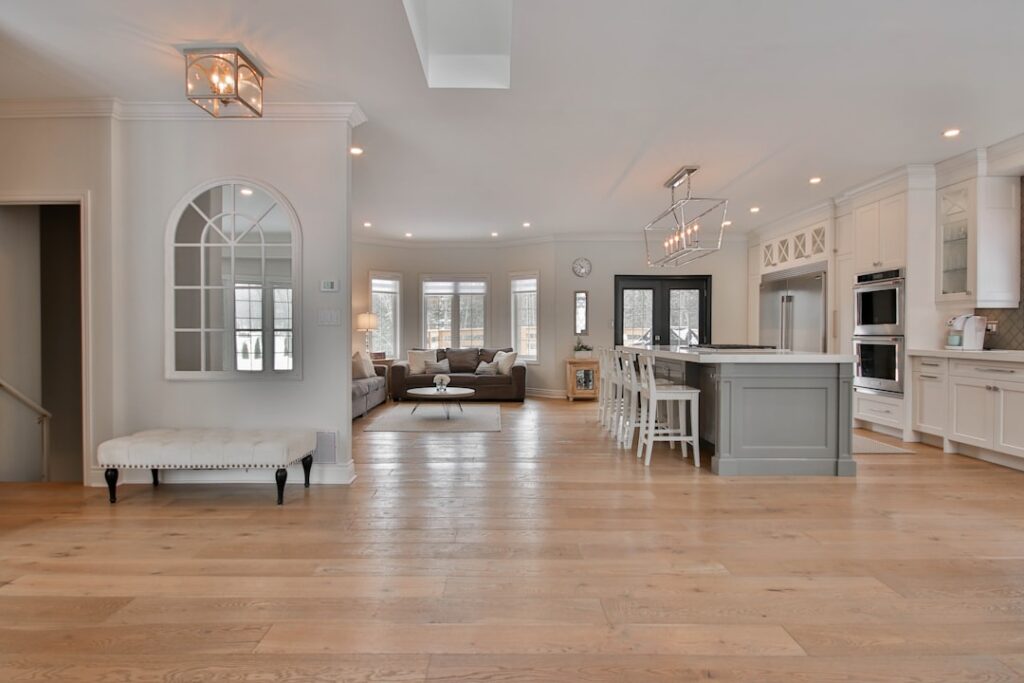
Satin finish hardwood flooring has quietly become the default choice for new floors, and for good reason. It sits at a low-to-medium sheen — roughly 25 to 35 gloss units on the standard 60-degree gloss meter — which means it reflects enough light to look warm and finished without turning your floor into a mirror that broadcasts every footprint, scratch, and dust bunny. If you want a floor that looks great on day one and still looks great after the dog, the kids, and three winters, satin is where I point most clients.
Understanding sheen is the key to picking a finish you will not regret. Let me walk through what satin actually is, how it compares to the alternatives, and how to keep it looking sharp.
What Sheen Actually Measures
Sheen is the amount of light a finish reflects, measured in gloss units. Manufacturers test at a fixed angle and report a number, and those numbers cluster into named categories. From flattest to shiniest:
- Matte: roughly 5 to 15 gloss units — almost no shine, very natural
- Satin: roughly 25 to 35 gloss units — soft, low-medium sheen
- Semi-gloss: roughly 45 to 55 gloss units — noticeably reflective
- High-gloss: 70+ gloss units — wet, mirror-like shine
The exact cutoffs vary slightly by brand, but satin universally means that comfortable middle zone. It is glossy enough to look intentional and rich, flat enough to stay forgiving.
Why Satin Hides Wear So Well
A shiny surface reflects light in a uniform sheet, so any interruption — a hairline scratch, a smudge, a film of dust — breaks that reflection and jumps out at you. Semi-gloss and high-gloss floors are beautiful for about an hour after cleaning, then every particle of dust becomes visible. Satin scatters light more diffusely because its surface is microscopically less smooth, and that scattering hides small imperfections. A pet claw mark that would glare on a semi-gloss floor practically disappears on satin.
This is exactly why satin is the most popular sheen sold today. It photographs well, it lives well, and it forgives the reality of a floor that people actually walk on. In a busy kitchen or an entry hall, the practical difference between satin and semi-gloss is enormous.
Satin vs. Matte vs. Semi-Gloss
Matte finishes take the hide-everything logic further and are having a real moment in modern and Scandinavian design. The trade-off: some matte finishes can look slightly flat or chalky under certain light, and a few older matte formulas showed traffic patterns as they burnished. Satin gives you most of matte’s forgiveness while keeping a bit of life and depth in the wood grain.
Semi-gloss still has its place. Formal traditional homes, historic restorations, and rooms where you want the wood to gleam can carry it beautifully. But you accept higher maintenance — you will dust and damp-mop more often to keep it looking clean. High-gloss is rare in residential settings now outside of pianos-and-parquet formal spaces, because the upkeep is relentless.
My general advice: if you cannot decide, choose satin. It is the safe, flattering, resale-friendly middle.
Caring for a Satin Floor
Satin is easy, but wood is still wood. A simple routine keeps it looking new for years:
- Dust or dry-mop every few days with a microfiber pad to lift grit before it scratches the finish.
- Damp-mop weekly with a pH-neutral hardwood cleaner. Never use vinegar, ammonia, steam mops, or oil soaps — they dull or streak the finish.
- Wring the mop nearly dry. Standing water is the enemy of any wood floor; wipe up spills immediately.
- Use felt pads under furniture legs and a walk-off mat at every exterior door to trap sand.
- Keep indoor humidity between 35% and 50% RH year-round to limit seasonal movement and finish stress.
One quiet advantage: when a satin floor eventually needs a refresh, a screen-and-recoat is easy to blend because the low sheen hides the seam between old and new coats. High-gloss recoats are far less forgiving.
Buying Satin Finish Flooring
You can get satin two ways. Prefinished boards arrive from the factory already sealed, usually with an aluminum-oxide-fortified urethane that is extremely durable — often carrying 25-year-plus wear warranties. Check the spec sheet; reputable makers list the sheen in gloss units or simply as “satin.” Site-finished floors are sanded and coated in your home, and you choose the sheen at the finishing stage, which gives you a seamless surface with no micro-bevels between boards.
A few buying pointers:
- Match sheen room to room. If you are extending an existing satin floor, confirm the new product’s gloss units land in the same 25 to 35 range.
- Ask about the finish chemistry. Oil-modified urethane ambers slightly over time; water-based urethane and UV-cured factory finishes stay clearer.
- Sample in the actual room. The same satin can look different under north light versus warm evening bulbs.
Satin Finish Chemistry Options
Satin is a sheen level, not a finish type, so you can get it in several different coating chemistries — and the chemistry affects durability, color, and cure time as much as the sheen does. Knowing the differences helps you match the finish to how hard your floor will work.
- Oil-modified polyurethane (OMU): the old workhorse. Durable and inexpensive, but it ambers noticeably over the years and takes longer to cure — often several days before furniture goes back.
- Water-based polyurethane: dries clear and stays clear, low odor, fast recoat times. Modern two-component water-based finishes rival OMU for toughness and are the go-to for keeping white oak looking pale.
- Hardwax oil: penetrates the wood rather than forming a thick film, giving a very natural low-satin look that is easy to spot-repair, though it needs periodic re-oiling.
- UV-cured factory finish: found on prefinished boards, cured instantly under UV lamps and fortified with aluminum oxide for exceptional wear resistance.
All of these are available in a satin sheen. If keeping the wood’s true color matters, lean water-based or UV-cured; if budget rules and slight ambering is fine, OMU still performs.
Common Satin Finish Mistakes to Avoid
Even a forgiving sheen can be undone by bad habits. The most common problem I see is over-wetting — people mop with too much water or use a steam mop, and standing moisture eventually clouds or lifts the finish and can swell the boards. Wring the mop until it is barely damp and dry any spills right away.
The second mistake is the wrong cleaner. Vinegar and ammonia are acidic or alkaline enough to slowly etch and dull a satin surface, and oil soaps leave a residue that builds a haze and makes future recoating difficult. Stick to a pH-neutral hardwood-specific cleaner. Finally, do not confuse satin’s forgiving nature with invincibility: grit is still abrasive, so a walk-off mat at every door and prompt sweeping protect the sheen far more than any product you spray on.
Is Satin the Right Call?
For the vast majority of homes, satin finish hardwood flooring is the smart, low-regret choice. It delivers a warm, finished look, hides the scratches and dust that real life produces, and costs nothing extra compared to shinier options. Choose semi-gloss only if you specifically want more shine and accept more cleaning, and consider matte if you are committed to a modern, ultra-flat aesthetic.
Whatever species or width you land on, the sheen you pick affects how the floor looks every single day. Satin earns its popularity by being the finish that keeps looking good long after the installers have gone home.
Prefer to explore on your own?
See how new flooring looks in your actual room in seconds — free, no signup.
Try the free Floor Studio →