
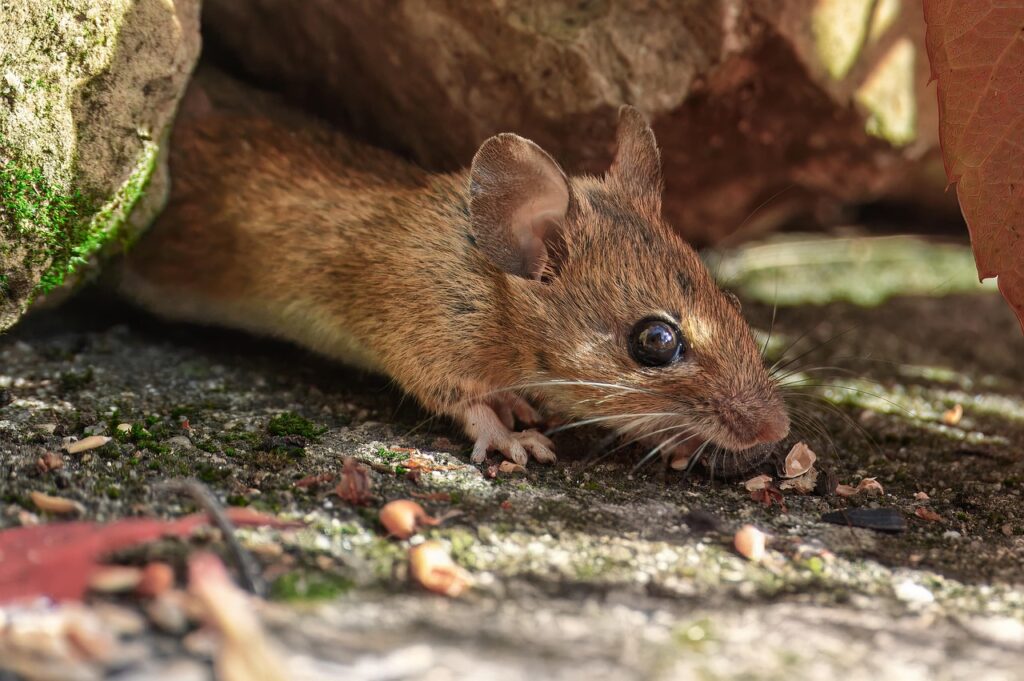
One brown blur across the kitchen floor and your stomach drops. You pull out the flashlight, check behind the toaster, sweep under the fridge, and find nothing. No pellets, no chew marks, no urine smell. Saw a mouse in my house but no droppings is one of the most common calls pest control operators get, and it usually means one of three things: the mouse is brand new, it is passing through, or you have already cleaned without realizing it. The good news is your response window is wide open.
What “No Droppings” Actually Tells You
A house mouse, Mus musculus, drops 50 to 75 fecal pellets per 24 hours. If you have searched thoroughly and found zero, the mouse has likely been inside for less than 24 hours, or it is using a runway you have not yet inspected. Pellets are 1/8 to 1/4 inch long, dark brown to black, and tend to cluster along walls, under sinks, behind the stove, and inside drawers. Look on top of cabinets and inside the silverware drawer; those are the two spots homeowners skip.
Single sightings without droppings also happen when a mouse enters through an open garage door, scurries across a room, and exits the same way. CDC field studies on Peromyscus species show juveniles can travel 30 to 50 feet through an unfamiliar space before retreating.
Inspect Before You Trap
Before you spend a dime on traps, do a 20 minute inspection with a bright flashlight. Pull the kick plate off the dishwasher. Open every floor-level cabinet. Check the back of the pantry. Look at the gap behind the refrigerator coils. Smudge marks, also called rub stains, are gray-brown smears where oily fur touches drywall and baseboards. They predate droppings by days and confirm a runway.
While you are down there, look for entry points. Mice fit through any opening larger than 1/4 inch, which means dryer vent gaps, gas line penetrations, AC line set holes, and torn weatherstripping under exterior doors all qualify.
Set Monitoring Traps Even If You Saw Only One
One mouse is rarely one mouse. Set six to eight Victor M156 snap traps or Tomcat Press ‘N Set traps along baseboards, perpendicular to the wall, with the trigger end touching the wall. Bait with a pea-size dab of peanut butter or a Nutella smear; cheese is a myth that fails empirical tests. Check traps every morning for seven straight days. If you catch zero mice and find no droppings, you likely had a transient.
- Victor M156 snap trap: $2 to $3 each at Home Depot or Lowe’s
- Tomcat Press ‘N Set: $3 to $5 each, easier to set without finger snaps
- Trapper T-Rex by Bell Labs: $6 each, professional-grade reset
Seal Entry Points Within 72 Hours
Trapping without exclusion is a treadmill. Mice scent-mark routes with pheromones in their urine, and other mice follow those trails. Use 1/4 inch hardware cloth from Lowe’s at about $14 per roll to cover dryer vents, gable vents, and weep holes. Stuff copper mesh like Stuf-fit or steel wool into gaps around pipe penetrations, then seal with Great Stuff Pestblock expanding foam. The foam alone won’t stop a mouse; mice chew right through polyurethane unless it has the embedded fibers.
Inspect the garage threshold and the door bottoms. A standard garage door seal at $25 to $45 from Home Depot replaces in 15 minutes and closes off the largest mouse entry point on most houses.
What to Do Tonight
If you saw the mouse less than two hours ago, do four things before bed. First, take out the kitchen trash. Second, wipe counters and stovetop with a degreaser like Mr. Clean Multi-Surface, because cooking residue is a primary attractant. Third, transfer any open boxes of cereal, rice, pasta, or pet food into glass or thick plastic containers; cardboard does not stop mouse teeth. Fourth, set traps in the room where you saw the mouse and one room over.
When to Call a Pro
If after a week of trapping you catch a mouse and find fresh droppings, you are dealing with at least three to five animals and likely a breeding pair somewhere in the wall cavity or attic. Call a pest control operator certified by the National Pest Management Association. A standard inspection runs $125 to $225, and a full exclusion job with sealing, baiting stations, and a 90 day warranty runs $400 to $900 for an average single-story home. Terminix and Orkin price slightly higher than independents; both are worth quoting against a local NPMA member.
What Not to Do
Skip the ultrasonic plug-in repellers; multiple university studies, including Kansas State, show they fail to deter rodents past 72 hours. Avoid glue traps in homes with children or pets; the welfare and cleanup issues outweigh the cost savings. Do not use rodenticide pellets like d-CON inside living areas. A mouse that ingests anticoagulant bait often dies inside a wall cavity, and the resulting odor lasts two to three weeks with no remediation possible short of cutting drywall.
Health Risk in Perspective
House mice carry salmonella, lymphocytic choriomeningitis virus, and trigger asthma reactions in roughly 18 percent of urban children per CDC data. Hantavirus is associated almost exclusively with deer mice, not house mice. Still, treat any mouse contact area with diluted bleach at a 1:10 ratio (per CDC guidance) or a quaternary ammonium cleaner like Lysol Clean & Fresh. Never vacuum or sweep dry droppings; mist them with disinfectant first and wipe with a paper towel.
One sighting without droppings is the best-case scenario for catching a problem early. Move fast, seal hard, and you can resolve it in under two weeks for under $100 in supplies.


