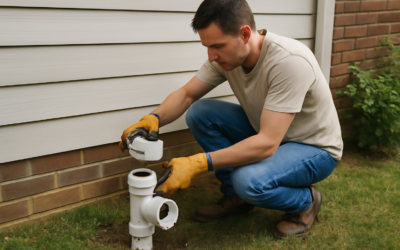
When your main sewer line backs up, the sewer line cleanout is your direct access point for clearing the blockage. This simple pipe fitting — usually a 3 or 4-inch capped pipe sticking up from the ground near your foundation — gives plumbers (and capable homeowners) a straight shot into the main drain without pulling toilets or dismantling plumbing. Knowing where yours is and how to use it can save hours of flooding damage and hundreds of dollars in emergency service calls.
What a Sewer Line Cleanout Looks Like
Most residential cleanouts are a white PVC or black ABS pipe with a threaded cap, rising 2-4 inches above ground level. Older homes may have cast iron or brass cleanout plugs set flush with the floor in the basement or garage. Some are round with a square nut in the center that requires a wrench to open. Others have a standard threaded cap that unscrews by hand or with large pliers.
Houses typically have two cleanout points: one near the front of the house where the sewer line exits toward the street, and one at the rear or side where the main drain exits the building. The front cleanout provides access toward the city sewer main. The rear cleanout accesses the interior building drain. A two-way cleanout (Y-shaped fitting) allows access in both directions from a single point.
How to Find Your Cleanout
Start by looking along the exterior foundation wall facing the street. The cleanout is usually within 5 feet of the house, often near a bathroom or kitchen location on the opposite side of the wall. Look for a white PVC cap at ground level, sometimes partially buried under mulch, dirt, or landscaping. A metal detector can help locate buried cast iron cleanouts.
- Slab-on-grade homes: Cleanout is typically outside, within 3 feet of the foundation
- Basement homes: Check inside the basement near the floor drain or along the main waste line
- Crawl space homes: May be under the house or outside near the foundation
- No cleanout found: Homes built before 1978 may lack one entirely. Installation costs $200-$800
Your local building department may have a plumbing diagram on file from when the house was built. Call and request the original plumbing permit drawings — they show the exact cleanout location and sewer line route.
How to Open and Use the Cleanout
Before opening the cleanout during a backup, prepare for sewage to flow out. Place towels or a bucket nearby and wear rubber gloves. Slowly loosen the cap counterclockwise — if pressure has built up behind the blockage, sewage may spray when the cap releases. Stand to the side, not directly over the opening.
- Locate the cleanout and clear any dirt or debris from around the cap
- Use a pipe wrench or large pliers to loosen the cap slowly. If it is stuck, apply penetrating oil (PB Blaster) and wait 15 minutes
- Once pressure equalizes and any standing sewage drains, you have clear access to the line
- Insert a drain snake or auger and feed it toward the blockage. A 50-foot manual drain snake ($30-$50 at any hardware store) handles most residential clogs
- Once the blockage clears, flush with a garden hose to verify flow
- Replace the cap and hand-tighten. Do not overtighten PVC caps — they crack under excessive torque
When to Use It vs. When to Call a Plumber
A single slow drain — one toilet or one sink — usually indicates a branch line clog, not a main sewer issue. Clear these through the individual fixture’s drain or trap. The sewer line cleanout comes into play when multiple fixtures back up simultaneously, water rises in the lowest drain (basement floor drain or first-floor shower), or sewage odor comes from multiple locations.
Call a professional plumber when you encounter tree root intrusion (the snake hits a solid obstruction that does not clear), a collapsed pipe (the snake cannot advance at all), or repeated blockages in the same location (indicating a structural problem). Professional sewer cleaning with a motorized auger costs $150-$400. Camera inspection to diagnose the problem runs $100-$300 additional. Both are worthwhile investments if you are experiencing recurring issues.
Installing a Cleanout If You Do Not Have One
Older homes often lack exterior cleanouts, forcing plumbers to access the main drain through toilets or interior floor drains — a messy and time-consuming process. Adding a sewer line cleanout costs $200-$800 depending on access difficulty. A plumber cuts into the main sewer line near the foundation, installs a wye or tee fitting with a cleanout plug, and extends it to grade level.
Most building codes now require cleanouts within 5 feet of the building and at every change of direction greater than 45 degrees. If your home does not have one and you are planning any plumbing renovation, adding a cleanout during that project saves money since the line is already exposed. Many jurisdictions require a cleanout installation during any major plumbing remodel or sewer line repair.
Maintenance and Prevention
Inspect your sewer line cleanout cap annually. Cracked, missing, or improperly sealed caps allow rainwater infiltration, root intrusion, and pest entry into your sewer line. Replacement caps cost $3-$10 at any hardware store. Apply Teflon tape to threaded caps for a better seal.
If you have mature trees within 25 feet of your sewer line, schedule a preventive drain cleaning every 12-18 months. Tree roots are the leading cause of main sewer blockages, and roots grow back after clearing. Copper sulfate root killer ($10-$15 for a 2-pound container) flushed down the toilet twice yearly helps slow root regrowth, though it does not eliminate established root masses. For persistent root problems, a plumber can apply root-inhibiting foam ($200-$400) that prevents regrowth for 2-3 years.