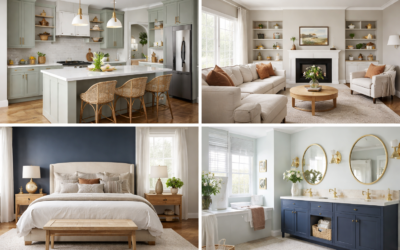
Gray became the neutral of the decade for good reason, but anyone who has held up a fan deck knows that “gray” hides dozens of very different colors underneath it. Some lean blue, some lean purple, and some are really warm greiges pretending to be gray. Navigating sherwin williams gray paint colors comes down to understanding undertones, light reflectance, and how a swatch behaves in your actual room. This guide breaks down the most reliable Sherwin-Williams grays, what makes each one tick, and how to avoid the surprise of a color that turns lavender at dusk.
Part of our Paint & Walls guide — explore the full guide →
- Warm Gray vs. Cool Gray: Know the Difference
- Understanding LRV
- The Most Popular Warm Grays (Greiges)
- The Best Cool and True Grays
- Dramatic Charcoals and Deep Grays
- Pairing Grays with Trim and Accents
- How to Test Before You Commit
- Best Grays for Kitchen Cabinets
- Grays That Work on Exteriors
- Matching the Gray to the Room
- Sherwin Williams Charcoal Gray and Dark Gray Picks
Warm Gray vs. Cool Gray: Know the Difference
Every gray leans one way or the other. Warm grays carry beige, taupe, or yellow undertones and feel cozy — designers often call these greiges, a blend of gray and beige. Cool grays carry blue, green, or violet undertones and feel crisp and modern. The trap is that a gray looking neutral on the chip can reveal a strong undertone once it covers a whole wall, especially in the direction of light your room gets.
North-facing rooms get cool, bluish light that amplifies cool undertones and can make a gray feel cold or even blue. South-facing rooms get warm, abundant light that softens grays and brings out warmth. Match the color to the room: use warmer greiges in north light and you can get away with cooler grays in bright south-facing spaces.
Understanding LRV
Light Reflectance Value, or LRV, measures how much light a color reflects on a scale from 0 (black) to 100 (pure white). It is printed on every Sherwin-Williams color chip and is the single most useful number for predicting how a gray will read. A gray with an LRV in the low 40s to 60s stays light and airy; one in the 20s to 30s reads as a true mid-tone; anything under 20 becomes a deep charcoal. Rooms with little natural light need a higher LRV to avoid feeling dim, while bright rooms can handle darker, moodier grays without closing in.
The Most Popular Warm Grays (Greiges)
These crowd-pleasers work because their beige base keeps them from ever feeling cold:
- Agreeable Gray (SW 7029): LRV 60. The most popular greige in the country. Balanced, flexible, and flattering in almost any light. A safe first choice.
- Repose Gray (SW 7015): LRV 58. Slightly cooler than Agreeable Gray with a faint purple whisper in some light. Great for a modern-neutral feel.
- Accessible Beige (SW 7036): LRV 58. Warmer still, tipping toward beige. Perfect when you want cozy over crisp.
- Mindful Gray (SW 7016): LRV 48. A deeper greige for accent walls, islands, and rooms that can handle more color.
The Best Cool and True Grays
When you want a cleaner, more contemporary gray, these deliver without going icy in most rooms:
- Passive (SW 7064): LRV 60. A light, elegant gray with subtle blue undertones. Beautiful in well-lit modern spaces.
- Gray Screen (SW 7071): LRV 56. A true gray with a hint of blue that stays balanced.
- Network Gray (SW 7073): LRV 27. A rich mid-gray for dramatic walls and exteriors.
- Dorian Gray (SW 7017): LRV 39. A greige-leaning gray that grounds a room without darkening it too much.
Dramatic Charcoals and Deep Grays
For a moody accent wall, a front door, or kitchen cabinets, deeper grays add sophistication:
- Peppercorn (SW 7674): LRV 10. A soft near-black charcoal, popular for cabinets and exterior trim.
- Iron Ore (SW 7069): LRV 6. A warm off-black that reads as the darkest gray in the range — a favorite for exteriors and statement doors.
- Gauntlet Gray (SW 7019): LRV 17. A strong, warm charcoal for accent walls and lower cabinets.
Deep grays show brush marks and imperfections more than light colors, so surface prep matters. Use a quality enamel in a satin or semi-gloss finish on cabinets and trim for durability and an even sheen.
Pairing Grays with Trim and Accents
A gray wall needs the right white on the trim to look intentional. Warm greiges pair best with soft warm whites like Alabaster (SW 7008) or Pure White (SW 7005), which share their gentle undertone. Cool grays can carry a crisper white such as Extra White (SW 7006) or High Reflective White (SW 7757) for a sharp contrast. Mixing a warm gray with a stark cool white — or the reverse — is the most common way rooms end up looking slightly off without anyone knowing why.
How to Test Before You Commit
Never choose a gray from the chip alone. Undertones only reveal themselves at scale and across the day. Follow this simple process:
- Buy sample pints of your top two or three candidates, or order the large peel-and-stick color swatches Sherwin-Williams sells.
- Paint a two-foot square on at least two different walls, since light hits each wall differently.
- Live with the samples for a full day. Look at them in morning light, midday sun, overcast light, and under your evening artificial bulbs.
- Hold your flooring, countertop, and cabinet samples against the paint to confirm the undertones agree.
The bulbs you use matter a lot — a warm 2700K bulb pushes grays warmer, while a cool 4000K bulb pushes them toward blue. Test under the lighting you actually live with.
Best Grays for Kitchen Cabinets
Gray cabinets have become nearly as common as white, and Sherwin-Williams grays translate beautifully to cabinetry. For a light, airy kitchen, Repose Gray and Passive keep cabinets soft without going stark. For a two-tone kitchen with darker lowers, Mindful Gray, Dorian Gray, and Gauntlet Gray add depth and ground the space. For a dramatic, modern statement, Peppercorn and Iron Ore on an island or a full run of cabinets read as sophisticated and hide fingerprints well. When painting cabinets, use a durable enamel such as Emerald Urethane Trim Enamel in a satin or semi-gloss sheen, which levels smoothly and cures hard enough to withstand daily use. Always prime bare or previously finished wood, and sample the color on a spare door or drawer front before committing, because a gray reads differently on horizontal-grain wood under kitchen lighting than it does on a wall.
Grays That Work on Exteriors
Several of these grays double as excellent exterior colors, where they read differently under open sky and full sun than they do indoors. Dorian Gray and Gauntlet Gray make handsome, versatile siding colors, while Iron Ore and Peppercorn are perennial favorites for front doors, shutters, and modern board-and-batten accents. On exteriors, remember that colors appear lighter outdoors because of the abundant natural light, so a shade that looks like a rich mid-gray on an indoor wall may read noticeably lighter on a full house. Use Sherwin-Williams’ exterior-grade paints such as Duration or Emerald for the durability and fade resistance an exterior demands, and always sample large swatches on more than one wall of the house, checking them in both sun and shade before ordering.
Matching the Gray to the Room
Different spaces reward different grays. For an open-concept main floor, a flexible greige like Agreeable Gray or Repose Gray keeps everything cohesive. For a bathroom or a bright office, a cooler Passive or Gray Screen feels fresh and clean. For cabinetry, an island, or a cozy den, reach for the deeper Mindful Gray, Gauntlet Gray, or Peppercorn. Because Sherwin-Williams grays are so widely used, you will find countless real-home photos online for any color you consider — a quick search of the color name is one of the best free tools for previewing a shade in rooms like yours.
One last practical tip: paint sheen changes how a gray reads. A flat or matte finish absorbs light and mutes the color, hiding wall imperfections but showing scuffs; an eggshell or satin finish reflects a bit more light, making the same gray appear slightly lighter and easier to wipe clean. For most walls, eggshell strikes the best balance, while satin or semi-gloss suits trim, doors, and high-traffic areas. Because sheen shifts the apparent depth of a color, view your sample in the same finish you plan to use rather than judging from a flat swatch card.
Get the undertone and LRV right for your light, coordinate your trim white, and test at scale, and a Sherwin-Williams gray will give you the calm, versatile backdrop it is famous for.
Sherwin Williams Charcoal Gray and Dark Gray Picks
Sherwin-Williams does not sell one color simply called charcoal gray; instead, its dark grays span several named shades from soft mid-tones to near-black. Gauntlet Gray (SW 7019, LRV 17), Peppercorn (SW 7674, LRV 10) and Iron Ore (SW 7069, LRV 6) are the usual charcoal choices, while Dovetail and Mineral Gray fill gaps people often search for. Compare them by LRV and undertone, since two dark grays with similar depth can lean very warm or very cool.
| Color | LRV | Character | Good for |
|---|---|---|---|
| Mindful Gray (SW 7016) | 48 | Deeper warm greige | Accent walls, islands |
| Dovetail (SW 7018) | About 26 | Warm, taupe-leaning mid-dark gray | Cabinets, exterior siding, dens |
| Gauntlet Gray (SW 7019) | 17 | Warm charcoal | Lower cabinets, accent walls |
| Peppercorn (SW 7674) | 10 | Soft near-black charcoal | Cabinets, doors, trim |
| Mineral Gray (SW 2740) | About 9 | Cool, blue-leaning dark gray | Exterior doors, shutters, bold rooms |
| Iron Ore (SW 7069) | 6 | Warm off-black | Front doors, exteriors |
Dove gray versus Dovetail
Many people searching for a dove gray from Sherwin-Williams end up at Dovetail. Despite the soft name, it is not a pale gray: with an LRV around 26 it sits in the dark range, close to the depth of Network Gray. It reads as a warm gray with a taupe cast, so it pairs well with oak, brass and creamy whites rather than stark ones.
Choosing a dark gray paint from Sherwin-Williams
- Pick by undertone first. Mineral Gray reads cooler and suits white quartz and chrome; Gauntlet Gray, Dovetail and Iron Ore suit warm wood and brass.
- Check LRV against the room’s light. Under about 20, a gray behaves like charcoal and can make a small, dim room feel closed in.
- Sample on a full door or a two-foot board. Dark colors show sheen and brush marks, so test in the finish you plan to use.
Most popular gray, and where slate grays fit
Agreeable Gray (SW 7029) remains the most popular Sherwin-Williams gray overall, and Mindful Gray is its deeper relative for spaces that can handle more color. If you want a slate gray, look for a dark gray with a blue or green lean, such as Mineral Gray, and confirm the current LRV on the color’s page on the maker’s site before ordering.