A rainfall shower head trades the tight, driving spray of a standard head for a wide, gentle downpour that lands straight on your shoulders. It’s the single most popular bathroom upgrade under $200, and for good reason: it feels like a spa. But the wrong size or a mismatch with your home’s water pressure turns that dream into a weak drizzle. Here’s how to pick and install one that actually delivers.
Part of our Bathroom Remodeling & Flooring guide — explore the full guide →
Before you buy, understand that a rain head works differently than a conventional one. Instead of pressurizing water into a fast jet, it spreads flow across a large face and lets gravity do the work. That design choice drives every decision below, from size to plumbing.
- Rainfall Shower Head Sizes
- Flow Rates: 2.5 gpm vs 1.8 gpm WaterSense
- Ceiling Mount vs Wall Mount
- Shower Arm and Pressure Requirements
- How to Install a Wall-Mount Rain Head
- Price Ranges and What to Buy
- Combo Setups and Handheld Add-Ons
- Materials and Maintenance
- Final Buying Advice
- Frequently Asked Questions
Rainfall Shower Head Sizes
Face diameter is the headline spec. Bigger looks dramatic but demands more water and pressure to cover the whole surface evenly. Common sizes:
- 8 inch: The practical sweet spot for most homes. Covers head and shoulders, works on typical residential pressure, and fits standard showers. Usually $30 to $80.
- 10 inch: A noticeable step up in coverage without overwhelming your plumbing. Great for a master bath. Around $50 to $120.
- 12 inch: Full-shoulder-and-back coverage. Needs solid pressure to avoid weak edges. Typically $80 to $200.
- 16 inch: A luxury, walk-in-only statement. Demands strong pressure and often a dedicated supply line. $150 to $400-plus.
If you’re unsure, go with an 8 or 10 inch head. Buyers who jump straight to 12 or 16 inches on older plumbing are the ones who complain the outer nozzles barely trickle.
Flow Rates: 2.5 gpm vs 1.8 gpm WaterSense
Flow rate, measured in gallons per minute, decides how much water reaches you and how it feels:
- 2.5 gpm: The federal maximum for shower heads in the U.S. This gives a rain head its fullest, most drenching feel and is the best match for large faces.
- 1.8 gpm (WaterSense): EPA-certified water-saving heads capped at 1.8 gpm. They cut water use by roughly 28 percent versus 2.5 gpm and can save a family real money on water and heating bills. Some states, notably California, cap flow even lower.
The tradeoff is honest: a 1.8 gpm head sips less water but can feel thinner on a 12- or 16-inch face because there’s less water to cover all that area. If you want both coverage and conservation, pair a WaterSense 1.8 gpm rating with an 8- or 10-inch head so the flow isn’t spread too thin. On a big face, 2.5 gpm feels dramatically better.
Ceiling Mount vs Wall Mount
How the head connects to your plumbing shapes the whole look and the install effort:
- Wall mount (with a shower arm): The head attaches to an S-shaped or gooseneck arm coming out of the wall. Easiest to install because you use the existing water line. A high-rise or extended arm angles the head so water falls more vertically. This is the DIY-friendly path.
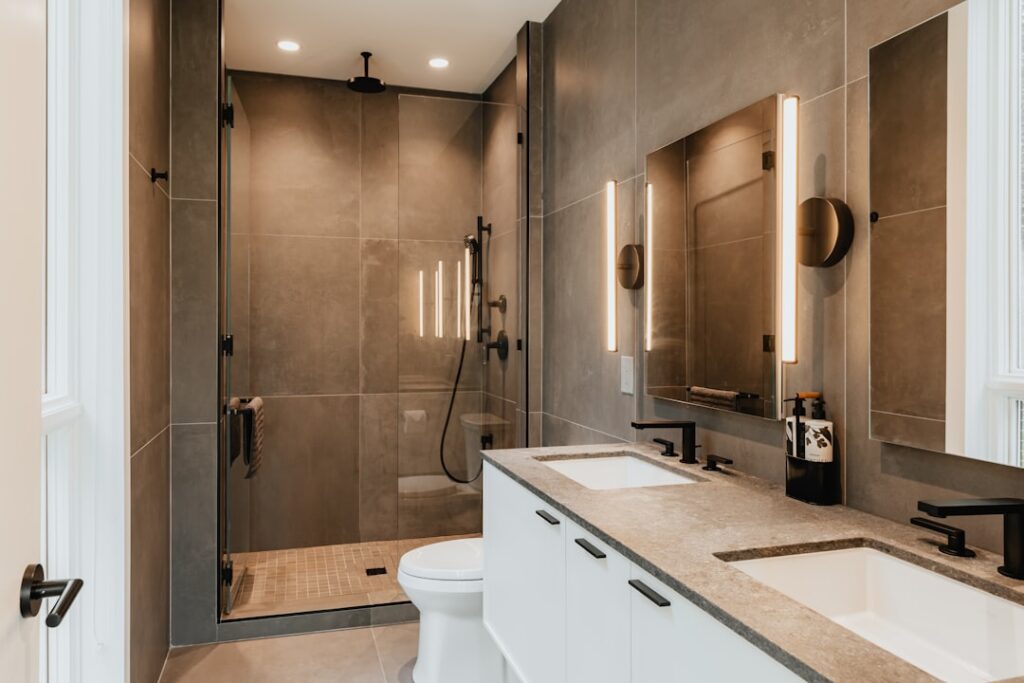
- Ceiling mount: The head drops straight down from the ceiling for a true, vertical downpour and the cleanest look. It requires running a supply line up through the wall and across the ceiling, which usually means opening drywall and calling a plumber. Budget several hundred dollars extra for that work.
Shower Arm and Pressure Requirements
Two behind-the-scenes factors make or break the experience. First, the arm. A standard shower arm points the head at an angle, which is fine for a compact 8-inch head. For anything 10 inches or larger, use an extended or high-rise shower arm (often 12 to 16 inches long) so the large face sits farther out and higher, letting water fall straight down onto you rather than behind you.
Second, pressure. Rain heads live and die by water pressure. Recommended minimums:
- Aim for at least 40 to 45 psi for satisfying flow on an 8- to 10-inch head.
- Larger 12- and 16-inch heads want 50 psi or more to fire every nozzle evenly.
- Below 40 psi, the outer edges of a big head weaken noticeably. If your home has low pressure, size down or look for a rain head designed with a smaller face and pressure-boosting nozzles.
You can check your pressure with a $10 gauge that screws onto an outdoor spigot or the shower arm threads. It’s worth doing before spending $150 on a head your plumbing can’t feed.
How to Install a Wall-Mount Rain Head
Swapping a wall-mount rainfall head onto an existing arm is a 15-minute job with no special tools:
- Unscrew the old shower head counterclockwise by hand or with a wrench padded by a rag.
- Clean the old plumber’s tape off the arm threads.
- If you’re upgrading to a larger head, unscrew the old arm and thread in a new extended or high-rise arm.
- Wrap the arm threads clockwise with three or four turns of Teflon plumber’s tape.
- Hand-thread the new head on, then snug it a quarter to half turn with a padded wrench. Don’t overtighten.
- Run the shower and check for drips at the joint. A weeping connection just needs another wrap of tape.
Price Ranges and What to Buy
You don’t need to overspend. A quick budget map:
- $25 to $60: Solid 8-inch plastic or thin-stainless heads. Great value for a standard bathroom.
- $60 to $150: Heavier 10- to 12-inch stainless or brass heads with air-injection nozzles and better anti-clog silicone tips.
- $150 to $400-plus: Large 12- to 16-inch, ceiling-ready luxury heads, often with dual-function or LED features.
For most homeowners, a 2.5 gpm 8- or 10-inch stainless head on a high-rise arm, in the $50 to $100 range, hits the ideal balance of coverage, pressure tolerance, and cost.
Combo Setups and Handheld Add-Ons
One drawback of a fixed overhead rain head is that it’s awkward for rinsing the tub, bathing kids, or washing a dog. That’s why many buyers choose a combo. Two popular arrangements:
- Rain head plus handheld on a diverter: A single valve feeds both, and you flip a lever to switch between the overhead downpour and a handheld wand on a hose. Combo kits run $60 to $150.
- Dual overhead plus handheld: Higher-end systems let you run both at once, though that demands strong pressure and pushes toward the 2.5 gpm ceiling fast.
Remember that federal flow limits apply to the whole shower, so a busy multi-head system splits that 2.5 gpm across every active outlet. On modest plumbing, keep it simple with one rain head and one handheld you use one at a time.
Materials and Maintenance
Rain heads live in a wet, mineral-heavy environment, so build quality shows over time:
- Stainless steel resists rust and looks premium; the best value in the $60 to $120 range.
- Solid brass is the most durable and heaviest, common on luxury heads.
- ABS plastic with chrome plating is lightweight and cheap but can crack or discolor over years.
Whatever you buy, look for soft silicone or rubber nozzle tips. Hard-water scale clogs metal nozzles, while flexible tips let you rub the deposits off with your thumb. If the spray goes patchy after a year, unscrew the head and soak the faceplate in white vinegar for an hour to dissolve the mineral buildup.
Final Buying Advice
Match the size to your water pressure first, pick your flow rate second, and choose the mount and arm that suit your bathroom. A quick decision path:
- Test your water pressure; below 40 psi, size down to 8 inches.
- Pick 2.5 gpm for the fullest feel, or WaterSense 1.8 gpm to save water on a smaller face.
- Buy an extended or high-rise arm for any head 10 inches or larger.
- Choose stainless or brass over plated plastic for longevity.
Get those steps right and a quality rainfall shower head will turn an ordinary shower into the best five minutes of your morning, for a fraction of what a full bathroom remodel costs.
Frequently Asked Questions
Do rainfall shower heads have low pressure? They can feel softer because the water falls by gravity rather than firing out under pressure. That gentle downpour is the point. If yours feels weak, the usual culprits are a face that’s too large for your home’s psi or a flow restrictor you can leave in place for water savings.
What size rain head is best for an average bathroom? An 8- or 10-inch head is the safe, satisfying choice for most homes. It covers your head and shoulders, works on typical residential water pressure, and won’t overwhelm older plumbing the way a 12- or 16-inch face can.
Can I install one myself? A wall-mount head that threads onto your existing shower arm is a 15-minute DIY job needing only plumber’s tape and a padded wrench. Ceiling-mount installs require running a new supply line and usually a plumber.
Is 1.8 gpm enough for a rain head? Yes, on a smaller 8- or 10-inch face. WaterSense 1.8 gpm heads cut water use meaningfully and still feel full when the flow isn’t stretched across a huge surface. Reserve 2.5 gpm for the big 12- and 16-inch faces.