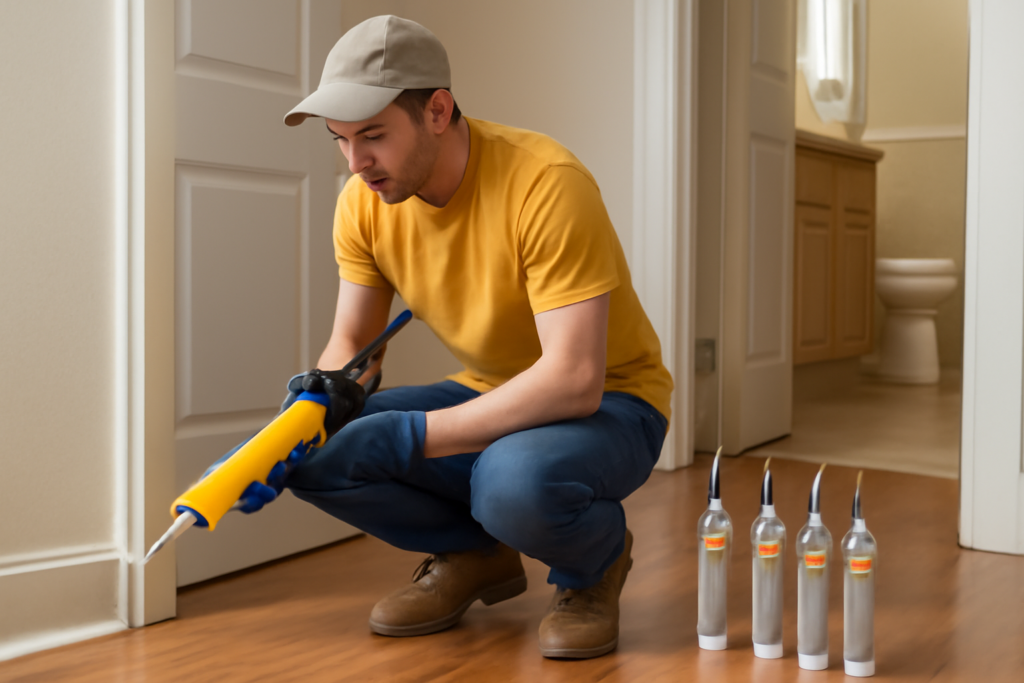
Ask three contractors about Sikaflex and you may get three different answers, because they are picturing three different tubes. Sikaflex caulk is not a single product — it is Sika’s family of polyurethane sealants and adhesives, ranging from a $9 self-leveling concrete joint sealant at the big-box store to industrial marine adhesives that hold boat windshields in place. The chemistry across the line is similar: tough, flexible, moisture-curing polyurethane. The formulas, viscosities, and intended jobs are not. Matching the right Sikaflex to the joint in front of you is the whole game, and this guide sorts the lineup the way a concrete guy would explain it over the tailgate.
Part of our Paint & Walls guide — explore the full guide →
- Why Polyurethane in the First Place
- Sikaflex Self-Leveling Sealant: The Homeowner Favorite
- Sikaflex-1a and Construction Sealant: The Vertical Workhorses
- Crack Flex and Concrete Fix: Repair-Aisle Specialists
- 11 FC and the Adhesive End of the Line
- Working Time, Cure, and Cold-Weather Reality
- Sikaflex Versus NP1, Silicone, and the Cheap Stuff
- Mistakes That Shorten a Polyurethane Joint's Life
- The Short Version
Why Polyurethane in the First Place
Sika built its name on concrete chemistry, and polyurethane sealants are the natural companion to slabs and masonry. A cured Sikaflex bead behaves like dense rubber: it stretches as joints open in winter cold, compresses in summer heat, shrugs off tire traffic, and bonds ferociously to concrete, wood, metal, and most masonry without primer in typical conditions. Most of the construction-facing formulas meet ASTM C920 with movement ratings of 25 to 35 percent of joint width, which is the performance class engineers specify for expansion joints.
Unlike acrylic latex caulk, polyurethane cures by reacting with atmospheric moisture rather than by drying, so it does not shrink much and it keeps curing in damp conditions that would ruin water-based products. The trade-offs are honest ones: longer cure times, stickier tooling, solvent cleanup, and a bead that will chalk slightly after years of direct sun. Nearly every formula is paintable once cured, which silicone cannot offer.
Sikaflex Self-Leveling Sealant: The Homeowner Favorite
If you have seen one Sikaflex product, it is probably the red-labeled Self-Leveling Sealant stocked at Home Depot for roughly $9 to $12 per 10.1-ounce cartridge. It is designed for horizontal joints only — driveway control joints, sidewalk gaps, garage slab joints, and cracks up to about an inch wide. Cut the tip, gun it in, and the sealant flows out to a smooth, level surface with no tooling at all, which is why first-timers get professional-looking results with it.
Two rules make or break the job. First, the joint must be horizontal; on even a modest slope the sealant will slowly creep downhill before it skins, so switch to a non-sag formula on grades. Second, control the depth. Stuff backer rod or sand into joints deeper than 1/2 inch so you are sealing a band roughly 1/4 to 1/2 inch deep, not filling a bottomless crack with $12 of urethane. Expect it to skin within a few hours and take foot traffic in about a day at 73°F, with full cure over three or more days in cool weather.
Sikaflex-1a and Construction Sealant: The Vertical Workhorses
For walls, windows, and any joint gravity would drain, the non-sag formulas take over. Sikaflex-1a is the pro-grade classic — a one-component, gun-grade polyurethane meeting ASTM C920 Class 35, used on window and door perimeters, precast panels, stucco terminations, flashings, and immersion-tolerant joints. It hangs in vertical joints without slumping, tools into a clean concave profile, and comes in colors beyond the standard white, limestone, and gray through commercial distributors, typically at $8 to $14 per cartridge or less in 20-ounce sausages.
The retail-shelf sibling, usually labeled Sikaflex Construction Sealant, delivers similar non-sag polyurethane performance in homeowner-friendly packaging. Use either one anywhere you would otherwise reach for a premium exterior caulk: gaps between siding and masonry, foundation-to-sill joints, hose bib penetrations, and vertical control joints in block walls. Tool with a dry spoon or gloved finger and light pressure — flooding polyurethane with soapy water invites surface bubbling.
Crack Flex and Concrete Fix: Repair-Aisle Specialists
Sika also packages the same chemistry for repair-minded shoppers. Sikaflex Crack Flex Sealant is a self-leveling formula aimed squarely at random cracks in slabs rather than formed joints — the meandering hairline-to-1/4-inch cracks that show up in every driveway after a decade of freeze-thaw. For cracks wider than about 1/4 inch, push foam backer rod down first so the sealant forms a proper flexible band. Textured versions exist as well, blending sand-like grit into the urethane so a repaired joint in a broom-finished sidewalk does not read as a shiny stripe.
These repair sealants will not structurally knit a slab back together — nothing in a caulk tube will. What they do is keep water out of the crack, which is the actual battle in freeze-thaw climates. Water that cannot enter the crack cannot freeze, expand, and turn a 1/8-inch cosmetic flaw into a spalled trench.
11 FC and the Adhesive End of the Line
Sikaflex-11 FC blurs the line between sealant and adhesive, and pros treat it as both. The FC stands for fast cure: it skins in under an hour and builds handling strength quickly, while still meeting movement-joint specs. Crews use it to bond landscape block caps, glue thresholds and stair treads, seal penetrations, and stick down transition strips — jobs where you want gap-filling grab plus permanent flexibility. Beyond that sit the numbered industrial grades: Sikaflex-221 in vehicle and RV assembly, and the 291/292 marine series trusted below the waterline on boats. A homeowner rarely needs them, but their existence explains why “Sikaflex” shows up in forums about everything from campers to sailboats.
Working Time, Cure, and Cold-Weather Reality
All the one-part Sikaflex products cure with humidity at roughly 1/16 inch of depth per day in 73°F, 50 percent RH conditions. A 3/8-inch bead is not fully cured for several days, even if it feels skinned over by dinner. Application range runs from about 40°F to 100°F; below that window the sealant guns like cold peanut butter and cure slows to a crawl. In winter, store cartridges indoors overnight and carry them in a cooler with a hand warmer — a 70°F tube flows twice as nicely as a 35°F one.
Surface prep follows the standard playbook: clean, dry, dust-free, with old sealant cut out and concrete laitance wire-brushed away. Solvent-wipe non-porous surfaces. Uncured cleanup is mineral spirits; cured cleanup is a razor and regret. And give new concrete time — freshly placed slabs should cure for a few weeks before sealing so residual moisture and alkalinity do not fight the bond.
Sikaflex Versus NP1, Silicone, and the Cheap Stuff
Sikaflex and MasterSeal NP 1 are direct competitors — both one-part construction polyurethanes with comparable specs — and most contractors simply use whichever their supply house stocks, with Sikaflex enjoying far better retail availability for weekend projects. Against silicone, Sikaflex wins on paintability, abrasion resistance, and concrete adhesion; silicone wins in permanently wet interiors and on glass. Against $3 acrylic latex there is no comparison worth making outdoors: on a moving concrete joint, acrylic is a one-season product while polyurethane is a decade product. The only place the cheap tube wins is on painted interior trim, where polyurethane would be messy overkill.
Mistakes That Shorten a Polyurethane Joint’s Life
Most Sikaflex failures in the field follow the same short list. Skipping backer rod tops it: sealant poured deep into a joint bonds to three sides — both walls plus the bottom — and three-sided adhesion tears the bead apart the first winter the joint opens up. Backer rod is not just a volume saver; it forces the correct hourglass profile and lets the sealant stretch freely. Second is sealing over failed caulk or paint instead of bare substrate; polyurethane bonds ferociously, but only to whatever it touches, and if that layer lets go, the bead goes with it. Third is puncturing the foil pack or cartridge and walking away — opened polyurethane starts curing from atmospheric moisture, so a half-used tube is usually a dead tube within weeks even with a nail in the tip.
Longevity expectations are worth setting honestly. A properly installed Sikaflex joint in a driveway typically delivers 10 to 20 years before UV chalking and joint movement call for replacement, and vertical joints out of direct sun last longer still. When the time comes, do not bury new sealant over the old, weathered surface: cut the failed bead out, re-establish clean joint walls, and start fresh. Twenty minutes with a utility knife is the difference between a repair that lasts another decade and one that peels loose in a season.
The Short Version
Flat concrete joints and driveway cracks: Sikaflex Self-Leveling or Crack Flex, with backer rod below. Vertical and exterior building joints: Sikaflex-1a or Construction Sealant. Bond-and-seal repairs on masonry and thresholds: 11 FC. Whatever the tube, prep the joint, control the depth, respect the multi-day cure, and Sikaflex caulk will still be flexing quietly in that joint when most of the caulk aisle has cracked, shrunk, and been redone twice.