Many “broken” pop-up drains aren’t broken at all. They’re gunked shut. If your sink plug stuck in the open or closed position has you reaching for the phone, hold off. Most of the time, you can free it in 15 minutes with tools already under your sink. When you can’t, it’s usually an inexpensive part swap that any homeowner can handle.
- Why Sink Plugs Seize Up in the First Place
- Quick Diagnosis Before You Touch Anything
- Freeing a Pop-Up Bathroom Sink Plug
- Releasing a Stuck Click-Clack Stopper
- Kitchen Basket Strainer That Won't Budge
- When Chemical Cleaners Help (and When They Don't)
- Replacing the Whole Assembly
- Prevention That Actually Works
Why Sink Plugs Seize Up in the First Place
Soap scum, hair, and mineral scale build up on the linkage below the basin. Hard water (anything above 7 grains per gallon) accelerates this dramatically. The pop-up rod, pivot ball, and clevis strap all rely on small clearances. A 1/16-inch layer of crud is enough to lock the mechanism.
Push-button plugs (the “click-clack” style) fail differently. The internal spring loses tension or a chunk of soap wedges between the body and the cap. Basket strainer plugs in kitchen sinks usually stick because the rubber gasket swelled or the slot rusted to the strainer.
Quick Diagnosis Before You Touch Anything
Look under the sink. If you see a horizontal rod running into the drain tailpiece with a small ball-joint, you have a pop-up assembly. If the stopper just twists or presses down, it’s a click-clack. Kitchen sinks almost always use a basket strainer with a center rubber seal.
Run your finger around the stopper and check for visible hair. A flashlight helps. Many pop-up failures are nothing more than a thumb-sized clump of hair wrapped around the rocker arm.
Freeing a Pop-Up Bathroom Sink Plug
Place a towel in the basin so you don’t lose small parts down the drain. Locate the retaining nut on the back of the tailpiece where the horizontal rod enters. It’s usually plastic, hand-tight. Unscrew it counterclockwise and pull the rod and pivot ball out together.
The stopper should now lift straight out. If it resists, twist it 90 degrees while pulling. Wipe everything with a paper towel, then soak the metal parts in a 50/50 white vinegar and water bath for 20 minutes. Scrub with an old toothbrush, rinse, and reinstall in reverse order. Adjust the clevis screw so the stopper seats fully when the rod is up.
Releasing a Stuck Click-Clack Stopper
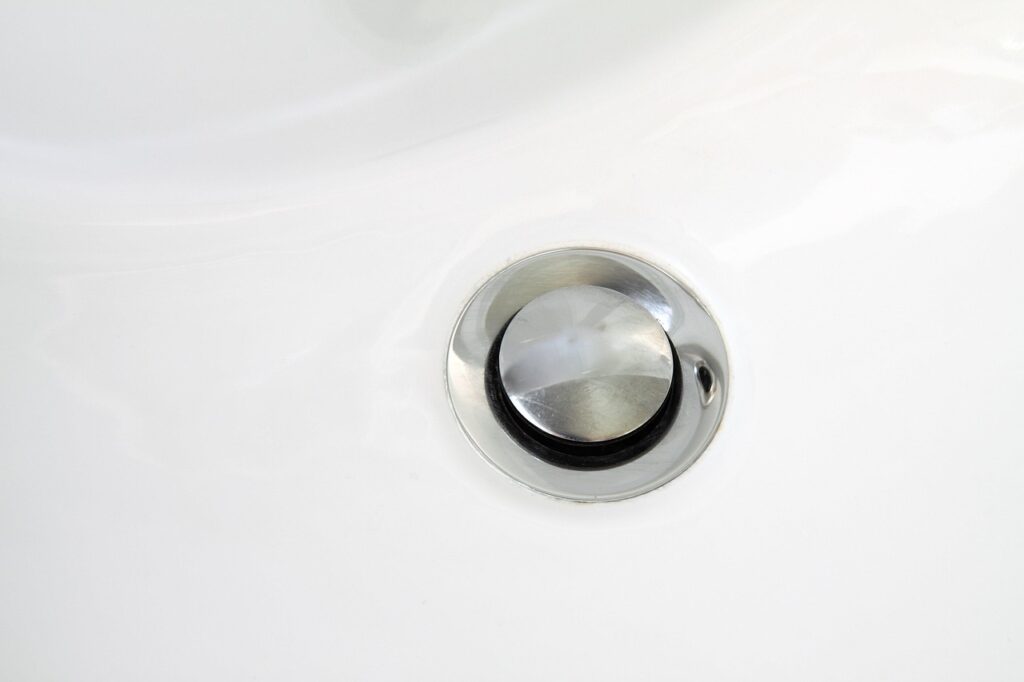
These look like solid caps but most unscrew. Hold the drain body steady from below with one hand and twist the cap counterclockwise. A rubber jar opener gives you grip without scratching the chrome. If it won’t budge, the internal post may be corroded.
Try the suction method: a heavy-duty plunger sealed over the stopper, then pulled straight up sharply. The vacuum often pops a frozen click-clack loose. Spray a little WD-40 into the seam, wait 10 minutes, and try again. Avoid pliers on the visible cap — you’ll mar the finish and still not have leverage.
Kitchen Basket Strainer That Won’t Budge
Kitchen plugs that won’t lift usually have a swollen rubber seal grabbing the strainer walls. Pour two cups of boiling water around the rim, wait 30 seconds, then twist the basket with a wooden spoon handle in the cross slots. Heat shrinks the rubber just enough to release.
If the basket itself rotates but won’t come out, the locknut underneath has loosened. From below, tighten the large plastic nut around the strainer body while a helper holds the basket steady. Stuck strainer plugs that are deformed cost about $8 to replace — buy the OXO Good Grips Silicone Sink Stopper or a Kohler universal basket as a drop-in.
When Chemical Cleaners Help (and When They Don’t)
Skip the drain snake chemicals. They’re formulated for grease clogs, not stopper hardware, and the lye can pit chrome plating. Instead, mix 1/2 cup baking soda with 1 cup white vinegar, pour around the stopper, and let it foam for 15 minutes. Flush with hot water.
For mineral-locked parts, CLR Calcium Lime Rust Remover works quickly on chrome, but keep it off brushed nickel and oil-rubbed bronze, since it can strip coatings. A pump bottle of distilled white vinegar costs $3 and handles most stuck-plug situations without finish risk.
Replacing the Whole Assembly
If the pivot ball is cracked, the spring is shot, or the threads are stripped, replace the unit. A complete pop-up drain assembly from Moen, Delta, or Pfister runs $18 to $35 at Home Depot. Bring the old one for size matching — 1-1/4 inch is standard for bath, 1-1/2 inch for kitchen. Installation takes about 30 minutes with plumber’s putty and a basin wrench.
For frequent failures, a TubShroom or Hair Snare insert costs $13 and traps debris before it reaches the linkage. Catching hair before it reaches the linkage makes the next stuck plug far less likely.
Prevention That Actually Works
Once a month, fill the basin with hot water and a tablespoon of dish soap, then pull the plug and let it drain. The flush flow keeps soap from setting up around the linkage. Every six months, pull the pop-up stopper, wipe it down, and check the pivot ball for play.
If your water hardness exceeds 10 grains per gallon, consider a whole-house softener or at minimum a faucet aerator that filters scale. The same minerals freezing your sink plug are also shortening the life of your water heater and dishwasher, so it’s rarely a one-fixture problem.