Ready-mix trucks weigh 60,000 pounds loaded and cannot reach half the pours contractors actually do — backyard slabs behind fences, footings in the middle of a building, fence-post lines across soft ground. A skid steer concrete bucket bridges that gap: the truck discharges into the bucket at the curb, and the skid steer ferries and places concrete exactly where it is needed through a gated chute. At $2,000 to $7,000 to buy or $100 to $200 a day to rent, it is dramatically cheaper than pumping on small jobs. This guide covers the bucket types, capacity math against your machine’s ratings, chute and discharge options, top brands, and the placement technique that keeps concrete moving instead of setting in the bucket.
What a Concrete Dispensing Bucket Is
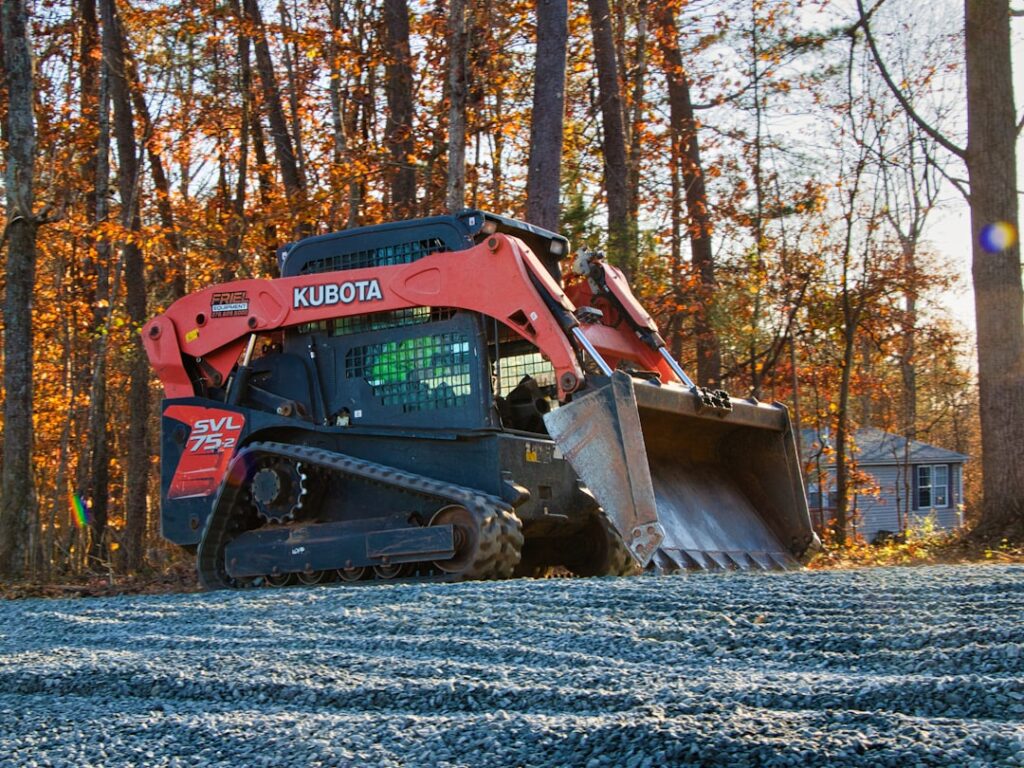
A concrete bucket (also sold as a dispensing bucket or material placement bucket) is a heavy-gauge steel hopper on a universal skid steer quick-attach plate, with a discharge gate low on the front or side and usually a bolt-on chute. Unlike a dirt bucket, it is designed for controlled metering: the operator opens the gate — by manual lever on basic models, or hydraulic cylinder on better ones — and concrete flows down the chute into forms at a rate the operator controls from the seat. Construction is 3/16-to-1/4-inch steel with reinforced sidewalls, because wet concrete weighs roughly 4,000 pounds per cubic yard and sloshes hard against welds during travel. Common features worth having: a hydraulic gate (feathering flow one-handed while driving is the entire skill), side-discharge chute options for pouring along walls and curbs, mesh or grate tops to knock down aggregate surge when the truck loads you fast, and fork pockets or crane lugs so the same bucket can be flown by telehandler or crane on other jobs.
Capacity Math: Your Machine Decides, Not the Bucket
Buckets come in nominal capacities of 1/4, 1/2, 3/4, 1, and 1.5 cubic yards, and the biggest mistake in the category is buying capacity the machine cannot lift. Run the numbers: concrete at ~4,050 pounds per yard means a 1/2-yard bucket holds about 2,025 pounds of material plus 600 to 900 pounds of bucket — call it 2,700 to 2,900 pounds total. Skid steer rated operating capacities (ROC, which is 50 percent of tipping load for wheeled machines) tell you what is safe: a mid-size machine with a 2,200-pound ROC handles a 1/2-yard bucket at partial fill or a 1/4-yard comfortably, while a full 3/4-yard load (about 3,600 pounds loaded) wants a large-frame machine with 3,000-plus ROC — think Bobcat S76/T76-class and up. Track machines carry more but the same discipline applies. Practical guidance: match bucket size so a full load sits at or under 80 percent of ROC, because you will be traveling over rough ground with a live, sloshing load carried high enough to clear forms. Overloaded skid steers with raised concrete buckets are one of the classic tip-over scenarios on residential sites.
Types and Discharge Options
The market breaks into a few functional variants:
- Front-discharge gravity buckets: the standard — gate and chute centered on the front, pouring where the machine points. Simplest, cheapest, and right for slabs, footings, and piers. $2,000 to $4,000.
- Side-discharge buckets: chute exits the side, letting the machine drive parallel to a wall form, curb line, or trench while pouring continuously. Worth the premium ($2,800 to $5,500) for anyone doing walls or long runs.
- Combination material buckets with gates: general-purpose buckets with a bolt-on discharge kit; more versatile, less controlled. Adequate for occasional use.
- Auger-feed and conveyor placers: powered attachments that meter stiff mixes uphill or across distance; specialty money at $6,000-plus and mostly contractor fleet gear.
Chute extensions (2 to 4 feet, bolt-on) are cheap and worth carrying; they drop concrete inside tall forms without smearing the top rails and reach over rebar mats cleanly.
Brands and Prices
Reliable names in the attachment space include Star Industries (a long-running specialist in concrete placement buckets), CID, Blue Diamond, Spartan, Titan Attachments at the value end, and OEM-branded units from Bobcat and Cat built by the same attachment makers. Expect street prices around $2,000 to $2,800 for a manual-gate 1/2-yard, $3,000 to $4,500 for hydraulic-gate 1/2-to-3/4-yard units, and $4,500 to $7,000 for large side-discharge or 1-yard-plus models. Hydraulic gates require a standard-flow auxiliary circuit — universally available on modern machines — and connect with flat-face couplers in seconds. On the used market, concrete buckets hold value well but inspect two spots hard: the gate seal area (worn or concrete-crusted gates dribble grout and jam mid-pour) and the quick-attach plate welds, which absorb the shock of every loaded traverse. Rental houses in most metros stock these at $100 to $200 per day or $350 to $600 per week — the obvious answer for a one-slab project when you are already renting the skid steer at $250 to $400 a day.
Workflow: Truck to Forms Without Wasted Minutes
The pour rhythm matters because ready-mix waits for no one — most plants allow 4 to 7 minutes per yard of unload time before demurrage fees, and concrete in a bucket on a hot day is on a clock. A clean operation looks like this: stage the truck where its chute reaches a loading spot with firm, level ground; position the skid steer under the chute and take a partial load first to learn the slosh; travel low and smooth to the forms — bucket just high enough to clear obstacles, never boomed up while moving; feather the hydraulic gate to lay concrete in even strips starting at the far end of the pour; and rotate immediately back for the next load while the placement crew spreads with come-alongs. Two useful numbers: a 1/2-yard bucket empties a 10-yard truck in about 20 cycles, so a 200-foot round trip at typical speeds turns the truck in roughly 60 to 90 minutes — fine for one truck, marginal for three. For bigger volumes or longer carries, compare against a line pump at $600 to $1,000 per pour day; somewhere around 15 to 20 yards and awkward distance, pumping wins. Below that, the bucket you already rented wins by hundreds of dollars.
Beyond Slabs: Other Jobs the Bucket Earns Its Keep On
Once a concrete bucket is in the fleet, it finds work far past flatwork. Fence and deck contractors use it as a mobile batch hopper — fill once from the truck or from site-mixed batches, then meter a precise cone of concrete into each post hole down a 200-foot run, a task that otherwise means a wheelbarrow marathon. Footing and pier pours inside existing buildings are a signature use: a compact machine fits a 6-foot door opening and delivers to interior pad footings no chute or barrow crew can reach efficiently. The same gated hopper handles non-concrete metering jobs — dry sand into paver joints, gravel into french drains, topsoil into raised beds — anywhere controlled flow beats dump-and-shovel. Some crews use theirs as a washout containment station at day’s end, catching chute rinse water for proper disposal instead of letting it soak into a client’s lawn (many municipalities now fine uncontained washout). None of these individually justifies the purchase; together they explain why concrete buckets show up on machines that pour concrete only one week a month. An attachment that replaces the wheelbarrow in every material-moving chore quietly becomes one of the most-used plates in the yard.
Cleanup and Care: The Ten Minutes That Preserve the Attachment
Concrete forgives nothing left overnight. The moment the last load discharges, wash the bucket — inside, gate track, chute, and the quick-attach plate — with a pressure washer or strong hose stream, working the gate open and closed while rinsing. Cured buildup narrows the gate opening, throws off metering, adds permanent dead weight, and eventually demands chipping hammers that gouge the steel. Between pours, a film of form-release oil or diesel-free release agent on interior surfaces makes the next washout trivial. Grease the gate pivots and cylinder pins on the same schedule as the machine, and store the bucket gate-open so seals do not take a set. Treated this way, a quality skid steer concrete bucket is essentially a lifetime attachment — a few thousand dollars of plate steel that repeatedly replaces $800 pump days and turns inaccessible pours into ordinary Tuesday work.