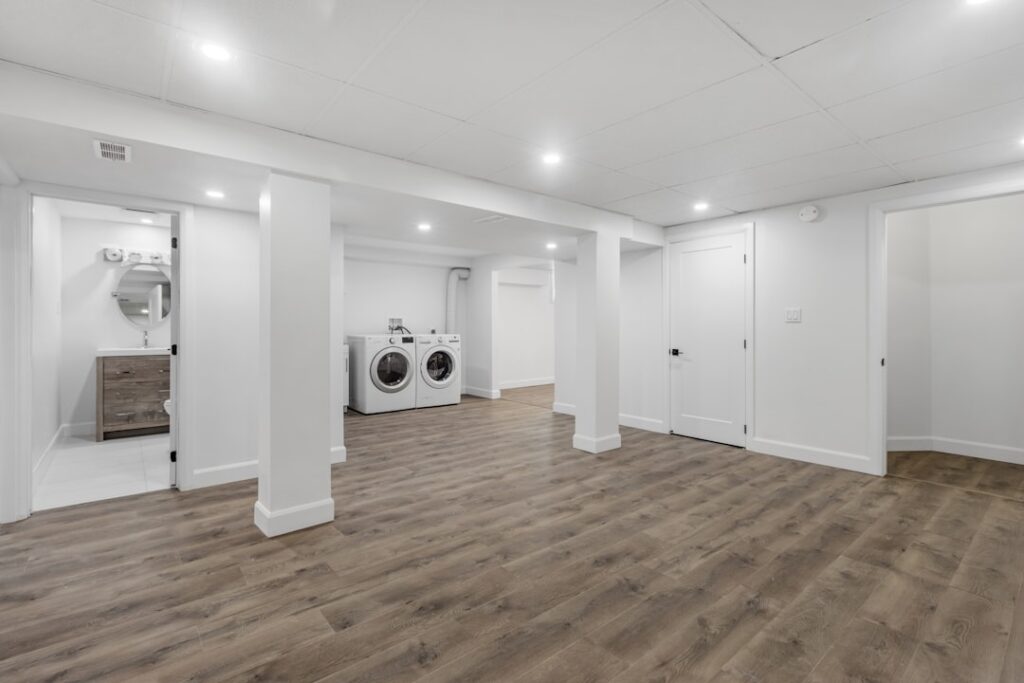
A basement corner is some of the most underused square footage in the average home, and it can become the quiet, distraction-free office that the rest of the house cannot offer. The trick with small basement office ideas is solving the basement’s built-in problems — low light, low ceilings, cold concrete, and limited space — while creating a setup you actually want to work in. Done right, a basement office gives you separation from household noise without the cost of an addition. Here are the design moves that turn a dim corner into a sharp, functional workspace.
- Fight the Lighting Problem First
- Maximize a Tight Footprint
- Define the Office Within a Larger Basement
- Handle the Cold, Hard Surfaces
- Build in Smart Storage
- Make It a Place You Want to Be
- Address Sound and Distraction
- Budget-Friendly Setups vs Higher-End Builds
- Addressing Moisture Before You Furnish
- The Bottom Line
Fight the Lighting Problem First
The single biggest challenge in any basement office is light, and it deserves top priority. Without it, the space feels like a cave and your productivity suffers. Layer multiple light sources at different heights to compensate for the lack of windows:
- Overhead lighting — recessed LED can lights or a flush-mount fixture provide ambient brightness without eating headroom.
- Task lighting — a quality desk lamp directly on your work surface prevents eye strain.
- Accent lighting — LED strips behind shelves or a floor lamp in the corner add warmth and depth.
Choose bulbs around 4000K to 5000K for the work zone, which mimics daylight and keeps you alert, while warmer 2700K-3000K bulbs elsewhere keep the room from feeling clinical. If you have an egress or hopper window, position your desk to face it and skip heavy window treatments that block what little natural light exists.
Maximize a Tight Footprint
Small basement offices win or lose on smart space planning. Choose furniture scaled to the area and use vertical space aggressively, since floor space is the scarce resource:
- A compact desk or a corner desk tucks into an awkward nook and frees up the room.
- A wall-mounted floating desk leaves the floor open and reads light and modern.
- Floating shelves and wall-mounted organizers store files and supplies without consuming floor area.
- A fold-down or murphy-style desk works if the basement does double duty as a guest or play space.
Keep the palette light and consistent. Pale walls, a light desk, and a few mirrors make a small, low-ceiling room feel noticeably larger than its measured size.
Define the Office Within a Larger Basement
Many basement offices share space with laundry, storage, or a rec area, so carving out a clear work zone matters for focus. You do not need walls. Use an area rug to anchor the office footprint, a bookshelf or open shelving unit as a room divider, or a folding screen to create visual separation. A simple change in flooring or a painted accent wall behind the desk signals where work begins and home life ends.
This psychological boundary is what lets you concentrate in an open basement and “leave” the office when the day ends, even if you never walk through a door.
Handle the Cold, Hard Surfaces
Concrete floors and bare block walls make a basement feel uninviting and uncomfortable for long work sessions. Warm up the space underfoot and on the walls:
- Flooring — interlocking foam tiles, a thick area rug over the slab, or luxury vinyl plank insulates against the cold concrete and softens the room.
- Walls — a coat of warm paint, slat-wood paneling, or framed art breaks up bare block and adds personality.
- Comfort — a small space heater or ensuring the office ties into the home’s HVAC keeps the chill off in winter.
If moisture is an issue, run a dehumidifier below 50 percent humidity to protect your electronics, paper files, and your own comfort. A dry basement is a usable basement.
Build in Smart Storage
Clutter shrinks a small office fast, so storage has to be intentional. Use the walls for everything you can — floating shelves, pegboards, wall-mounted file holders, and cabinets keep the desk surface clear. A single multi-drawer cabinet or rolling cart corrals supplies. Cable management matters more than people expect: route cords through a tray or sleeve under the desk so the tight space stays clean and visually calm. A tidy small office feels twice as big as a cluttered one.
Make It a Place You Want to Be
A productive office is also a comfortable, personal one. Invest in a genuinely good ergonomic chair — you will spend hours in it, and a cheap chair undermines an otherwise nice setup. Add touches that make the windowless space feel alive: low-light plants like pothos or snake plants, a piece of art you enjoy, and a corkboard or whiteboard for ideas. A small soundbar or speaker masks any echo from the basement’s hard surfaces and makes the space feel finished.
Color helps too. Soft, warm neutrals on the walls with one energizing accent color keep the room feeling open and motivating rather than sterile.
Address Sound and Distraction
Basements can echo, and ductwork or a nearby laundry room can intrude. Soft surfaces — a rug, fabric chair, curtains over open shelving, even acoustic panels behind the desk — absorb sound and improve call quality. Positioning your desk away from the furnace, water heater, and laundry keeps mechanical noise out of video meetings. For shared basements, a noise-canceling headset is a cheap, effective fix.
Budget-Friendly Setups vs Higher-End Builds
You can create a functional basement office at almost any budget, and it helps to know where to spend and where to save. On a tight budget, focus your dollars on the two things you cannot fake: good lighting and a quality chair. A few clamp lights or LED fixtures, a $150 to $250 ergonomic chair, a simple desk, and a fresh coat of warm paint can transform a corner for a few hundred dollars total.
If you have more to invest, the upgrades that deliver the most comfort are luxury vinyl plank flooring over the slab, built-in or floating cabinetry for clean storage, recessed lighting on a dimmer, and proper climate control tied into the home’s HVAC. A higher-end build might also include acoustic treatment and an egress window for light and code compliance. Whatever your budget, prioritize light, warmth underfoot, and seating comfort first — those determine whether you actually want to work down there.
Addressing Moisture Before You Furnish
The one issue that can sink a basement office is moisture, and it deserves attention before you move a single piece of furniture in. Basements are prone to humidity, and damp air ruins electronics, warps wood, and breeds mold on paper files and fabric. Start by running a dehumidifier and keeping relative humidity below 50 percent — many models have a built-in gauge and auto shut-off.
Look for and fix the sources too. Seal any foundation cracks, ensure exterior grading slopes away from the house, and clear downspouts so water drains well clear of the foundation. If the floor ever gets damp, choose flooring that tolerates it — interlocking vinyl or sealed LVP rather than carpet that traps moisture. Getting the basement genuinely dry first protects your equipment, your files, and your own health, and it is the difference between an office that lasts and one that smells musty within a season.
The Bottom Line
A small basement office succeeds when you solve the basement’s weaknesses head-on: layer in plenty of light, scale the furniture and lean on vertical storage, warm up the cold floors and walls, and carve out a clear, defined work zone. Add a great chair, a few personal touches, and some sound control, and that overlooked corner becomes a quiet, productive workspace that the busy floors above simply cannot match — all without the cost of building an addition.