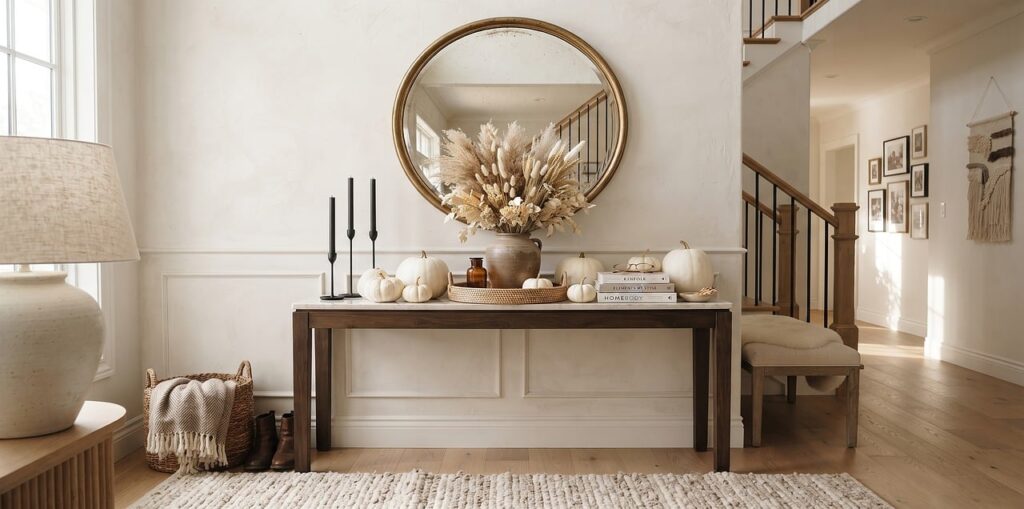
A 30-square-foot foyer feels three times bigger the moment you add a mirror — and three times more chaotic the moment you pick the wrong one. The best small entryway mirror ideas work because they solve three problems at once: bouncing light into a windowless space, giving you a final outfit check before the door closes, and visually doubling the depth of a tight footprint. The trick is choosing scale, shape, and finish that flatter the entry instead of overwhelming it.
Pick the Right Size First
Designers follow a loose two-thirds rule — the mirror should span roughly two-thirds the width of the console, bench, or wall section it anchors. For a 36-inch console, that puts the mirror at 24 inches wide. For a narrow 20-inch landing strip, a 14-inch round works better than a rectangle.
Vertical height matters too. The center of the mirror should sit at average eye level for the household — about 57 to 60 inches off the floor. Stack the mirror higher only when ceilings exceed 9 feet, and you need to draw the eye upward to balance proportion.
Round Mirrors for Visual Softening
Round mirrors are the most forgiving choice in small spaces because they soften the rectangle of door frames, baseboards, and consoles around them. A 24-inch matte black framed round from Pottery Barn (Sausalito, around $279) or West Elm Metal Frame (around $199) anchors a console without aggressively claiming wall space.
For budget builds, the Mainstays 24-inch round at Walmart hits $35, and the Better Homes & Gardens 30-inch wood-framed sits at $79. Pair a round mirror with a rectangular console for productive contrast — matching shapes flatten visual interest.
Arched and Cathedral Shapes
Arched mirrors carry transitional and traditional styling well, especially when the rest of the entry leans modern. The Crate & Barrel Caleb Arch (28×55 inches, $349) and the Studio McGee for Target Threshold Arch (24×55, $149) sell out reliably because they punch above their footprint.
Arches work best on walls between 32 and 48 inches wide, where the curve has room to breathe. If your entry is narrower, the cathedral top can feel pinched. Add wall sconces flanking the mirror — Visual Comfort or Hudson Valley fixtures — to throw warm light across the glass at night.
Sunburst and Statement Mirrors
Sunburst mirrors deliver maximum impact for minimum wall space because the radiating spokes read larger than the mirror surface itself. A 30-inch overall sunburst with a 12-inch mirror disk fills a 36-inch wall section while still feeling airy.
Capiz, brass, and rope variations carry different styling cues — Jonathan Adler’s brass starburst leans glam, the Anthropologie Capiz sunburst leans bohemian, and a rope-wrapped jute reads coastal farmhouse. Expect $89 to $450 depending on finish and brand.
Leaning Floor Mirrors
If your entry has no usable wall above a console, a leaning floor mirror gives you full-length outfit checking and bounces ceiling light back into the floor plane. The IKEA Hovet (30×77 inches, $159) is the budget benchmark, while the West Elm Floating Wood Floor Mirror runs $499 to $799 depending on size and finish.
Anchor leaning mirrors with a safety strap — a $4 furniture anchor from Home Depot prevents the mirror from tipping into a child or pet. CPSC injury data on falling furniture and mirrors is the reason every flat-pack mirror ships with a tip-restraint kit.
Mirrored Wall Galleries
Instead of one large mirror, hang three to five smaller mirrors in a gallery arrangement. Mix shapes — round, rectangle, arch — but keep frame finishes within one or two metals (brass and black, brass and wood, all matte black). The visual rhythm draws the eye through the space.
Lay everything out on the floor first, snap a phone photo, and adjust before drilling. Use Command Strips for mirrors under three pounds to skip the anchor hassle, or 3M heavy-duty picture-hanging strips up to 16 pounds. For anything heavier, hit a stud or use a 50-pound rated drywall anchor like the Toggler Snaptoggle.
Lighting the Mirror
The reason high-end entries look so polished comes down to layered light. A mirror alone in a windowless foyer will reflect whatever ambient ugliness exists. Add one of these light sources to elevate the look:
- Pair of wall sconces flanking the mirror: Visual Comfort Bryant ($249 each) or Hudson Valley Roslyn ($189).
- LED puck lights above the frame: Lutron Caseta or Philips Hue, dimmable, warm white 2700K.
- Pendant fixture overhead: Schoolhouse Electric or Rejuvenation, hung 78 to 84 inches above the floor.
- Built-in LED strip behind a floating mirror: 24V LED strip behind a 1.5-inch standoff for a halo effect.
Finish and Frame Material Choices
Among small entryway mirror ideas, finish is what ties the piece to the rest of the home. Matte black frames go with every interior style and forgive smudges. Brushed brass reads warm and traditional. Natural wood frames (white oak, walnut, rattan) anchor a Scandinavian or boho space. Leather-wrapped frames from BDDW or Restoration Hardware lean masculine and luxe at $1,200 and up.
Match the mirror finish to one other element in the entry — drawer pulls on the console, the door hardware, or a coat hook rail. Three points of finish create cohesion; one looks accidental, four feels overdesigned.
Installation Tips That Save Headaches
Before you drill, find the stud with a Franklin Sensors ProSensor 710 or a Stud Finder Pro app on your phone. Mark the centerline of the mirror at 60 inches and the top edge based on the mirror’s hanging hardware position. Most mirrors use D-rings, French cleats, or sawtooth hangers — French cleats are the most secure for anything over 20 pounds.
For mirrors near radiators, expect 1/8-inch seasonal movement from humidity swings. Avoid hanging glass directly above heat vents that blast 110°F air — uneven heating can stress the silver backing and cause black-edge corrosion over time.