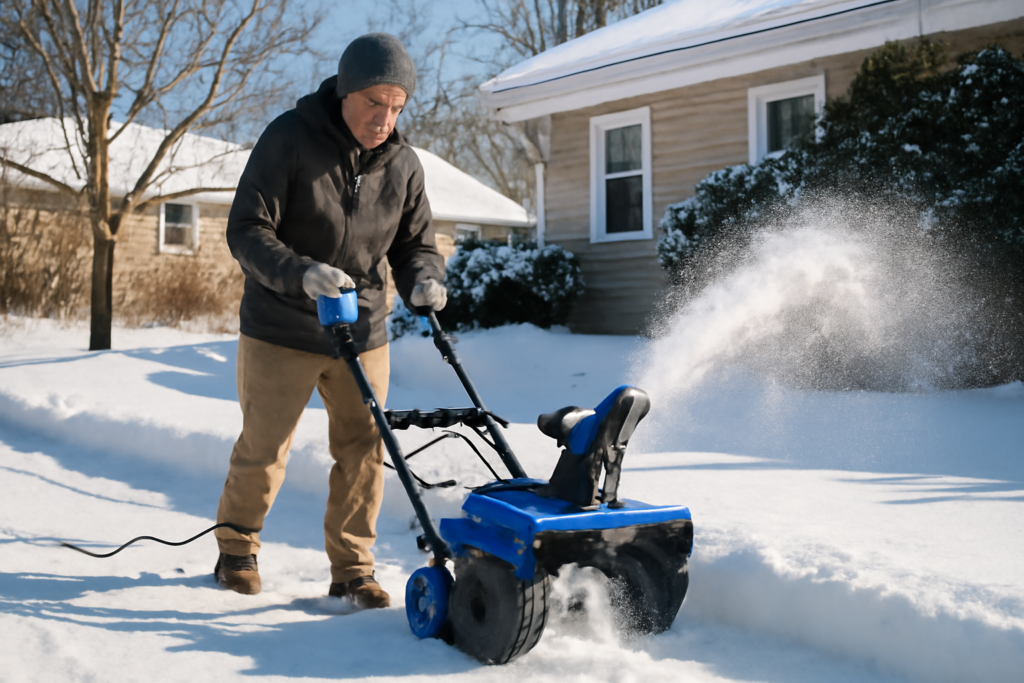
The morning after a storm, the difference between a 15-minute driveway clear and an hour of aching shovel work often comes down to one purchase. A Snow Joe electric snow blower has become the go-to for suburban homeowners who want gas-free snow clearing that starts with the push of a button, no pull cord, no oil, no gas cans in the garage. Snow Joe built its reputation on affordable, lightweight electric machines that punch above their price, and the lineup now spans corded models, 24V and 48V battery units, and larger two-stage blowers. This guide sorts through the options, clearing capacities, and pricing so you buy the right machine for your snowfall.
Why Go Electric for Snow
Gas snow blowers are powerful but demanding: they need fresh fuel, oil changes, spark plugs, and a reliable pull-start on a subzero morning. Electric machines strip all of that away. A Snow Joe fires up instantly, produces no fumes so it can run in an attached garage doorway, and weighs far less, making it easy for anyone to handle.
The trade-off is capacity. Electric single-stage blowers are built for the average suburban driveway and snowfalls up to roughly 12 to 18 inches, not the multi-foot dumps of the northern snow belt. For most homeowners in moderate snow country, that is exactly the right tool.
Corded vs. Cordless Models
Snow Joe splits its electric lineup into two power approaches, and choosing between them is the first decision.
Corded Electric
Corded models plug into a standard outlet through an outdoor-rated extension cord and never run out of power. They are the lightest and cheapest option, ideal for small driveways and walkways near an outlet. The obvious limits are cord reach, usually a practical 100 feet, and dragging the cord around obstacles.
Cordless Battery
Battery models on Snow Joe’s 24V iON+ and 48V platforms free you from the cord entirely. They deliver gas-free convenience with full mobility, and a second charged battery extends the clearing session. Runtime per charge typically covers a single to double driveway before a swap.
- Corded: unlimited runtime, lightest weight, lowest price, tethered to an outlet
- Cordless 24V: nimble and light, good for walkways and small drives
- Cordless 48V (dual battery): more power and runtime for full driveways
To put names to the tiers, Snow Joe’s corded lineup includes the popular SJ618E (18-inch, 13-amp motor) and the wider SJ627E (22-inch, 15-amp). On the cordless side, the 24V-SB18 single-battery model suits walkways, the 24V-X2-SB21 pairs two 24V packs for a full 48 volts of power and a 21-inch swath, and the 100V iONPRO series steps up to two-stage-style clearing. Matching the model number to your driveway size is more useful than fixating on the corded-versus-cordless label alone.
One overlooked corded factor is wire gauge on the extension cord. A long run of thin 16-gauge cord starves the motor of voltage and saps clearing power, especially in cold, which raises resistance. Use a 14-gauge cord for runs up to 50 feet and a heavy 12-gauge cord beyond that, and buy one rated for outdoor cold-weather use so the jacket stays flexible at low temperatures instead of turning stiff and cracking.
Clearing Capacity and Specs
Snow Joe rates each model by clearing width and intake height, the two numbers that determine how fast you finish. Popular single-stage models clear a swath around 18 to 22 inches wide and take a bite roughly 10 to 13 inches deep per pass, throwing snow up to 20 or 25 feet.
A common benchmark model clears in the range of hundreds of pounds of snow per minute, enough to handle a two-car driveway in one session. The steel or durable auger scrapes down to the pavement on a hard surface, though single-stage machines work best on paved drives rather than gravel.
The 24V cordless models typically ship with 4.0Ah or 5.0Ah batteries, and Snow Joe’s 24V 5.0Ah pack stores about 120 watt-hours. In practice a dual-battery 48V machine clears roughly 300 to 500 square feet of six-inch snow per full charge, or about a single two-car driveway, before you swap or recharge. A single 24V pack on a walkway blower runs closer to 30 to 40 minutes of intermittent use. Cold weather itself trims lithium capacity, so keeping spare packs warm indoors until the moment you head out noticeably improves real-world runtime.
Battery Care in Freezing Weather
Lithium batteries and deep cold do not mix well, which is the one real quirk of cordless snow clearing. Cells lose available capacity as temperatures drop, and charging a battery that is below freezing can permanently damage it. Store and charge the packs indoors at room temperature, and only bring them outside when you are ready to clear.
- Charge fully the night before an expected storm, then keep packs inside until you start
- Never charge a pack straight out of the cold; let it warm to room temperature first
- Swap to a warm spare when clearing power fades rather than forcing a cold, sagging pack
- After clearing, let the used pack warm and dry indoors before recharging
Treated this way, a set of two packs comfortably outlasts a typical storm and holds its capacity across many winters instead of degrading after a season or two of cold abuse.
Matching a Model to Your Snowfall
Buy for your typical storm, not the once-a-decade blizzard. Use these rough guidelines.
- Light snow, small drive (under 6 inches): a compact corded or 24V model clears it fast
- Moderate snow, two-car drive (6 to 12 inches): a mid-size corded or 48V single-stage machine
- Heavy, wet snow or long drives (12 to 18 inches): a larger 48V dual-battery or Snow Joe two-stage model
- Deep snow-belt totals (18 inches plus): step up to a gas two-stage; electric will struggle
Wet, heavy snow taxes any single-stage electric machine more than dry powder. If your region gets that dense coastal snow, size up rather than down.
What They Cost
Affordability is Snow Joe’s calling card. Compact corded models often sell for roughly $100 to $180. Mid-size 24V cordless units run around $150 to $300 with a battery and charger. Larger 48V dual-battery machines land in the $350 to $600 range, and Snow Joe’s bigger two-stage electric blowers reach $500 to $900.
Compare that to gas two-stage blowers that routinely cost $700 to $1,500 and demand yearly maintenance. For a homeowner with a standard driveway in moderate snow country, the electric route saves money up front and every season after.
Care and Storage
Electric snow blowers need almost no maintenance, but a few habits keep them reliable. After each use, clear packed snow from the auger and chute, and let the machine dry before storing to prevent rust. Never clear a clogged chute with your hand; use the clean-out tool with the machine off.
For battery models, store the packs indoors at room temperature at a partial charge over the off-season, since cold storage degrades lithium cells. Check the auger and scraper blade for wear each fall and replace them when they no longer reach the pavement.
Technique for Faster, Easier Clearing
A few habits make any single-stage electric blower clear faster and clog less. First, clear early and often; two passes on three inches of fresh snow is far easier than one pass on six inches of settled, heavier snow. If a big storm is falling, go out mid-storm and again at the end rather than waiting for it to pile up.
Second, aim the chute downwind and always throw the snow with the wind, not into it, or you will re-coat the driveway you just cleared. Overlap each pass by several inches so you are not leaving thin ribbons, and take narrower bites in wet, heavy snow to keep the auger from bogging. When you reach the end of the driveway, throw the snow well back rather than piling it at the curb where the plow will push it right back.
If the chute clogs, release the trigger, wait for the auger to stop completely, and clear it with the plastic clean-out tool, never your hand or foot. Applying a coat of spray-on silicone or a dedicated chute lubricant to the auger housing and chute before a wet-snow storm dramatically cuts sticking and clogging.
The Bottom Line
For the millions of homeowners outside the deepest snow belt, a Snow Joe electric snow blower delivers the core benefit, fast, effortless snow clearing, without the cost and hassle of gas. Choose corded for the lightest, cheapest option near an outlet, or go cordless 48V for full-driveway freedom. Match the clearing width and intake height to your typical storm, keep the batteries warm over summer, and you will trade the shovel for the button for many winters to come.