Choosing playground surfacing isn’t a design decision — it’s a safety decision regulated by ASTM F1292, the standard impact attenuation test for playground surfaces. Soft playground flooring has to meet a critical fall height matched to the equipment installed above it. Get the rating wrong and a fall from a 6-foot platform can become a head injury. Get it right and the same fall is just an embarrassed kid getting back up.
This guide explains the rating system, walks through the surface options, and gives realistic cost estimates for installs from backyard play sets to municipal parks.
- Understanding ASTM F1292 Fall Heights
- Poured-in-Place (PIP) Rubber
- EPDM Bonded Rubber Mulch
- Rubber Tiles and Mats
- Engineered Wood Fiber (EWF)
- Pea Gravel and Sand
- Synthetic Turf with Foam Pad
- Choosing the Right Surface
- Use Zones and Edge Containment
- Maintenance Realities
- Inspection and Compliance
- Frequently Asked Questions
Understanding ASTM F1292 Fall Heights
ASTM F1292 measures how well a surface absorbs impact. The test drops an instrumented headform from increasing heights onto the surface until it reads either a Head Injury Criteria (HIC) over 1000 or a peak g-force over 200. The maximum height where the surface stays under both thresholds is the “critical fall height.”
Equipment manufacturers list a “fall height” — the distance from the highest part the user can reach down to the surface. Your surfacing must be rated for that fall height or higher.
Common equipment fall heights:
- Toddler swings: 4-5 ft
- School-age swings: 6-8 ft
- Climbing structures: 5-10 ft
- Slides (entry platform height): 4-8 ft
Poured-in-Place (PIP) Rubber
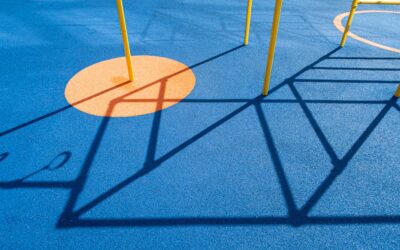
The premium playground surface. EPDM rubber granules are mixed on-site with a polyurethane binder and troweled over an SBR base layer. Cured surface is seamless, ADA-compliant, and rated for fall heights up to 12 feet depending on thickness.
Key Specs
- Total thickness: 2-5 inches; thicker pours equal higher fall ratings
- Top layer: 1/2-inch EPDM granules (the colored, UV-stable layer)
- Base layer: 1.5-4 inches SBR (recycled tire crumb) for shock absorption
- Surface options: Solid colors, multi-color graphics, custom logos and designs
Installed Cost
$15-25 per square foot for standard install; $20-35 for graphics or color blends. A 1,000 sq ft playground runs $15,000-35,000.
EPDM Bonded Rubber Mulch
EPDM granules bonded with polyurethane and applied like loose mulch — but locked in place. Cheaper than full PIP and easier to repair locally.
- Fall height: 4-10 feet depending on depth
- Thickness: 2-6 inches typical
- Installed cost: $8-15 per sq ft
- Lifespan: 10-15 years with annual top-off
Rubber Tiles and Mats
Modular interlocking tiles, 24×24 or 36×36 inches, in thicknesses from 1.5 to 4 inches. Field-replaceable, DIY-friendly for smaller playgrounds.
- Fall height: 1.5-inch tiles rated 4 ft; 2.5-inch rated 6 ft; 4-inch rated 10 ft
- Installed cost: $7-15 per sq ft
- Best for: Backyards, daycare centers, smaller commercial play areas
- Top brands: Greatmats, Rubber-Cal, PlayMore Design
Engineered Wood Fiber (EWF)
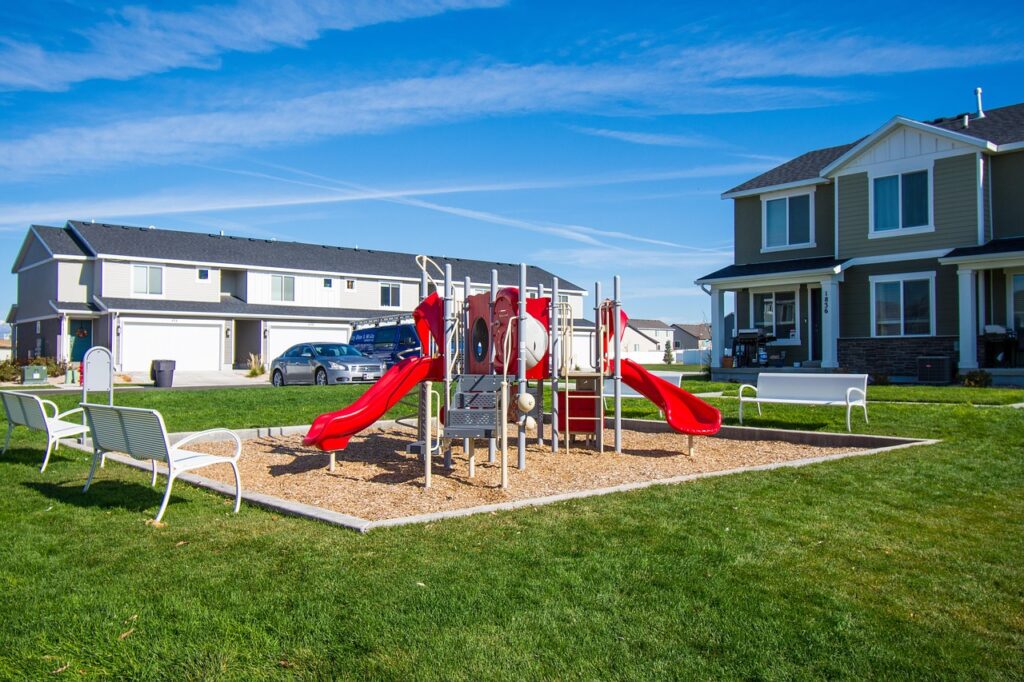
Specially-shaped wood chips engineered for ASTM compliance. Looks like fancy mulch but tested rigorously for impact attenuation. Common in municipal parks because it’s the lowest-cost option that hits compliance.
- Fall height: 7-12 feet at proper depth (typically 12 inches loose, 9 inches compacted)
- Installed cost: $1.50-3 per sq ft
- Maintenance: Frequent top-off needed; redistribute monthly under high-traffic areas
- ADA-compliant: Only when installed with proper sub-base and edge containment
- Brand to know: Fibar, Zeager Brothers Woodcarpet
Pea Gravel and Sand
Old-school playground surfaces still common in some parks. Pea gravel meets ASTM F1292 at 9-inch depth for falls up to 5 feet. Sand similar. Both fail ADA accessibility — wheelchairs sink — and both require constant raking.
Increasingly being phased out in favor of EWF or rubber surfaces.
Synthetic Turf with Foam Pad
Playground synthetic turf incorporates a foam impact pad rated for falls. Newer option, popular for daycares and schools wanting a “lawn” appearance without mowing or mud.
- Fall height: 6-10 feet depending on pad thickness
- Installed cost: $10-18 per sq ft
- Lifespan: 10-15 years with normal use
- Considerations: Heat retention in direct sun (can reach 140°F+), infill management
Choosing the Right Surface
Match the surface to context:
- Backyard with one swing set: Interlocking rubber tiles ($800-2,500) or EWF over a 12-foot perimeter use zone
- Daycare or preschool: PIP rubber for ADA compliance and easy cleaning of bodily fluids — required by some state regulations
- Municipal park: EWF for budget reasons; PIP for high-visibility flagship parks
- School playground: PIP rubber or synthetic turf with foam pad
- Pediatric medical or therapy facility: PIP rubber for hygiene and accessibility
Use Zones and Edge Containment
The fall protection zone extends at least 6 feet around stationary equipment and twice the chain length plus 6 feet in front and back of swings. Inside the use zone, the surface must meet the equipment’s fall height rating.
Loose surfaces (EWF, pea gravel, sand) require edge containment — landscape timbers, concrete curb, or proprietary edging like Fibar Border. Without containment, surfacing migrates outside the use zone within months.
Maintenance Realities
- PIP rubber: Pressure wash annually, reapply UV-protective topcoat every 5-7 years
- Rubber tiles: Replace damaged tiles individually; sweep monthly
- EWF: Top off twice yearly, redistribute monthly, inspect for foreign objects daily
- Synthetic turf: Brush infill quarterly, top off as needed, deodorize annually
Inspection and Compliance
Public playgrounds typically require certified playground safety inspector (CPSI) certification of new installs and annual inspections thereafter. The CPSI checks fall height ratings, surface depth, equipment-to-surface clearances, and ASTM F1487 compliance for equipment itself. Documentation matters for liability — keep test results and inspection reports on file.
Frequently Asked Questions
Is rubber mulch safe for playgrounds?
Loose rubber mulch made from recycled tires has been controversial because of trace heavy metals. EPDM rubber mulch (made from virgin EPDM, not recycled tires) is generally considered safer. Many schools have moved to PIP rubber for liability reasons.
How thick should playground rubber be?
Depends on fall height. For a 6-foot fall: 2-2.5 inches of PIP rubber, 4 inches of bonded EPDM, or 2.5-inch interlocking tiles all hit ASTM F1292 compliance.
What’s the cheapest soft playground flooring?
Engineered wood fiber at $1.50-3 per sq ft installed. Lowest cost but highest maintenance — requires regular top-off and redistribution.
Does playground rubber get hot in the sun?
Black rubber surfaces can reach 140-160°F in direct summer sun. Light-colored EPDM granules or shade structures over the play area mitigate the issue significantly.
Prefer to explore on your own?
See how new flooring looks in your actual room in seconds — free, no signup.
Try the free Floor Studio →