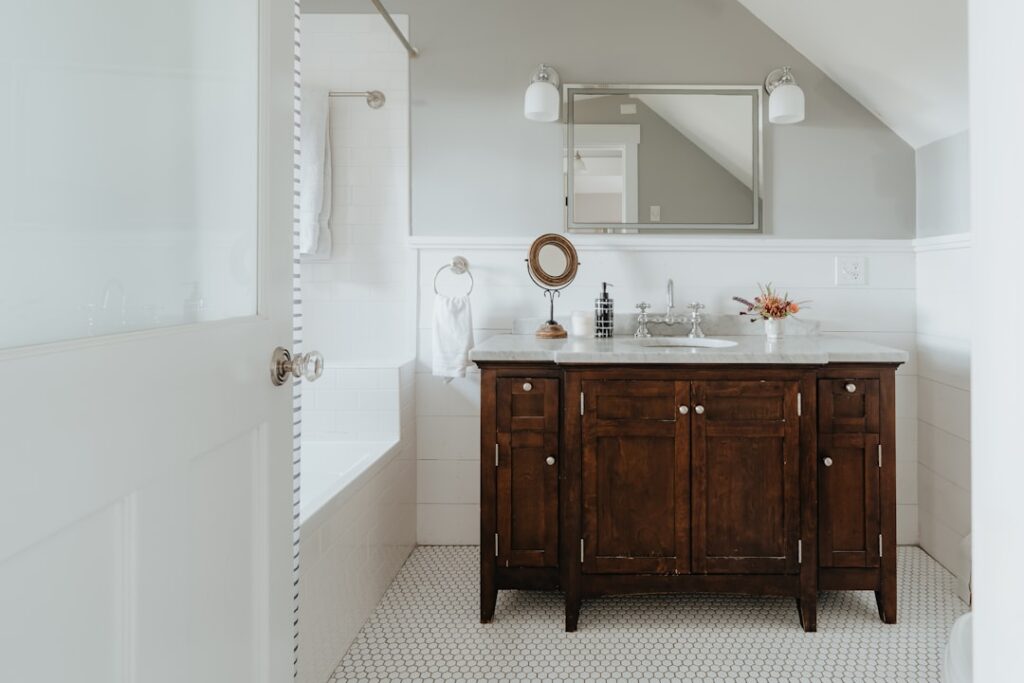
The phrase gets thrown around loosely, so let us be precise from the start: a true solid wood bathroom vanity is built from actual hardwood boards, not particleboard wrapped in a wood-look laminate or thermofoil. That distinction determines how long the piece lasts in the most humid room of your house, how it handles a leaking supply line, and whether it is worth two or three times the price of a big-box cabinet. I have pulled out swollen, delaminated particleboard vanities that failed in five years and refinished solid oak vanities that were still rock solid after thirty. The material is the whole story.
Solid wood earns its premium in durability and repairability, but it demands respect. Wood moves with humidity and rots if water sits on unsealed surfaces. Understand both sides before you spend the money.
What Counts as Solid Wood
Manufacturers muddy the water, so read the spec sheet. A genuine solid wood vanity uses hardwood lumber, oak, maple, birch, walnut, teak, or hickory, for the frame, doors, and drawer fronts. Better constructions pair a solid hardwood face frame and doors with a high-grade plywood box, which is actually ideal because plywood resists moisture-driven warping better than wide solid panels do.
Watch for the impostors. Particleboard and medium-density fiberboard, MDF, are engineered from wood fibers and glue; they are smooth and cheap but swell permanently the moment water penetrates the finish. Thermofoil is a vinyl skin heat-pressed over MDF that peels near heat and moisture. Neither belongs in a wet bathroom if you want longevity. A quick test at the store: knock on a door and lift a drawer. Solid wood sounds dense and weighs noticeably more than engineered panels.
The Advantages Worth Paying For
Solid wood buys you three things engineered panels cannot. First, durability: a hardwood vanity shrugs off daily bumps, and if a supply line drips, sealed wood tolerates brief moisture that would destroy particleboard. Second, repairability: you can sand out a scratch, fill a dent, and refinish the whole piece in a weekend, which means one vanity can outlast several design trends.
Third, resale and feel. A solid wood vanity reads as quality to buyers and feels substantial in use, drawers that do not flex, doors that stay square, a top rail you can lean on. Over a 20-to-30-year lifespan, the higher upfront cost often works out cheaper per year than replacing a $300 cabinet every 6 to 8 years. That math is why I steer clients renovating a primary bath toward solid wood even when the budget is tight.
The Drawbacks to Weigh Honestly
Solid wood is not maintenance-free, and pretending otherwise sets you up for disappointment. Wood expands and contracts with humidity swings, so panels can develop hairline gaps at joints in dry winters and tighten in humid summers. This is normal movement, not a defect, but it means a solid-panel door may show seasonal seams a laminate door never would.
The bigger risk is water. Unsealed or poorly sealed wood, especially end grain and the underside near the sink, will absorb moisture, swell, and eventually rot or grow mildew. Solid wood also costs two to four times more than engineered alternatives and weighs enough that a large double vanity is a two-person install. If your bathroom has poor ventilation or you are not willing to reseal periodically, a moisture-resistant plywood or a quality thermofoil may serve you better.
Sizes and What They Cost
Standard vanity dimensions make shopping predictable. Common widths are 24, 30, 36, 48, 60, and 72 inches, with 60 and 72 inches typical for double sinks. Standard depth is 21 inches, and height runs 32 to 36 inches; the taller 36-inch comfort height matches kitchen counters and suits most adults, while 32 inches suits kids’ baths.
- 24-to-30-inch solid wood single vanity: roughly $400 to $900.
- 36-to-48-inch single vanity: roughly $700 to $1,800.
- 60-to-72-inch solid wood double vanity: roughly $1,500 to $4,000 and up.
Prices swing with the species and top. Oak and birch sit at the affordable end; walnut and teak command a premium. Add $200 to $1,200 for the countertop, since most solid wood vanities ship as a base and you choose quartz, granite, marble, or a cultured-marble top separately.
Sealing and Protecting the Wood
A solid wood vanity survives the bathroom only if it is sealed correctly and kept that way. Factory finishes vary, so before installation I seal all six sides of any raw or lightly finished wood, paying special attention to the top edge under the counter, the back, and the bottom, the surfaces water reaches first.
Use a marine-grade or water-resistant polyurethane, or a penetrating tung oil finish for a natural look you can refresh easily. Apply two to three coats, sanding lightly between them, and reseal high-contact areas every one to three years. Run a bead of clear silicone caulk where the countertop meets the backsplash and where the sink meets the counter so water cannot wick into the wood from above. Add rubber bumpers under any toiletry bottles and wipe standing water off the top promptly.
Solid Wood Versus Engineered Alternatives
To decide whether solid wood is worth it for your bathroom, put it side by side with the alternatives it competes against. Plywood-box construction, often with a solid hardwood face, is arguably the smartest all-around choice for a bathroom because plywood resists moisture-driven warping better than a wide solid panel while still giving you a real-wood face and drawer fronts. Many high-end vanities are built exactly this way.
Particleboard and MDF sit at the bottom for durability; they are smooth and cheap but swell permanently the first time water penetrates the finish, which is why the cabinet floor under the sink is the usual failure point. Thermofoil, a vinyl skin over MDF, looks clean but peels near heat and steam. If your budget is tight, a plywood-box vanity with a hardwood face outperforms a solid-panel piece made of a cheaper species, so do not assume solid always beats engineered, judge the specific construction and where the wood actually is.
Best Countertops to Pair With Solid Wood
A solid wood base usually ships without a top, which lets you choose a surface that both protects the wood and suits your style. Quartz is the most practical partner: nonporous, stain-resistant, and it never needs sealing, so it shrugs off the water and cosmetics a bathroom throws at it. Granite is nearly as durable and adds natural variation, though it wants resealing every year or two.
Marble looks luxurious but etches from acidic products like certain cleaners and cosmetics, so it demands more care in a bathroom. Cultured marble and solid-surface tops are budget-friendly, seamless, and easy to clean, a sensible match for a mid-range solid wood base. Whatever you pick, the critical detail is the same: seal the joint where the top meets the wood with clear silicone so water cannot wick down into the cabinet, because the finest countertop in the world will not save a wood vanity from a leak it channels straight into the box.
Everyday Care That Extends Its Life
Living with solid wood is easy once the habits stick. Wipe spills and splashes immediately rather than letting water pool. Clean with a barely damp cloth and a mild pH-neutral soap, never a soaking wet rag or harsh ammonia and bleach cleaners that strip the finish and dry the wood.
Control humidity, the real enemy. Run the bathroom exhaust fan during and for 20 minutes after every shower, and crack a window when you can. Check under the sink twice a year for slow supply-line or drain leaks that quietly rot the cabinet floor. Refinish before the surface finish wears through, not after, so water never touches bare wood. Treated this way, a quality solid wood bathroom vanity is a genuine 20-to-30-year fixture, the kind of piece you refinish for a new look instead of hauling to the curb.