Clean water sitting on carpet for more than 48 hours becomes dirty water. After 72, the carpet pad below is almost always a mold farm whether you can see it or not. Spilled water on carpet is one of those problems where the response speed matters more than the technique. I have pulled up enough rotten pads from delayed cleanups to know the difference between a $40 fan rental and a $2,400 restoration bill comes down to what you do in the first six hours.
- Immediate Steps in the First Hour
- Wet Vacs Beat Towels for Larger Spills
- Airflow and Dehumidification
- When You Need to Pull the Carpet Back
- Disinfecting Clean Water Spills
- Dirty Water and Sewage Backups Are Different
- Step-by-Step Drying Process
- Tools and Cost Breakdown
- When to Replace Instead of Save
Immediate Steps in the First Hour
Move everything off the wet area, especially anything with metal feet that will rust-stain the carpet. Lift the carpet edge if you can to check the pad. If water has reached the pad, you are dealing with a much bigger drying job than just blotting the surface fibers.
Press down with thick white bath towels or microfiber cloths to absorb standing water. Skip colored towels because dye can transfer into wet carpet. Walk on the towels with shoes off to drive your weight into the absorption. Switch towels every two minutes until they come up only slightly damp.
Wet Vacs Beat Towels for Larger Spills
For any spill larger than 12 inches across, rent a wet/dry vacuum. The Shop-Vac 5-gallon model at Home Depot rents for $32 a day or sells for $109. Run the vacuum head slowly across the carpet in overlapping passes. A good vac will pull 80 to 90 percent of the surface water and a meaningful chunk from the pad below.
For carpets installed over a slab, water tends to spread sideways under the carpet. Vacuum a wider area than the visible wet patch, usually 18 to 24 inches beyond the obvious stain. The hidden water is what causes mold three weeks later.
Airflow and Dehumidification
After extraction, set up airflow immediately. Two box fans pointed across the wet area at a 45-degree angle move enough air to dry surface fibers in 8 to 14 hours. A high-velocity air mover like the B-Air Vento 1 ($179 from Amazon) cuts drying time to 4 to 6 hours by pushing 1,500 CFM across the carpet.
Run a dehumidifier in the same room set to 40 percent relative humidity. The Frigidaire 50-pint at Home Depot for $279 pulls enough water from the air to prevent the moisture from migrating into baseboards and drywall. Empty the tank every 8 hours or run a continuous drain hose.
When You Need to Pull the Carpet Back
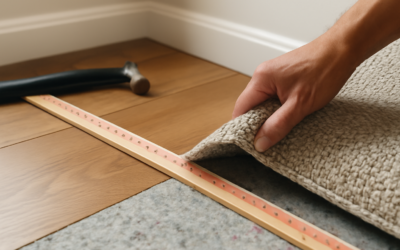
If the pad squelches when you press on it, or you can see water beading on the surface after vacuuming, pull the carpet back from the nearest wall. Use needle-nose pliers to grip the carpet edge and pull up off the tack strip. Fold the carpet back over a dry section of floor.
Inspect the pad. Standard 6-pound rebond pad absorbs 4 to 5 times its weight in water. If it is saturated, the pad is finished. Cut it out with a utility knife, dry the subfloor with fans for 24 hours, and replace the pad section with a piece of the same density. New pad runs $0.50 to $1.20 per square foot at Lowe’s.
Disinfecting Clean Water Spills
Even clean tap water grows bacteria in carpet within 24 hours. Once the carpet is dry to the touch, apply an antimicrobial treatment to prevent mildew. OdoBan at $11.99 per gallon dilutes 5 ounces per gallon of water and sprays on with a pump sprayer.
For natural fiber carpets like wool, skip OdoBan and use Bona Pet System Stain & Odor Eliminator instead. Wool reacts poorly to strong disinfectants and the dye can shift on light-colored carpets. Test in a closet corner first if you are unsure.
Dirty Water and Sewage Backups Are Different
Water from a toilet overflow, dishwasher backup, or any source that touched waste lines is Category 3 water under the IICRC S500 standard. Carpet and pad both need to be removed and discarded. No amount of cleaning makes Category 3 carpet safe to keep, especially in a house with kids or pets.
Call a restoration company like ServPro or Rainbow Restoration for sewage events. Average cost is $7 to $14 per square foot, often covered by homeowners insurance under sudden discharge clauses. Document the source with photos before any cleanup begins.
Step-by-Step Drying Process
- Extract surface water with towels or wet vac (first 30 minutes)
- Pull back carpet to inspect pad (first hour for medium or larger spills)
- Run air movers and dehumidifier for 24 to 48 hours
- Replace pad if saturated, dry subfloor minimum 24 hours
- Apply antimicrobial spray once dry
- Re-stretch carpet with a knee kicker or rent a power stretcher
- Run a moisture meter check at 7 and 14 days to confirm no residual moisture
Tools and Cost Breakdown
For a typical 6-by-8 foot spill, expect to spend $80 to $250 in supplies and rentals if you DIY. Towels and rags ($25), wet vac rental ($32), air mover rental ($45), pad replacement ($60), antimicrobial spray ($12), and knee kicker rental ($26). Total time investment is 6 to 10 hours spread over two days.
For comparison, calling a professional water mitigation service for the same spill runs $400 to $900 in most markets. Worth the money for ceilings dripping water or spills larger than 100 square feet. DIY is the right call for laundry hose bursts under 80 square feet caught within four hours.
When to Replace Instead of Save
Carpet older than 10 years rarely justifies the labor cost of drying and re-stretching. If your carpet is past its replacement window already, use a water event as the trigger to upgrade to something more water-friendly. Mohawk SmartStrand or Shaw LifeGuard carpets have waterproof backing systems specifically for this scenario, starting around $3.50 per square foot installed.
Hardwood or LVP also makes sense in rooms where spills are likely. Karndean and COREtec luxury vinyl plank handles flooding without permanent damage as long as the subfloor stays dry. Expect $4 to $8 per square foot for material on a midrange product.