The wall beside a staircase is often the tallest, emptiest surface in a house, and it is seen every single day. Yet most people either leave it bare or hang a random cluster of frames that drift out of alignment as the stairs climb. The best staircase wall decor ideas modern homes use share one principle: they treat the stair wall as a single composition that follows the diagonal of the steps. Get that angle right, keep the palette restrained, and a plain stairwell becomes an intentional design feature.
Part of our Stairs & Stair Flooring guide — explore the full guide →
- Staircase Wall Decor Ideas Modern Designers Start With
- Gallery Walls With a Modern Edge
- Oversized Statement Art
- Architectural Wall Treatments
- Lighting as Decor
- Mirrors, Shelving, and Paint Tricks
- Coordinating Decor With Stair Flooring
- Budget Guide for a Stair Wall Makeover
- Hanging Tips for a Clean Result
Staircase Wall Decor Ideas Modern Designers Start With
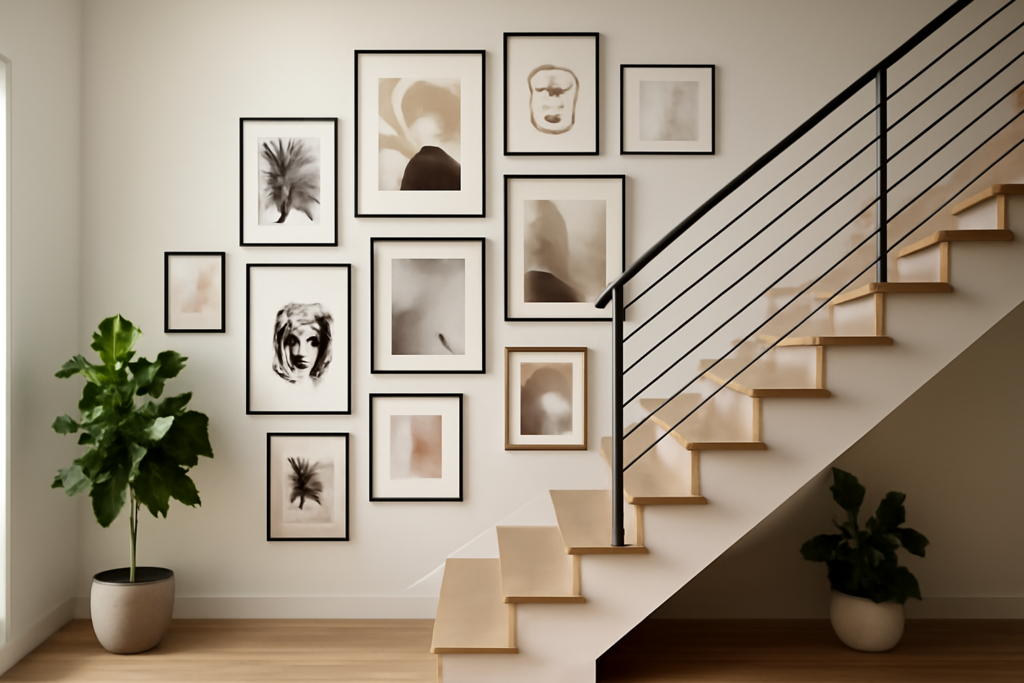
Before choosing art or materials, study the geometry. A typical stair climbs about 7-1/2 inches for every 10 to 11 inches of run, which creates a slope near 35 degrees. Anything you hang should respect that line. Designers usually set an imaginary center line 57 to 60 inches above each tread nosing, then place pieces so their centers track that diagonal. This keeps artwork at eye level for someone walking up or down rather than floating too high near the top or dropping too low near the bottom.
Also think about viewing angles. People see a stair wall from the landing, from the foyer, and while moving. Large, simple pieces work better than detailed small ones because nobody stops mid-step to study a 5×7 print. Modern design favors fewer, bigger elements with plenty of negative space between them.
Gallery Walls With a Modern Edge
A gallery wall remains the most popular choice, but the modern version is far more disciplined than the family-photo collage of the past.
The Stepped Grid
Use identical frames, such as 16×20 thin black metal frames with wide white mats, hung in a strict grid that steps up with the stairs. Keep spacing consistent at 2 to 3 inches between frames. Black-and-white photography or monochrome prints unify the look even if subjects vary. Expect about $25 to $60 per frame for good-quality metal or matte wood options.
The Single-Row Diagonal
For narrow stairwells, a single row of five to seven frames following the rake of the stairs looks clean and avoids crowding. Pick one orientation, all portrait or all landscape, for a calm rhythm.
Picture Ledges
Two or three stepped picture ledges, each 36 to 48 inches long, let you rotate art without new nail holes. Lean frames in overlapping layers for a relaxed editorial look. Ledges run $30 to $90 each and should be screwed into studs because stair walls take bumps from laundry baskets and moving furniture.
Oversized Statement Art
On a two-story stairwell or a tall landing wall, one large piece often beats a dozen small ones. A 48×72 canvas, a large abstract painting, or a textile hanging can anchor the entire space. Center the piece on the landing wall or on the section of wall visible from the foyer, since that is where most guests will first see it.
Weight matters with big art. A framed 40×60 piece can easily weigh 25 to 40 pounds. Use a French cleat or heavy-duty D-rings screwed into studs, and check that the piece does not project into the stair path. Code-compliant handrails need 1-1/2 inches of clearance from the wall, and art or frames placed near the rail should not reduce that grip space.
Architectural Wall Treatments
Modern stair walls increasingly skip art altogether and let the wall surface itself become the decor.
- Vertical wood slat walls: 1×2 or 1×3 oak or walnut slats spaced 1/2 to 1 inch apart over a black backing create warmth and texture. Prefinished acoustic slat panels cost $80 to $200 per 2×8-foot panel.
- Geometric trim molding: thin 1×3 or flat MDF strips arranged in angled boxes that echo the stair rake, painted the same color as the wall for a sculptural, tone-on-tone effect. Materials run about $3 to $6 per sq ft.
- Limewash or plaster finishes: a hand-troweled Venetian plaster or limewash adds movement and depth that photographs beautifully under natural light. Professional application costs $6 to $15 per sq ft.
- Large-format wallcovering: a single oversized mural or grasscloth in a muted tone works on stair walls that are too tall for framed art.
Slat and trim treatments must stop at the handrail brackets or be notched around them, so plan layout with the rail installed or clearly marked. A painted flat trim that follows the stair stringer line, sometimes called a skirt accent, is an inexpensive way to tie a wall treatment to the stairs themselves.
Lighting as Decor
Lighting is where modern stairwells separate themselves from ordinary ones. A few well-placed fixtures can make the wall the focal point after dark.
- Recessed step lights: small LED fixtures set 12 to 16 inches above the tread, one every two or three steps, wash light across the treads and improve safety. Installed cost runs $150 to $300 per light.
- Picture lights: slim LED picture lights over statement art add gallery drama, with plug-in and hardwired options from $40 to $250.
- Sculptural sconces: globe, linear, or cylinder sconces placed on the landing wall double as art. Keep them at least 80 inches above the treads or clear of the walking path.
- Linear LED channels: a continuous aluminum channel running parallel to the stair rake creates a floating light line and looks striking with a wood slat wall.
Choose 2700K to 3000K color temperature for warm, residential light that flatters wood and art. Any new hardwired fixture should be installed by a licensed electrician, especially when adding circuits in a finished stairwell.
Mirrors, Shelving, and Paint Tricks
Mirrors bounce light into dim stairwells and make narrow ones feel wider. A set of three round mirrors, 24 to 30 inches in diameter, stepped along the diagonal is a clean modern arrangement. On a landing, a tall arched floor mirror leaned against the wall and secured with an anti-tip strap adds height.
Floating shelves work on wide landings where they will not be bumped. Keep objects minimal: a single ceramic vase, a few books, or a trailing plant. Avoid shelves along the stair run itself, since anything that falls lands on the steps.
Paint may be the most affordable decor of all. Try these modern approaches:
- Two-tone diagonal: paint the lower portion of the wall a deeper shade, with the dividing line running parallel to the stair stringer about 36 inches above the treads.
- Color-drenching: paint walls, trim, stringers, and even the handrail the same deep color, such as charcoal, olive, or navy, for a moody, enveloping look.
- Matte black accent: a black stair wall behind white oak treads and a black iron railing creates a crisp gallery backdrop.
Use a scrubbable eggshell or satin finish on stair walls. Hands, bags, and pets rub against these surfaces constantly, and flat paint shows scuffs within weeks.
Coordinating Decor With Stair Flooring
Wall decor looks best when it relates to the stairs themselves. If your treads are natural white oak, repeat that tone in frames, slats, or a ledge. Dark walnut or ebony-stained treads pair well with brass picture lights and warm white walls. For carpeted stairs or a patterned runner, keep the wall calmer, with solid color or a restrained grid, so the two surfaces do not compete.
Consider contrast carefully on stairs. A strong visual edge between tread and riser helps people see each step, and busy wall patterns right at step level can make that edge harder to read. Keep the loudest decor above waist height and let the lower wall stay quieter.
Budget Guide for a Stair Wall Makeover
A modern stair wall does not require a large budget. A paint-only refresh with a two-tone diagonal runs about $80 to $200 in materials for an average 12- to 14-step stairwell. A stepped gallery grid of eight to ten metal frames with printed photography typically costs $300 to $700. Architectural treatments sit higher: a DIY geometric trim wall is often $250 to $600 in lumber and paint, while a professionally installed wood slat wall or plaster finish can reach $1,500 to $4,000 depending on height. Add lighting last, since step lights or a sconce pair can be phased in once the wall design is settled.
Hanging Tips for a Clean Result
- Mock it up: cut kraft paper templates for each frame and tape them to the wall for a few days before drilling.
- Use a laser level: a cross-line laser tilted to the stair angle makes it easy to keep frame centers on a consistent diagonal.
- Work from the middle: hang the center piece first at 57 to 60 inches above its tread, then build outward.
- Secure everything: use anti-slip bumpers on frame corners and security hangers so pieces stay straight despite vibration from foot traffic.
- Stay safe on the ladder: use a stair-specific ladder or adjustable multi-position ladder rather than balancing a stepladder on treads.
Whether you choose a disciplined gallery grid, a sculptural slat wall, or a single oversized canvas washed in warm light, the goal is the same: make the stair wall feel deliberate. Pick one bold idea, commit to it, and give it room to breathe.