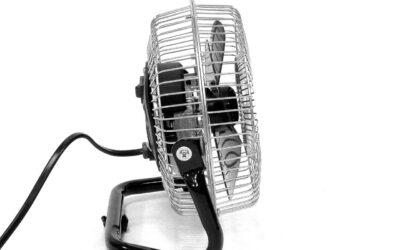
Cheap plastic pedestal fans rattle, wobble, and crack their oscillation gears within two summers. A quality standing metal fan uses cast iron or steel base weights, all-metal blade assemblies, and industrial-grade motors that run for a decade or more. They also move significantly more air per watt than plastic models, which matters when you are cooling a 400 square foot bonus room or a workshop where ceiling fans are not an option. This guide covers what separates a true metal fan from a metal-look plastic fan, how to read the spec sheets, and which models stand up to daily use.
What “Metal” Actually Means on a Fan
Manufacturers freely use the word “metal” when only the grille is steel and everything else is ABS plastic. A genuine metal standing fan has at least four metal components: blade hub and blades, motor housing, telescoping pole, and base. The grille, knobs, and oscillation cap are usually steel even on plastic-bodied fans, so checking those alone is misleading.
Lift the fan if possible. A 16-inch all-metal pedestal fan weighs 12-18 pounds. A plastic fan with a metal grille weighs 6-9 pounds. The weight difference comes from the cast aluminum or steel base, which is also why metal fans do not tip over in normal household use. Models from Vornado, Hunter Original, and Lasko’s Cyclone Pro series fit this description and are worth the $80-180 price.
Airflow and Noise: The CFM-to-dB Ratio
Cubic feet per minute (CFM) measures how much air a fan moves. A standard 16-inch metal pedestal fan moves 2,200-3,200 CFM on high. The 20-inch industrial models push 4,500-5,800 CFM. By comparison, a typical ceiling fan moves 4,000-7,000 CFM but only at the floor 8 feet below, while a pedestal fan delivers air directly at body height.
Noise matters when the fan runs near a bedroom or office. Look for these benchmarks:
- Bedroom use: 45-55 dB on low, 60-65 dB on high
- Living room or kitchen: 55-65 dB tolerable
- Workshop or garage: 65-75 dB acceptable, hearing protection above 80
Hunter Original Pedestal Fans hit 48 dB on low and 62 dB on high, which is among the quietest in the metal category. Cheaper Lasko stamped-steel models run 55 dB on low. Industrial brands like Patton and B-Air push 75+ dB on high, ideal for moving large volumes of air but not for sleeping spaces.
Height Adjustment and Tilt Range
A telescoping pole between 38 and 54 inches tall covers the most use cases. At 38 inches, the fan blows over couches and tables for general room circulation. At 54 inches, the fan reaches upper torso level when standing, ideal for kitchen prep work and workshop benches.
Tilt range is often overlooked. A head that tilts only 30 degrees forces you to either point the fan straight ahead or risk having it slip. Premium models from Vornado and Hunter tilt 90 degrees, letting you direct air toward the ceiling for whole-room circulation. Combined with full 90-degree side oscillation, the fan covers more square footage than a fixed-orientation unit.
Best Picks Across Price Tiers
Each of these fans has a metal blade assembly, metal pole, and cast or weighted base:
- Vornado 683DC Whole Room Air Circulator: $180, DC motor, 2,200 CFM, 99-speed dial, 12-year warranty
- Hunter Original 18-inch Retro Pedestal: $165, vintage aluminum housing, 3-speed, 90-degree oscillation
- Lasko Cyclone Pro Performance 18-inch: $90, stamped steel grille and base, brass motor bearings
- Honeywell Double Blade 16-inch Stand Fan: $70, dual blade system, metal grille, plastic body (entry tier)
- Patton High Velocity 18-inch Air Circulator: $80, all-metal industrial design, 5,500 CFM
- B-Air FIRTANA-20X 20-inch Industrial: $75, fully metal, 4,650 CFM, ETL-listed for commercial use
The Vornado 683DC is the value pick for whole-home use because the DC motor draws 38 watts on high compared to 75-90 watts for AC motor competitors. Over a hot summer running 14 hours a day, that saves around $25 in electricity at the national average rate.
Oscillation Mechanisms: The Failure Point
The oscillation gear is where most pedestal fans die. Plastic gears strip at the teeth after 1,500-2,000 hours of use. Metal worm gears in higher-end fans last 8,000-12,000 hours. Hunter and Vornado both use sealed metal gear assemblies that survive a full decade of daily use. Lasko Cyclone Pro uses a hybrid design with metal gears and a plastic clutch that absorbs impact when the head bumps an obstruction.
If a fan’s oscillation makes a clicking sound, the gear is already chipped. Stop oscillating immediately and check whether the manufacturer sells replacement gear assemblies. Hunter Original parts run $15-30 and ship from authorized dealers. Most $40 plastic pedestal fans have no replacement parts at all, which is why a metal fan with documented parts availability is a better long-term purchase.
Remote Controls, Timers, and Smart Features
Mid-range and premium metal fans now include remote controls, 8-hour timers, and increasingly Wi-Fi connectivity. The Vornado 683DC pairs with a magnetic remote that sticks to the grille for storage. Hunter offers a Bluetooth-enabled model that integrates with Hunter SIMPLEconnect for scheduling.
True smart fans with Alexa and Google Home support are still rare in the all-metal pedestal category. The Dreo Polyfan and Levoit Classic models offer voice control and app scheduling but use plastic bodies. For now, the trade-off remains between vintage metal construction with simple controls and modern plastic with smart features. Most homeowners choose the metal construction, since voice control on a fan saves only seconds per use.
Maintenance That Doubles the Lifespan
A standing metal fan needs annual cleaning to stay efficient. Dust builds up on the blade leading edges and reduces CFM by 10-20 percent over a season. Disassemble the front grille (usually two clips and a center screw), wipe blades with a damp microfiber cloth, and vacuum the motor housing intake with a brush attachment.
Lubricate the oscillation gear with a single drop of 3-in-1 oil at the gear shaft access port every 12-18 months on Hunter and Vornado models. Skip WD-40, which is a solvent and a degreaser, not a lubricant. A well-maintained metal pedestal fan runs 15-25 years, easily five times the lifespan of a comparable plastic unit, which justifies the higher upfront cost over its full life cycle.