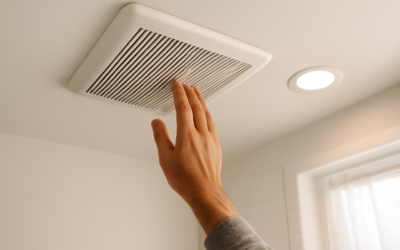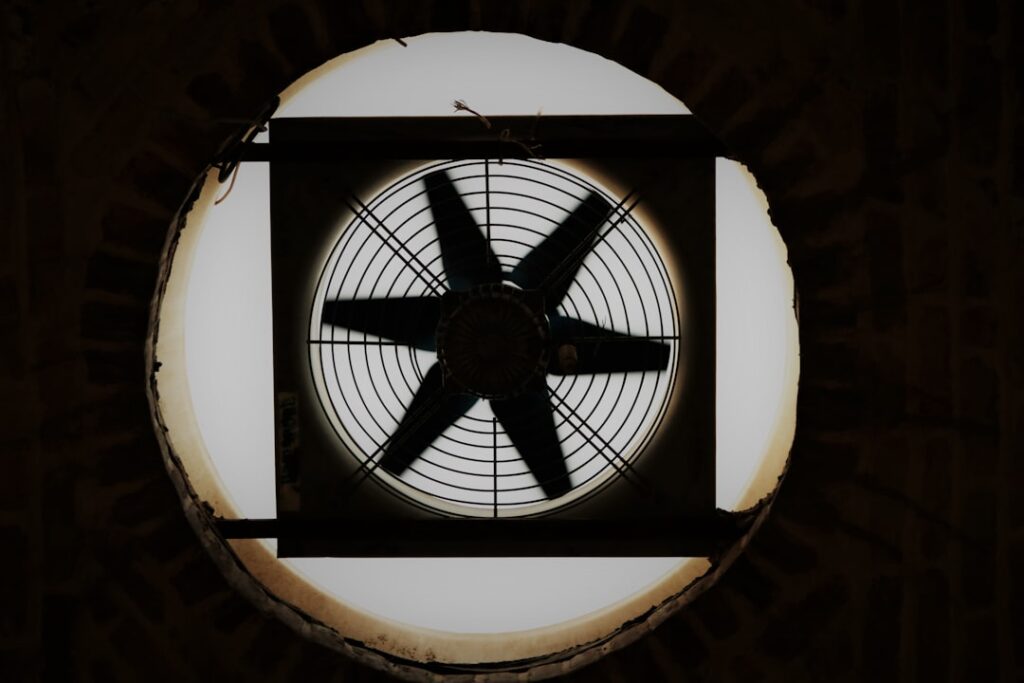
If your mirror stays fogged for ten minutes after a shower, or you can smell last night’s guest three rooms away, your ventilation is losing the fight. A strong bathroom exhaust fan is the single cheapest defense against the mold, peeling paint, and rotting trim that chronic moisture causes, yet it is the fixture homeowners think about least until something goes visibly wrong. Replacing an undersized, wheezing builder-grade fan almost always transforms how a bathroom feels and smells. This guide covers how to size a fan properly, how to keep it quiet, and which features actually earn their price so you can pick one that clears the air in minutes rather than struggling for half an hour.
Part of our Bathroom Remodeling & Flooring guide — explore the full guide →
What Makes a Fan Actually Strong
Strength in an exhaust fan comes down to airflow, measured in cubic feet per minute, or CFM. That number tells you how much moist air the unit can physically pull out of the room and push through the duct to the outdoors. A weak builder fan might move 50 CFM on paper but far less in practice once it fights a long duct run. A genuinely strong fan moves 80 to 150 CFM and does it against real-world resistance. The other half of the equation is static pressure performance, which describes how well the fan maintains that airflow when it meets bends, screens, and long duct lengths. Two fans rated at the same CFM can perform very differently once installed, which is why the quality of the motor matters as much as the headline number.
Sizing by Square Footage
The baseline rule is simple and worth committing to memory: you want at least 1 CFM of exhaust for every square foot of bathroom floor space. Measure the length and width of the room, multiply them, and that product is your minimum CFM. A modest 7-by-9-foot bathroom comes to 63 square feet, so a 70 CFM fan is the floor and an 80 CFM unit gives you comfortable headroom. A larger 10-by-12-foot master bath works out to 120 square feet and genuinely needs a 120 to 150 CFM fan to keep up with a hot shower. Rounding up is always the safer choice, because a fan running a touch above its minimum still clears the room quickly and does not have to strain.
Ceiling height throws a wrench into the basic formula. The square-footage rule assumes a standard 8-foot ceiling. If your bathroom has a 9 or 10-foot ceiling, you are moving more cubic feet of air, so multiply your CFM figure by the ratio of your actual height to 8 feet. A bathroom with a vaulted or cathedral ceiling holds a surprising volume of humid air, and skimping on fan capacity there is a recipe for lingering fog and eventual mold in the highest, least-ventilated corners.
Adding CFM for Fixtures
For larger and more elaborate bathrooms, plumbing professionals often use a fixture-based method instead of raw square footage. Under this approach you add 50 CFM for each toilet, shower, and standard bathtub, and 100 CFM for a jetted tub, then total them up. A bathroom with a toilet, a shower, and a soaking tub would call for roughly 150 CFM under this counting system. When the fixture method and the square-footage method disagree, size to the larger of the two results. This is especially important in a spa-style bathroom where a steamy shower and a hot tub can each dump enormous amounts of vapor into the air, sometimes at the same time.
Noise: Understanding Sone Ratings
A fan you never turn on because it roars like a jet engine protects nothing. Noise is measured in sones, and lower is quieter. A rating of 4.0 sones is the loud, buzzy old fan you are probably trying to escape. Anything at or below 1.0 sone is genuinely quiet, closer to a soft refrigerator hum, and premium models reach 0.3 sones, so quiet you have to check the room to confirm they are running. Here is the counterintuitive part: the quietest fans are often the strongest, because manufacturers achieve low noise by using a larger, slower-spinning blower wheel and a better-balanced motor rather than a small blade screaming at high rpm. Do not assume a whisper-quiet fan is weak. Read the CFM and the sone rating together.
Ducting: The Detail That Makes or Breaks Performance
The best fan on the market will underperform badly if the duct behind it is wrong, and this is where most weak installations fail. Duct diameter should match the fan’s rated port, generally 4 inches for fans up to about 90 CFM and 6 inches for higher-capacity units. Undersizing the duct chokes airflow no matter how strong the motor. Use rigid metal duct or smooth-wall flex wherever you can, because the accordion-ribbed cheap flexible duct creates enormous turbulence that can cut real-world airflow by a third or more.
Keep the run as short and straight as possible, ideally under 8 feet with no more than one or two gentle bends, and always vent to the outdoors through a wall cap or roof cap, never into the attic. Dumping humid air into an attic simply relocates your mold problem to the framing and insulation where you cannot see it until the damage is severe. Insulate any duct that passes through unconditioned space so warm bathroom air does not condense inside the pipe and drip back down onto the fan.
Features Worth Paying For
Beyond raw airflow, a few features genuinely improve daily life. A built-in humidity sensor is the standout upgrade. It switches the fan on automatically when moisture spikes and runs it until the air dries out, which means the fan works even when guests forget to flip the switch. That single feature prevents more moisture damage than any other. Integrated LED lighting is common and convenient, and combination units that pair a fan with a light and a nightlight consolidate several ceiling penetrations into one. A quality backdraft damper keeps cold outdoor air and insects from drifting back in when the fan is off, and models with a delayed-off timer keep pulling air for several minutes after you leave, finishing the job of drying the room.
Installation Tips That Preserve Airflow
Even a perfectly sized fan disappoints if the installation cuts corners, so a few habits are worth insisting on. Mount the fan roughly centered between the shower and the toilet if you can, because that puts it near the two biggest moisture sources, and keep it a foot or so away from the supply register so it is not simply pulling in and exhausting freshly conditioned air. Seal the housing to the ceiling drywall with the gasket or a bead of caulk so the fan draws air from the room rather than sucking dusty air out of the attic, which is a subtle mistake that kills real-world performance and coats the blower in grime.
Wiring is often the part that intimidates homeowners, but most modern fans are designed for a straightforward swap when you are replacing an existing unit, since the wiring and the ceiling opening are already there. Upgrading to a larger, more powerful fan sometimes means enlarging the ceiling cutout and, occasionally, running a larger duct, so measure the new unit’s rough-in dimensions before you buy. If you are adding a fan where none existed, or you are uncomfortable working in the attic and with electrical connections, this is a reasonable place to bring in an electrician or handyman, since the labor typically runs $150 to $400 and guarantees the fan is vented outdoors correctly rather than into the attic.
Finally, remember that a strong bathroom exhaust fan still needs to be used to do its job. Run it during every shower and leave it running for at least ten to twenty minutes afterward to pull the last of the humidity out of the walls and grout, which is precisely why a humidity-sensing model or a simple countdown timer switch is such a worthwhile pairing. Clean the grille and vacuum the blower once or twice a year, because a fan choked with dust and lint can lose a third of its rated airflow without any obvious sign that something is wrong.
Brands and What to Expect to Spend
Two names dominate the quality end of the market. Panasonic’s WhisperCeiling and WhisperFit lines are the enthusiast favorites, pairing genuinely strong airflow with sub-1.0 sone operation and long motor life, typically running $130 to $280 depending on capacity and features. Broan-NuTone is the other giant, offering everything from inexpensive builder replacements around $30 up to powerful, quiet Roomside-installable units in the $150 to $250 range that you can service without going into the attic. Delta Breez sits in a strong value middle ground, delivering quiet, capable fans for $60 to $130.
Whatever you choose, buy for the room you actually have rather than the fan that happens to fit the old hole. Spending an extra hundred dollars on a properly sized, quiet, humidity-sensing unit is trivial next to the cost of repainting a peeling ceiling or remediating mold behind the tile. A strong bathroom exhaust fan is one of those rare home upgrades that pays for itself in protection you never have to think about, quietly pulling steam and odor out of the room every single day for a decade or more.