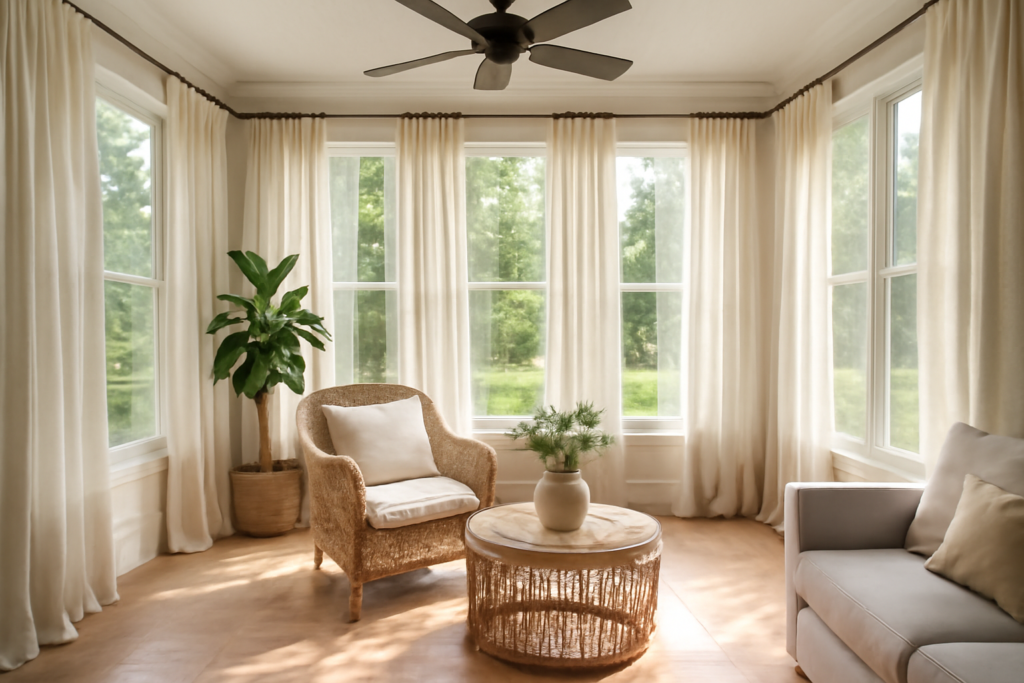
Sunrooms are the brightest rooms in the house, and that is exactly why the wrong drapes fail in them. Ordinary cotton panels fade within one summer, silk rots, and heavy velvet turns a glass room into a cave. The best sunroom curtain ideas balance three competing goals: keeping the view, cutting glare and heat, and holding up to relentless UV exposure. Below are design approaches, fabric choices, and hardware solutions that work for the odd window layouts sunrooms are known for.
- Sunroom Curtain Ideas That Start With the Right Fabric
- Sheer and Semi-Sheer Looks for Maximum Light
- Layering Curtains With Shades for Heat Control
- Hardware Solutions for Tricky Sunroom Windows
- Style-Based Sunroom Curtain Ideas
- Protecting Floors and Furniture From Sun Damage
- Budget Planning and Care Tips
- Measuring and Hanging Tips for Glass Walls
- Bringing It All Together
Sunroom Curtain Ideas That Start With the Right Fabric
Fabric choice matters more in a sunroom than anywhere else in your home. South- and west-facing glass can expose drapery to eight or more hours of direct sun a day, and UV breaks down fibers and dyes surprisingly fast.
- Solution-dyed acrylic — The same fabric used on outdoor cushions. Color runs through the fiber, so it resists fading for years. Panels cost $40 to $120 each and feel softer than most people expect.
- Polyester sheers and voiles — Affordable ($15 to $45 per panel), fade-resistant, and wrinkle-resistant. They diffuse light beautifully without blocking the view.
- Linen and linen blends — Relaxed, textured, and classic in a sunroom. Pure linen fades and weakens over time, so choose a linen-polyester blend or add a lining.
- Performance outdoor fabrics — Mildew-resistant options work well in three-season rooms that are not climate-controlled and see humidity swings.
Avoid silk, rayon, and bright cotton prints without a UV lining. A thermal or UV-protective lining adds $15 to $35 per panel and can double the life of the face fabric.
Sheer and Semi-Sheer Looks for Maximum Light
For most sunrooms, sheer curtains are the starting point. White or ivory sheers soften harsh midday glare while keeping the room luminous. Pale gray and oatmeal sheers cut brightness slightly more and hide dust better than pure white.
Hang sheers at full height, from just below the ceiling or the top of the window frame to about 1/2 inch above the floor. Full-length panels make the ceiling feel taller and the room more finished. Plan on fabric width equal to two to two-and-a-half times the width of the window for a full, gathered look; skimpy panels look like an afterthought in a room walled with glass.
Semi-sheer weaves such as open-weave linen blends or textured casement fabrics add privacy at night when interior lights make a glass room feel like a fishbowl. They are a smart choice in sunrooms that face a street or neighbors.
Layering Curtains With Shades for Heat Control
Curtains alone struggle to control heat gain in a room where glass makes up most of the wall area. Layering solves that. Pair a light-filtering or solar shade mounted inside the window frame with decorative side panels outside it.
Solar shades rated at 3 to 5 percent openness block roughly 95 to 97 percent of UV while preserving a view outward. They can reduce heat gain through a window substantially, especially on west exposures where late-afternoon sun climbs above 90°F in summer. Cellular shades add insulation value in winter, with double-cell styles offering an R-value in the range of 3 to 5.
The curtain layer then becomes purely decorative, framing the windows and adding color and softness. Stationary side panels, which only cover 12 to 18 inches on each side, use less fabric and cost far less than fully functional draperies across a 20-foot wall of glass.
Color Ideas for Layered Treatments
- Coastal: white solar shades with sea-glass green or pale blue linen panels.
- Farmhouse: woven bamboo shades with natural flax or ticking-stripe panels.
- Modern: charcoal solar shades with crisp white sheer panels on a black rod.
- Traditional: soft ivory Roman shades with a subtle botanical print panel.
Hardware Solutions for Tricky Sunroom Windows
Sunrooms rarely have the tidy wall space above windows that standard curtain rods need. Glass often runs nearly floor to ceiling, meets at corners, or climbs up a sloped roof. The right hardware makes or breaks the design.
- Ceiling-mounted track systems — Aluminum tracks screwed into the ceiling let panels glide across a whole wall of glass. Ripplefold and pinch-pleat carriers give a tailored hotel look. Expect $8 to $25 per linear foot for track hardware.
- Bendable corner rods — Swivel connectors or pre-bent 90-degree and bay rods let panels travel around corners without a gap.
- Tension rods and sash rods — For French doors or small transom windows, a rod mounted at top and bottom holds sheer fabric taut against the glass so it does not swing when doors open.
- Wire cable systems — Thin stainless cables tensioned between walls suit minimalist sunrooms and hold lightweight sheers with clips.
Sloped or skylight glazing is the hardest to dress. Fabric curtains sag on angles, so most designers use custom skylight shades or pleated shades with side-guide cables for those panes and keep curtains on the vertical walls only.
Style-Based Sunroom Curtain Ideas
Your sunroom’s architecture and furniture should guide the curtain style. Here are approaches that suit common sunroom looks.
Relaxed Boho Retreat
Layer cream macrame-trimmed sheers over rattan blinds, and let panels puddle an inch or two on a jute rug. Wooden rings on a natural oak rod reinforce the organic feel. This look forgives wrinkles, which is handy since sunroom humidity can make fabric crease.
Clean Scandinavian Room
Choose unlined white linen-blend panels on a slim matte-black track. Keep everything floor-length and minimal, and skip tiebacks. Pair with light oak or pale luxury vinyl plank floors to amplify the brightness.
Classic Conservatory
Pinch-pleat drapes in a small-scale floral or trellis pattern, held with tassel tiebacks, suit a Victorian-style glass conservatory. Line them with UV blackout fabric if the room doubles as a guest space.
Outdoor-Inspired Porch Room
In an unheated three-season room, outdoor curtains with grommet tops and weighted hems stand up to breezes and moisture. Stripes in navy, terracotta, or sage feel casual and cheerful.
Protecting Floors and Furniture From Sun Damage
Curtains are not just decorative in a sunroom; they protect everything else in the room. UV exposure fades hardwood, discolors area rugs, and yellows some vinyl and laminate finishes. Hardwood species like cherry and Brazilian cherry darken noticeably, while maple and oak can amber within months under direct sun.
Drawing sheers or lowering solar shades during the peak hours of 11 a.m. to 3 p.m. slows that change dramatically. Rotate rugs and furniture every few months so fading happens evenly. If you are choosing new flooring for a sunroom, porcelain tile and UV-stable luxury vinyl plank rated for sunrooms handle heat and light better than most natural wood.
Low-E window film is another tool worth considering alongside curtains. Professionally installed film costs about $8 to $15 per sq ft and blocks up to 99 percent of UV without darkening the view.
Budget Planning and Care Tips
Sunrooms often have 8 to 15 windows, so costs add up quickly. A realistic range for a 12-by-16-foot sunroom:
- Budget: ready-made polyester sheers and simple rods, $250 to $600.
- Mid-range: lined linen-blend panels, corner rod hardware, and solar roller shades, $1,200 to $3,000.
- Custom: made-to-measure drapery on ceiling tracks with motorized shades, $4,000 to $9,000.
Motorized tracks and shades, which can be scheduled to close during peak afternoon sun, add $250 to $600 per window but make managing a large glass room effortless.
For care, vacuum curtains monthly with a brush attachment to prevent dust from baking into fibers. Most polyester sheers are machine washable on a cool, gentle cycle; hang them back up while slightly damp so wrinkles fall out. Linen blends and lined drapes typically need dry cleaning. Inspect hems each spring for sun-weakened fabric, which tears easily once degraded.
Measuring and Hanging Tips for Glass Walls
Measure every window individually, because sunroom openings built from stock window units often vary by an inch or more. For stationary side panels, measure from the rod or track to 1/2 inch above the finished floor, and account for the thickness of any rug you plan to add. If you prefer a relaxed puddle, add 2 to 3 inches, but skip puddling in rooms where you track in sand, water, or potting soil from the garden.
Mount rods or tracks as high as the structure allows, ideally 4 to 6 inches above the window frame or directly on the ceiling when glass runs close to the top plate. Use drywall anchors rated for at least 25 pounds per bracket, or better, locate the header and screw into solid wood. Space brackets no more than 48 inches apart on rods holding lined panels to prevent sagging over a long span of glass.
Bringing It All Together
The most successful sunroom curtain ideas start with durable, UV-resistant fabric, use hardware designed for corners and full-height glass, and layer functional shades behind decorative panels. Pick a style that matches your furniture and flooring, measure carefully for fullness, and plan for sun protection as much as for looks. Done well, your curtains will frame the view, keep the room comfortable in July, and still look fresh several summers from now.