A sunroom is often the most underused space in the house, too hot in July, too cold in January, and furnished with whatever did not fit elsewhere. Turning it into a place to eat changes that. The best sunroom dining room ideas treat the glass walls as the main feature, then solve the practical problems that come with them: glare, heat gain, fading, and cold floors. Get those right and the sunroom becomes the room everyone gravitates to for breakfast, weekend lunches, and long summer dinners.
- Sunroom Dining Room Ideas Start With the Layout
- Choosing Flooring That Survives the Sun
- Managing Glare, Heat, and Fading
- Keeping the Room Comfortable Year-Round
- Furniture That Works in Bright Light
- Lighting for Evening Meals
- Connecting the Sunroom to the Kitchen and Living Areas
- Style Directions to Consider
- Budgeting Your Sunroom Dining Room
Sunroom Dining Room Ideas Start With the Layout
Most sunrooms are long and relatively narrow, often 10 to 14 feet deep and 12 to 20 feet wide. Before buying furniture, measure the room and mark the door swings, radiator or mini-split locations, and the main traffic path from the house. You need at least 36 inches of clearance behind each chair for people to pull out and sit down, and 44 inches or more where someone walks behind a seated diner.
- Rectangular table along the long axis: Works in rooms 11 feet or deeper. Seats 6 to 8 and puts every diner near a window.
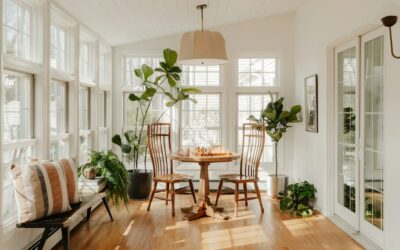
- Round pedestal table: Ideal for square sunrooms around 10 x 10 feet. A 48-inch round seats 4 comfortably, a 60-inch round seats 6, and the pedestal base means no table legs fighting chair legs.
- Banquette against the house wall: The most space-efficient choice. A built-in bench along the solid wall saves about 18 inches of chair clearance and adds hidden storage.
- Zoned layout: In a larger sunroom, place the dining table at one end and a pair of lounge chairs or a small sofa at the other, separated by a rug.
Keep the table away from the exterior door so there is a clear path in and out. If the sunroom connects to the kitchen, put the table as close to that door as possible so carrying plates is easy.
Choosing Flooring That Survives the Sun
Flooring is where many sunroom dining rooms go wrong. Direct sun through glass can push floor surface temperatures above 100°F in summer, while an uninsulated slab can drop to 40°F in winter. Food spills and chair traffic add wear. The flooring you choose has to handle all of it.
| Flooring | Installed cost per sq ft | Sunroom pros and cons |
|---|---|---|
| Porcelain tile | $10 to $20 | Fade-proof, waterproof, stores heat; cold without radiant heat |
| Luxury vinyl plank | $5 to $10 | Warm underfoot, waterproof; can expand in direct sun without gaps |
| Engineered hardwood | $9 to $16 | Warm look; fades and needs UV-filtering glass |
| Brick or natural stone | $12 to $30 | Classic conservatory look; needs sealing |
Porcelain tile is the most practical choice, especially wood-look planks in 8 x 48-inch sizes that give the warmth of timber without fading. If you choose luxury vinyl plank, confirm the manufacturer allows installation in sunrooms. Many prohibit it in rooms that exceed about 85°F to 100°F, and floating floors in hot sunrooms can buckle unless you leave the recommended expansion gap and use glue-down products rated for high heat.
An area rug under the table softens the look and absorbs sound bouncing off all that glass. Choose solution-dyed acrylic or polypropylene rugs, which resist fading far better than wool. Size the rug so all chair legs stay on it when pulled out, typically 24 inches beyond the table edge on every side.
Managing Glare, Heat, and Fading
Nobody enjoys dinner squinting into the setting sun. Window treatments in a sunroom dining room need to control light without blocking the view that makes the room special.
- Top-down, bottom-up cellular shades: Lower the top to block high sun while keeping the lower view open. Cellular shades also add insulation, which helps in winter.
- Solar screen shades: Available in openness factors from 1% to 14%. A 3% to 5% openness cuts glare and UV sharply while still showing the yard.
- Low-E window film: Professionally installed film runs about $8 to $15 per sq ft and blocks up to 99% of UV, protecting table finishes and upholstery.
- Ceiling shades or retractable fabric panels: Essential for sunrooms with glass roofs, where overhead sun can make the room unusable at midday.
Orientation matters too. A south-facing sunroom gets strong light all day and benefits most from shading. West-facing rooms get harsh late-afternoon sun right at dinner time, so plan for adjustable shades on that wall. North-facing sunrooms rarely overheat and can use lighter treatments.
Keeping the Room Comfortable Year-Round
A dining room only works if you want to sit in it for an hour. For three-season sunrooms, that often means adding heating and cooling. A ductless mini-split is the most common solution, costing about $3,500 to $6,000 installed for a single 12,000 BTU head that can handle most sunrooms up to 400 sq ft. It provides both heat and air conditioning without extending the home’s ductwork.
Other options include electric radiant floor heat under tile ($10 to $20 per sq ft installed for the system), which makes cold porcelain feel pleasant in winter, and a ceiling fan with a light kit to move air on warm days. Choose a damp-rated fan in sunrooms that are not fully sealed. Any new circuits for mini-splits, heated floors, or fans should be installed by a licensed electrician and permitted, since sunrooms often lack dedicated circuits.
Furniture That Works in Bright Light
Sun is hard on furniture. Dark wood tables lighten, cushions fade within a season, and some plastics become brittle. Choose materials that tolerate UV exposure.
- Tables: Teak, powder-coated aluminum, or stone and ceramic tops hold up well. Wood tables with a UV-inhibiting finish work if the glass has Low-E coatings.
- Chairs: Rattan and wicker give a classic garden-room feel. All-weather resin wicker lasts longer than natural rattan in hot rooms.
- Upholstery: Solution-dyed acrylic outdoor fabrics resist fading and wipe clean after spills.
- Storage: A low sideboard or buffet along the solid house wall holds linens and serving pieces without blocking windows.
Keep furniture scale light. Chunky upholstered dining chairs make a glass room feel crowded. Open-back chairs and slim table legs let light pass through and keep sightlines to the garden clear.
Lighting for Evening Meals
Daylight carries a sunroom until sunset, then the room can turn into a black mirror of reflections. Layered lighting solves that.
- Pendant or chandelier over the table: Hang the bottom 30 to 36 inches above the tabletop. Choose a fixture with a diameter about half to two-thirds the table width.
- Dimmers everywhere: Dimmed warm light (2700K) cuts window reflections and makes the room cozy.
- Wall sconces on the house wall: Add soft ambient light without glare in the glass.
- Exterior landscape lighting: Lighting the garden outside eliminates the mirror effect at night, because the glass reflects less when it is bright on both sides.
If your sunroom has a vaulted or glass ceiling with no place to hang a fixture, consider a plug-in swag pendant or a statement floor lamp, or have an electrician run a line through the header beam.
Connecting the Sunroom to the Kitchen and Living Areas
A dining room earns its keep when serving is easy. If the sunroom sits off the kitchen, widening the connecting opening makes a dramatic difference. Replacing a standard 30-inch door with a 6-foot cased opening or a pair of French doors lets light flow deeper into the house and makes the sunroom feel like part of the main floor rather than an afterthought. Removing or widening an opening in an exterior wall that the sunroom was built against usually means cutting a bearing wall, so have a contractor size a new header and pull a permit.
Flooring transitions matter here too. If the sunroom floor sits one step lower than the kitchen, which is common with slab-on-grade additions, mark the step edge with a contrasting nosing or a strip of LED step lighting so nobody misses it while carrying a hot dish. Where the floors are level, running the same porcelain or plank flooring from the kitchen into the sunroom visually enlarges both rooms. Use a flush T-molding or a Schluter-style profile at the threshold instead of a raised saddle.
Finally, think about a serving surface. A narrow console, bar cart, or built-in counter along the house wall gives you a landing spot for platters and drinks so the table stays uncluttered.
Style Directions to Consider
Once the practical choices are settled, the fun part is the style. A few directions that consistently work in sunroom dining spaces:
- Garden conservatory: Terracotta or brick-look tile, a weathered wood farm table, and plenty of potted citrus or fiddle-leaf figs.
- Coastal: Whitewashed wood-look porcelain, woven chairs, linen cushions, and soft blue accents.
- Modern minimal: Large-format gray porcelain, a white oval pedestal table, molded chairs, and black metal window frames.
- Traditional: A painted beadboard ceiling, a mahogany-look table, upholstered host chairs, and a crystal chandelier.
- Boho: A patterned rug, rattan pendant, mismatched vintage chairs, and trailing plants in hanging baskets.
Plants deserve a mention because the sunroom is the best spot in the house for them. Keep large planters on wheeled caddies so you can move them for parties, and place saucers under every pot to protect the floor.
Budgeting Your Sunroom Dining Room
Converting an existing sunroom into a dining room can be done on a wide range of budgets. A furniture-and-decor refresh might cost $1,500 to $5,000. Adding new porcelain tile, a mini-split, window film, and a light fixture typically totals $10,000 to $25,000 for a 200 sq ft room. Building a new four-season sunroom addition to house the dining area usually runs $250 to $400 per sq ft, and requires permits, foundation work, and a licensed contractor.
Start with the problems that make the room uncomfortable, then invest in furniture and styling. With good flooring, controlled light, and a comfortable temperature, these sunroom dining room ideas turn a forgotten glass room into the best seat in the house.