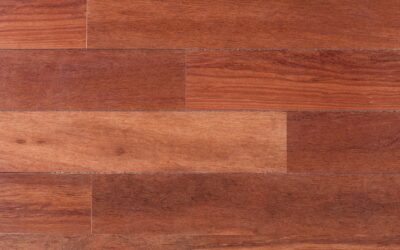
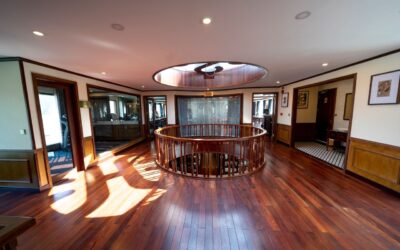
Real teak runs $14 to $24 per square foot for the lumber alone, and even reclaimed sources have largely dried up under CITES restrictions. Teak vinyl flooring exists because homeowners still want that warm honey-to-bronze color story with the unmistakable interlocking grain, but without spending a luxury car on flooring. Done well, modern SPC and WPC teak-look planks fool guests at standing height and cost a fraction of what the genuine tropical hardwood would demand.
What Distinguishes a Convincing Teak Print
Authentic teak has a specific palette: golden brown base, darker chocolate streaks, and occasional pale sapwood edges. Cheap vinyl prints flatten this into a uniform orange that screams fake. The better products use embossed-in-register (EIR) technology, where the surface texture lines up exactly with the printed grain pattern, plus 12 to 16 unique plank designs per box to avoid pattern repetition.
Look for sheen levels around 5 to 10 on the gloss scale. Real teak is naturally semi-matte; anything glossier than 15 reads plastic immediately. Karndean Korlok Antique Oak Teak, COREtec Plus Premium Teak, and Mannington Adura Max Acacia Teak all pass the convincing-at-three-feet test.
SPC, WPC, and Glue-Down Options
Stone polymer composite (SPC) gives you the most durable rigid-core teak vinyl. A 5 mm SPC plank with 22 mil wear layer handles dropped iron skillets, dog claws, and rolling office chairs. Expect $4.50 to $7.50 per square foot for quality product.
Wood plastic composite (WPC) trades some durability for warmer feel underfoot and better sound dampening. The thicker 6 to 8 mm cores absorb impact noise, making WPC a better choice for upstairs installations and condos with HOA noise rules. Pricing runs slightly higher at $5.50 to $8.50 per square foot.
Glue-down LVT in 4 mm thickness is the third option, mostly for commercial spaces and tight retrofits where you cannot raise floor height. It’s the cheapest at $2.99 to $4.99 per square foot but requires perfectly flat substrate.
Wear Layer Math
The wear layer is the clear urethane topcoat that determines lifespan. For teak vinyl flooring in residential applications:
- 6 to 8 mil: budget rental-grade product, 5 to 7 year lifespan
- 12 mil: residential moderate-traffic, 10 to 15 year lifespan
- 20 mil: heavy residential, 20 to 25 year lifespan
- 22 to 30 mil: light commercial rated, lifetime residential warranty
For a primary living area, never go below 12 mil. For kitchens and entryways with daily wear, push to 20 mil. The price difference between 12 and 20 mil is usually $0.80 to $1.40 per square foot, and the durability difference is enormous.
Brand Spotlight: Karndean Korlok
Karndean has the deepest bench in convincing wood visuals, and their Korlok Select line includes several teak interpretations. Burmese Teak RKP8104 uses 12 unique plank designs over a 6.5 mm rigid core with 30 mil wear layer and attached acoustic pad. List price runs $7 to $9 per square foot, but flooring stores routinely discount 15 to 25 percent.
The 0.55 mm beveled edges give Korlok planks the visual depth that flat-edged budget LVP lacks, and the wirebrushed surface texture catches light realistically. For premium teak-look installs, this is the bar to beat.
Installation Over Different Subfloors
Click-lock teak vinyl floats over concrete, plywood, OSB, and existing vinyl or tile. The subfloor must be flat to within 3/16 inch over 10 feet for rigid-core planks; WPC tolerates slightly more imperfection because of its forgiving core.
For concrete slabs, test moisture per ASTM F2170 before installation. Slabs reading above 80 percent relative humidity need a vapor barrier even with vinyl’s inherent water resistance. Use 6 mil poly sheeting taped at seams under the underlayment.
Leave 1/4 inch expansion gap at every wall, pipe, and fixed cabinet. Skip this and your planks will buckle the first humid summer.
Where Teak Vinyl Fits the Style Best
Mid-tone teak reads warm without being heavy, making it a strong choice for coastal homes, transitional kitchens, and contemporary spaces with white or warm-gray walls. It pairs beautifully with brass and matte black hardware, woven jute rugs, and rattan furniture.
Avoid teak vinyl in rooms with cool gray walls or stark white cabinetry. The orange undertones can clash with cooler color schemes and read dated within five years. Sample large planks against your existing finishes before ordering full quantity.
Maintenance That Preserves the Surface
Vacuum with a hard-floor brush attachment weekly. Damp-mop with manufacturer-approved cleaner like Shaw R2X, Bona for Luxury Vinyl, or Karndean Clean Refresh. Never use Pine-Sol, bleach, or steam mops; the heat compromises the urethane bond and the harsh cleaners strip the protective topcoat.
Use felt pads under all furniture. Roll office chairs and rolling kitchen islands require chair mats or polyurethane caster wheels rated for hard floors. Replace pads twice yearly because embedded grit turns soft felt into sandpaper.
Final Buying Decision
Teak vinyl flooring works if you want the tropical-hardwood look without the cost or sustainability concerns of genuine teak. Stick to SPC or WPC rigid-core construction, demand at least 12 mil wear layer (20 mil preferred), and buy from established brands with at least 25-year residential warranties. Budget $3,500 to $6,500 for a 750 square foot installation including labor.
Order full-size samples before committing to a full purchase. Showroom displays often light products under flattering accent lighting that exaggerates the realism of the wood print. Request 3 to 5 full planks of your shortlisted products, lay them in your home under actual lighting conditions, and live with them for a week before finalizing. Pay attention to how the pattern repeats across multiple planks; some budget brands repeat every 4 to 6 planks, creating an obvious pattern when installed across a large room. Premium brands like Karndean and COREtec use 12 to 24 unique designs per box, eliminating the visible repetition that betrays cheaper alternatives. With proper care, a quality teak vinyl floor lasts 20 years and still looks current at year 15.
Prefer to explore on your own?
See how new flooring looks in your actual room in seconds — free, no signup.
Try the free Floor Studio →