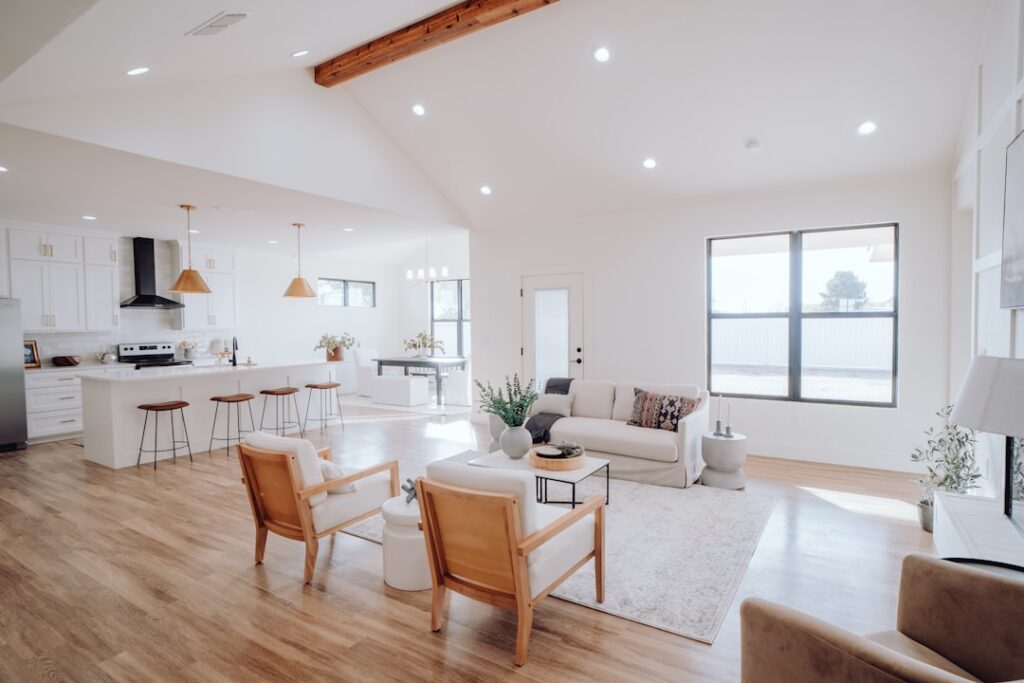
Wide planks are pushing 7 to 10 inches in most premium homes built since 2020, a dramatic shift from the 2.25-inch strip oak that dominated American floors for half a century. Timber plank flooring in this wider format adds visual scale and softens room lines, but it also exposes buyers to gapping, cupping, and finish wear if the wrong species or construction is paired with the wrong subfloor. This guide walks through what timber plank flooring actually means, how to choose between solid and engineered, and what real installations cost in 2026.
What Counts as Timber Plank Flooring
Industry definitions vary, but plank flooring generally describes boards 4 inches wide or wider in solid hardwood and 5 inches or wider in engineered. Anything narrower falls into strip flooring territory. The widest available formats now stretch to 12 inches, with custom mills offering even wider boards for character-grade projects.
The visual difference is significant. A 6-inch white oak plank in a 14 by 18 living room shows roughly half as many seams as a 3-inch strip in the same space. Furniture looks better. Rugs lay flatter. Sightlines feel longer.
Solid vs Engineered Plank
Solid timber planks are milled from a single piece of wood, typically 3/4 inch thick. They can be sanded and refinished 5 to 7 times across a 60 to 100-year lifespan. The trade-off is dimensional instability. Wide solid planks expand and contract significantly with humidity changes, which means a 7-inch board can gap 1/8 inch in winter and cup 1/16 inch in summer.
Engineered planks layer a hardwood veneer on top of a cross-laminated plywood or HDF core. Total thickness usually runs 3/8 to 5/8 inch. The cross-grain construction holds the board flat across wide widths and tolerates radiant heat, basements, and concrete slabs that would destroy solid wood. Most engineered planks can be sanded 1 to 3 times depending on veneer thickness.
Pros of Timber Plank Flooring
The aesthetic upgrade is the headline benefit. Wide planks photograph beautifully and consistently top buyer surveys in Houzz and NAHB research. Real estate agents in mid-to-upper price brackets routinely report 3 to 5 percent higher offers on homes with quality plank floors versus laminate or LVP.
Real wood also ages gracefully. Minor scratches blend over time. Refinishing restores it. A 30-year-old oak plank floor with good maintenance often looks better than a 5-year-old laminate floor with light wear.
Cons and Realistic Drawbacks
Cost is the obvious one. Mid-grade engineered plank runs $6 to $11 per sq ft installed. Solid wide-plank white oak typically lands between $12 and $20 installed. Premium European oak with rift and quartered cuts can exceed $25 per sq ft.
Maintenance also requires more attention than synthetic flooring. Timber planks need pH-neutral cleaners, no steam mops, and humidity control between 30 and 50 percent year-round. A whole-house humidifier or dehumidifier may be necessary depending on your climate zone.
Choosing a Species
White oak dominates current plank flooring sales for good reason. It runs 1360 on the Janka hardness scale, accepts almost any stain color evenly, and resists tannin reactions with water and pet urine better than red oak. Hickory at 1820 Janka offers more durability but pronounced grain that limits design flexibility.
Walnut planks (1010 Janka) appeal to buyers wanting deep brown color without staining, but the softer surface dents more easily. Maple at 1450 Janka produces tight, light-toned planks that suit modern designs but blotch badly under most stains.
Plank Width and Room Scale
Match plank width to room size for the best visual result. Rooms under 200 sq ft generally work best with 5 to 6-inch planks. Spaces between 200 and 400 sq ft handle 6 to 8-inch boards well. Open floor plans over 500 sq ft can support 8 to 10-inch planks without looking out of scale.
Mixed-width packages have gained popularity in the past 5 years. Brands like Mirage, Lauzon, and Carlisle offer cartons that include 5, 7, and 9-inch boards in random sequence. The look reads as traditional reclaimed flooring without the cost or labor of true reclaimed material.
Installation Methods
Nail-down installation remains the standard for solid plank over wood subfloors. Use cleats every 6 to 8 inches with a 1/2-inch expansion gap at all walls. Pre-drill ends to prevent splitting on planks 6 inches and wider.
Glue-down works for engineered plank over concrete or with radiant heat. Use a urethane adhesive like Bostik Best or Mapei Ultrabond ECO 980. Floating installations with click-lock engineered plank work over most subfloors and allow easier future repair, but they sound hollower underfoot than glued or nailed floors.
Finishes and Topcoats
Factory-finished planks come pre-coated with 7 to 11 layers of aluminum-oxide urethane that resist scratches better than any site-applied finish. The trade-off is visible micro-bevels between boards. Site-finished planks deliver a smooth, monolithic surface but require 3 to 5 days of curing time before furniture can return.
Hardwax oil finishes from Rubio Monocoat and Pallmann produce a low-sheen, natural look that hides scratches and spot-repairs easily. They cost slightly more upfront but eliminate the need for full refinishing for 15 to 20 years in residential settings.
Bottom Line
For a 1,200 sq ft installation, budget $8,000 to $14,000 for engineered plank and $14,000 to $24,000 for solid wide plank, all-in. Choose engineered for basements, slabs, or radiant heat. Choose solid for upper floors in stable climates if you want maximum longevity and refinishing potential.
Prefer to explore on your own?
See how new flooring looks in your actual room in seconds — free, no signup.
Try the free Floor Studio →