A tv stand with electric fireplace gives you two things in one piece of furniture: a media console that holds your television and gear, plus a plug-in flame that throws real heat. There’s no chimney, no gas line, and no permit. You slide it against a wall, plug it into a standard outlet, and you’re running in ten minutes.
- How Electric Fireplace TV Stands Actually Work
- Match the Console to Your TV Size
- Check the Weight Capacity
- Media Console Sizing and Storage
- Heat Output, Thermostats, and Running Costs
- Flame Technology: What You’re Actually Looking At
- Materials and Build Quality
- Electrical and Placement Rules
- What You’ll Pay
- Buying Checklist
I’ve installed dozens of these in living rooms and finished basements. They’re a great option when a built-in isn’t in the budget, but there are a few numbers you have to get right or you’ll end up with a console that’s too small for your TV or a firebox that trips your breaker. Here’s how to buy the right one.
How Electric Fireplace TV Stands Actually Work
Nearly all of these are plug-in 120V units. The firebox sits in the center of the console with an LED or holographic flame effect behind a glass or acrylic front, and a forced-air heater (a small ceramic element and fan) blows warm air out a front vent. The flame and the heat run independently, so you can enjoy the ambiance in July without cooking the room.
A typical firebox puts out 4,600 to 5,000 BTU and draws about 1,500 watts on high. That’s roughly 12.5 amps on a 15-amp circuit, which is why you should never run one on a shared circuit with a space heater or microwave. Coverage is honest but modest: figure 400 to 1,000 square feet of supplemental heat. This is a “take the chill off one room” appliance, not a furnace replacement.
Match the Console to Your TV Size
The single most common mistake is buying a stand that’s too narrow. The rule of thumb: the console should be at least as wide as your TV, and ideally 6 to 12 inches wider on each side so the set isn’t hanging over the edges.
- 55-inch TV (about 48 in. wide): buy a 58 to 60-inch console minimum.
- 65-inch TV (about 57 in. wide): buy a 68 to 72-inch console.
- 75-inch TV (about 66 in. wide): buy an 80-inch or wider console.
Most fireplace consoles run 48, 60, 68, or 70 inches wide. If you plan to mount the TV on the wall above instead of setting it on top, you get more flexibility, but keep the screen’s bottom edge at least 8 to 12 inches above the firebox so rising heat doesn’t bake the electronics.
Check the Weight Capacity
Modern TVs are light, but the stand still has to hold the set plus a soundbar, console, and whatever you pile on the shelves. Look at the published top-surface rating. Budget MDF consoles are often rated for 60 to 80 pounds on the top; sturdier units handle 100 to 150 pounds. A 65-inch TV weighs roughly 50 to 60 pounds, so a 60-pound-rated top leaves almost no margin for a soundbar. Aim for a top rating of at least double your TV’s weight.
If you’re going wall-mount above the console, none of the TV weight lands on the furniture, which is the safest setup for large screens.
Media Console Sizing and Storage
The heater eats the center bay, so all your storage lives in the side cabinets. Before you buy, measure your components:
- A soundbar needs an open, unobstructed shelf, ideally on top or in a bay with an open front so the IR remote reaches it.
- A game console or cable box needs about 4 to 5 inches of vertical clearance and ventilation.
- Look for wire pass-through holes in the back panels; cheaper units skip these and you’ll be drilling your own.
Barn-door and sliding-door consoles look great but sometimes block half a bay at a time. If you have a lot of gear, open-shelf or glass-door designs give you easier access and better remote line-of-sight.
Heat Output, Thermostats, and Running Costs
On the 1,500W high setting, a firebox costs roughly 18 to 20 cents per hour at the U.S. average electric rate of about 16 cents per kWh. Run it four hours an evening and you’re looking at $20 to $25 a month in the cold season. Most units have a low setting (around 750W / 5,000 BTU halved) and a thermostat, so the heater cycles off once the room hits temperature instead of running flat out.
Flame-only mode uses almost nothing, typically 10 to 40 watts for the LEDs, so leaving the ambiance on all evening costs pennies. Look for a remote, a timer, and adjustable flame brightness and color. The nicer inserts offer ember-bed effects and multiple flame speeds.
Flame Technology: What You’re Actually Looking At
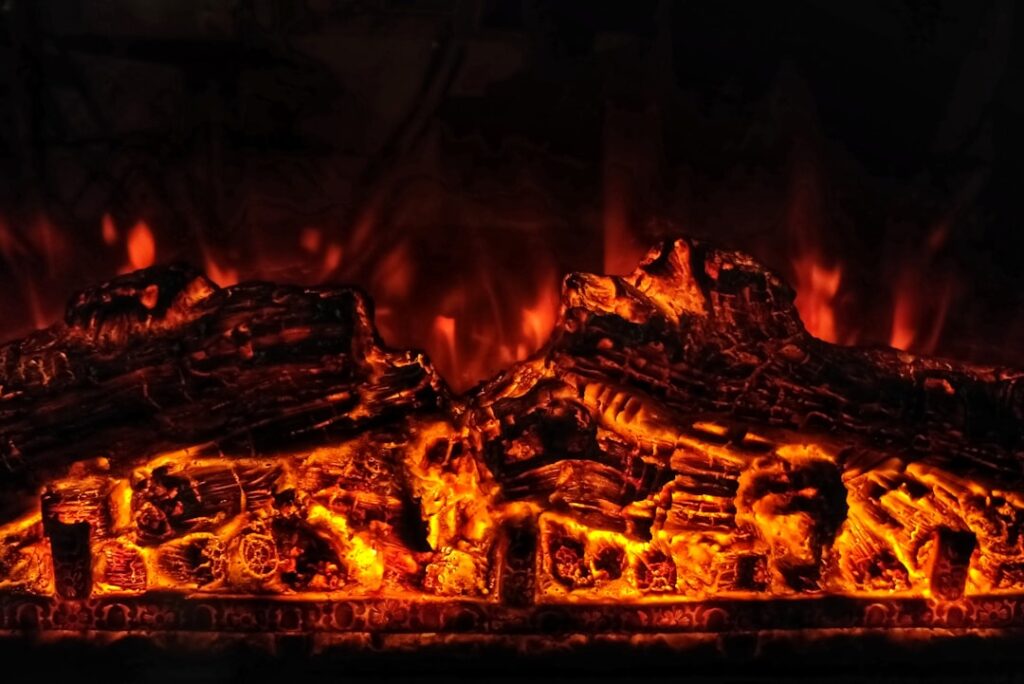
Not all flames are created equal, and the effect drives whether the piece looks convincing or cheap. The oldest and cheapest method spins a reflective rod behind the logs to bounce light around, producing a wavy but repetitive pattern. Mid-range consoles use LED strips with a shimmer effect. The best inserts project the flame onto a rear screen or use a “3D” holographic layer that gives real depth, so the fire looks like it sits in front of the logs rather than painted on.
Color options matter too. Look for units that let you switch between warm orange, cool blue, and mixed multi-color flames, and that offer several brightness levels for daytime versus evening. An adjustable ember bed, the glowing crackle under the logs, is the single feature that most separates a $250 console from a $700 one. If you can, view the flame in person or on video before buying because product photos are usually edited to look better than the real thing.
Materials and Build Quality
Most consoles in the $200 to $500 range are laminated MDF or particleboard. They look fine and hold up in low-traffic rooms, but the edges chip and the panels can sag under sustained weight, which is another reason to respect the top-surface rating. Step up to $600 and above and you start seeing real hardwood veneers over engineered cores, solid-wood legs, and metal hardware that survives repeated door use.
Check the back panel: cheap units use a thin fiberboard back that bows, while better ones have removable or vented back panels for cable access and heat dissipation. Soft-close doors, felt-lined drawers, and adjustable shelves are small tells that a manufacturer built the piece to last rather than to hit a price point. If the console will anchor a main living room, spending the extra $200 usually pays off over five to ten years of daily use.
Electrical and Placement Rules
These units are safe when you respect the wiring. A few hard rules:
- Plug directly into a wall outlet. Manufacturers prohibit extension cords and power strips because a 12.5-amp draw can overheat undersized cords.
- Don’t share the circuit with other high-draw appliances. If the breaker trips, that’s your sign.
- Keep the front heat vent clear by at least 3 feet; don’t tuck the console into a tight alcove.
- Never drape blankets or block the vent, and keep the firebox glass clean and cool before touching.
What You’ll Pay
Prices track with size and build quality. Small 48-inch consoles start around $200 to $300. A solid 60 to 70-inch unit in engineered wood with a decent insert runs $400 to $700. Real-wood or designer consoles with high-end flame effects hit $800 to $1,500. The insert itself, if you buy furniture and firebox separately, costs $150 to $400 for a standard 23 to 28-inch plug-in unit.
Watch for consoles sold “fireplace ready,” meaning the center opening is cut for a standard insert but no firebox is included. It’s an easy DIY add later, but budget for the insert.
Buying Checklist
- Console width at least equal to, ideally 12+ inches wider than, your TV.
- Top weight rating of 2x your TV’s weight, or plan to wall-mount.
- Firebox rated 4,600 to 5,000 BTU / 1,500W with a thermostat and remote.
- ETL or UL listing and overheat auto-shutoff.
- Cord long enough to reach a dedicated outlet without an extension.
- Storage bays sized for your actual components with cable pass-throughs.
Get the width and weight numbers right and a tv stand with electric fireplace is one of the easiest upgrades in the house: instant ambiance, real supplemental heat, and a tidy home for your electronics, all without touching a chimney. Measure twice, buy once, and plug it straight into the wall.