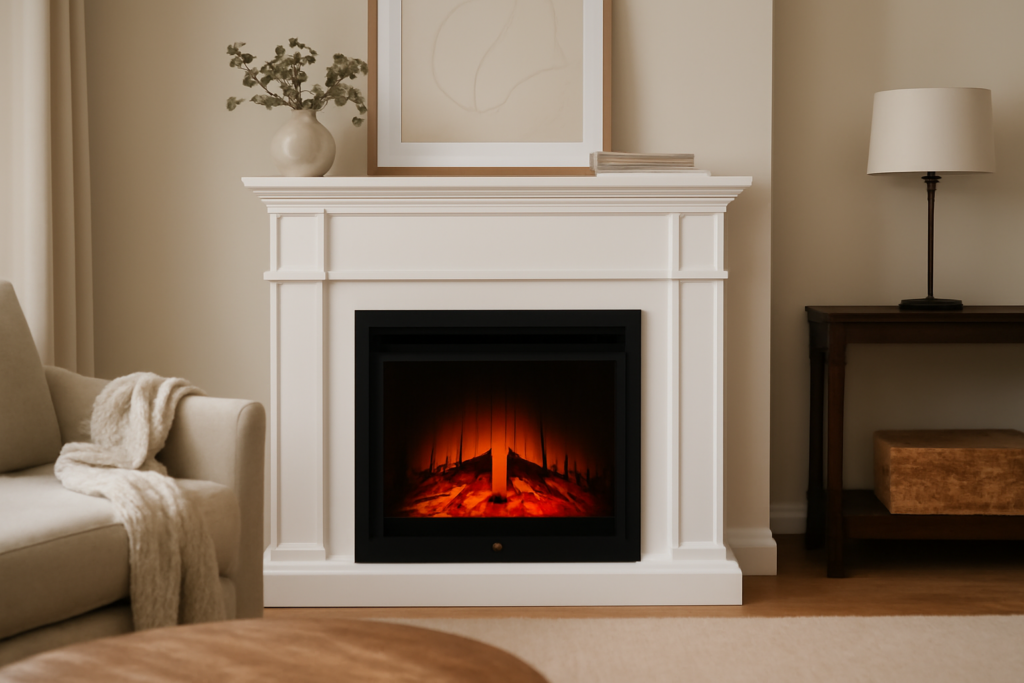
A Dimplex electric fireplace gives you the look of a real fire and genuine supplemental heat without a chimney, gas line, or venting. Dimplex practically invented the modern electric flame effect, and its patented technology is why its units look convincing across a room. This guide covers the model lines, sizing, running costs, installation, and how to buy the right one for your space.
Why Dimplex Stands Out
Plenty of brands sell electric fireplaces, but Dimplex built its reputation on flame realism. Its higher-end units use patented technologies — the Optiflame and Optimyst systems — that go beyond the simple LED-behind-a-rod look of budget inserts. Optimyst models actually generate a fine ultrasonic water mist lit from below, producing what looks like real flame and rising smoke. That realism, plus reliable heating and a strong warranty, is why Dimplex commands a premium over $100 no-name units.
Every electric fireplace shares core advantages: no combustion, no carbon monoxide, no venting, and no gas line. You plug it in, and the flame effect runs with or without heat, so you can enjoy the ambiance year-round.
The Main Dimplex Product Lines
Dimplex organizes its lineup by installation type. Knowing the categories helps you shop:
- Wall-mount / linear: Slim units that hang like a TV or recess into the wall. Popular models like the Prism and IgniteXL run 34 to 100 inches wide and suit modern rooms.
- Inserts: Drop into an existing masonry or prefab fireplace opening to convert a wood-burner to electric. The Revillusion and Multi-Fire XD lines are common here.
- Freestanding stoves: Portable stove-style units (like the classic black or bronze stoves) that plug into any outlet and can be moved room to room.
- Media consoles / mantel packages: An insert paired with furniture-grade cabinetry, giving you a fireplace and a TV stand or storage in one piece.
- Optimyst water-vapor units: The most realistic tier, using water mist for true 3D flame and smoke effect.
How Much Heat You Actually Get
Nearly every plug-in Dimplex electric fireplace uses a 120-volt outlet and produces up to about 5,000 BTU — roughly 1,500 watts — enough to warm 400 to 1,000 square feet as supplemental (zone) heat. That is the ceiling for any standard 120V plug-in appliance in North America, because a normal 15-amp circuit tops out near 1,500 watts.
Set expectations accordingly: an electric fireplace is a zone heater, not a whole-home furnace. It shines when you want to warm the room you are actually in and turn the central thermostat down. Some hardwired 240-volt Dimplex commercial or built-in units push higher output, but the plug-in home models cap at that 5,000 BTU figure.
What It Costs to Run
Running cost is simple to estimate. At full heat, the unit draws about 1.5 kilowatt-hours per hour. At the U.S. average of roughly $0.17 per kWh, that is about 25 cents per hour with heat on, or roughly $0.02 to $0.03 per hour for flame-effect only (the LEDs sip a few watts). Run it four hours an evening with heat and you are looking at about $1 a day, or $30 a month during the cold season. Because it lets you dial back central heating, many owners find it roughly cost-neutral or a modest saver when used for zone heating.
Sizing and Placement
Match the unit to the room and the wall:
- Small rooms / bedrooms (up to 400 sq ft): a 28-to-36-inch wall-mount or a freestanding stove.
- Living rooms (400 to 700 sq ft): a 50-to-60-inch linear unit centers a wall nicely under a mounted TV.
- Great rooms (700+ sq ft): a 74-to-100-inch built-in for visual scale, understanding it is still supplemental heat.
For a TV above the fireplace, confirm the model vents warm air out the front or bottom (most Dimplex units do) so heat is not blown up onto your electronics. Leave the manufacturer’s specified clearance above the heat outlet.
Installation Options
Installation ranges from plug-and-play to a small building project:
Plug-in (easiest)
Freestanding stoves and many wall-mounts simply hang on a bracket and plug into a standard grounded 120V outlet on a 15-amp circuit. This is a true DIY job — mount the bracket to studs, hang the unit, plug in. Just make sure the fireplace is on its own circuit or one not shared with other big loads, since it draws close to 12.5 amps at full heat.
Recessed / built-in
Recessing a linear unit into a framed wall or building a surround takes carpentry: frame the opening to the model’s rough-in dimensions, run an outlet inside the cavity, and finish with drywall, tile, or stone. Many homeowners frame it themselves and hire an electrician for the concealed outlet. Budget $300 to $1,500 for a built-in installation depending on finishes.
Insert conversion
To convert an old wood fireplace, slide a Dimplex insert into the existing opening and run a cord to a nearby outlet or have an electrician add one. This is popular because it reuses the mantel and hearth you already have.
Features Worth Paying For
- Adjustable flame brightness, speed, and color — the better Dimplex units let you tune the flame from warm orange to cool blue and dim it for evening ambiance.
- Optimyst water-mist for the most lifelike flame if realism is your priority.
- Thermostat and timer so the heater cycles to hold a set temperature.
- Remote and app/voice control on newer IgniteXL and Multi-Fire models.
- Ember bed and log/crystal media options to match your decor.
Price Ranges
Expect to pay more than for generic brands, and get more realism and reliability for it:
- Freestanding stoves: $200 to $500
- Wall-mount linear units: $400 to $1,500 depending on width
- Inserts: $500 to $1,800
- Optimyst water-vapor units: $1,000 to $3,000+
- Media console / mantel packages: $800 to $2,500
Maintenance and Longevity
Upkeep is minimal. Dust the glass and interior with a dry microfiber cloth, and vacuum the heater intake and outlet vents a couple of times a season so airflow stays clear. LED flame sources are rated for tens of thousands of hours and rarely need replacing. Optimyst units need periodic water refills and occasional cleaning of the transducer disc and reservoir; distilled water extends the life of that system. With basic care, a Dimplex unit routinely lasts 10 to 20 years, and the flame LEDs often outlast the cabinet.
Dimplex vs. Other Fireplace Types
It helps to know where an electric unit fits against the alternatives before you buy:
- vs. gas fireplace: Gas puts out far more heat (20,000 to 40,000 BTU) and works in a power outage, but needs a gas line, venting, professional installation, and annual service. A Dimplex needs none of that and adds zero carbon monoxide risk.
- vs. wood-burning: No chimney, no wood, no ash, no smoke, and no fire risk — but also none of the crackle or the intense radiant heat of a real fire.
- vs. cheap electric brands: This is where Dimplex earns its price. Budget units use a simple LED-and-rod flame that looks flat up close. Dimplex’s Optiflame and Optimyst systems produce depth and, in the water-vapor models, genuinely convincing 3D flame.
If you want ambiance plus modest zone heat with the least hassle and cost, an electric unit wins. If whole-room heating is the priority and you have gas, weigh a gas insert instead.
Common Questions Before You Buy
A few points trip up first-time buyers. A Dimplex will not heat your whole house — treat it as a zone heater for the room you occupy. The flame effect runs independently of the heater, so you get firelight in July with no added warmth. Most plug-in models share the same roughly 5,000 BTU ceiling, so a bigger unit means a bigger picture, not more heat. And because there’s no combustion, you never need a carbon monoxide detector for the fireplace itself or an annual gas-safety service — one of the biggest ownership advantages over gas.
The Bottom Line
A Dimplex electric fireplace is the safe, flexible way to add a fireplace to almost any room: no venting, no gas, no combustion, and up to about 5,000 BTU of zone heat for around a quarter an hour to run. Choose a wall-mount or insert for a fixed installation, a stove for portability, or an Optimyst model when flame realism matters most. Match the width to your room, keep it on an adequate circuit, and you get years of convincing firelight with almost no maintenance.