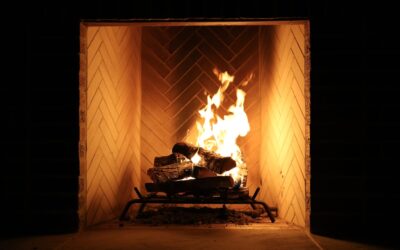
Electric fireplace logs are plug-in log sets that drop into an existing firebox and mimic a real fire with LED-lit flames, glowing embers, and an optional built-in heater. If you have a masonry fireplace you never use because a chimney sweep, liner, or gas hookup costs a fortune, a log insert is the cheapest way to make that opening look and feel alive again.
I put these in for clients who want the fireplace back without the smoke, ash, or annual chimney bill. They’re a weekend-free, tool-free upgrade. The trick is getting the size right so the set fills the opening and looks proportional instead of lost in a cavern. Here’s everything you need to know.
What Electric Log Sets Actually Are
An electric log set is a self-contained unit: molded resin logs cast from real wood, an LED light engine that projects flames onto a reflector or the logs themselves, and usually a 120V forced-air heater. You set it inside your old firebox, run the cord to a nearby outlet, and control everything with a remote. Nothing burns. There’s no combustion, no exhaust, and no need for the flue to be open or lined.
The better sets use a combination of upward LED flame projection and an “ember bed” that pulses like real coals. Cheaper ones just under-light the logs and look flat. Because there’s no real fire, these are safe in a firebox that’s no longer certified for wood burning, which is exactly why so many people choose them.
Heat: What to Expect
Most heated log sets draw 1,500 watts on high and put out roughly 4,600 to 5,000 BTU, enough supplemental heat for a 400 to 1,000 square-foot room. That’s about 12.5 amps on a 120V outlet, so plug directly into the wall, never an extension cord. Many sets have a low setting near 750 watts and a thermostat that cycles the heater on and off.
Run the flames without the heater and you’re using only 20 to 60 watts, so year-round ambiance costs almost nothing. If your goal is looks rather than warmth, some log sets are flame-only with no heater at all, which lets you use them in a firebox where you don’t want any added heat.
Sizing the Set to Your Firebox
This is the step people get wrong. Electric log sets are sold by width, commonly 20, 23, 24, 28, and 33 inches, measured across the widest point of the logs. Before you buy, measure your firebox opening in three places because masonry openings taper:
- Front width at the opening.
- Rear width at the back wall (usually narrower).
- Depth from front lip to back wall, and height at the opening.
Your log set’s width must be smaller than the narrowest point it has to pass, and its depth must fit without the logs poking past the front lip. Leave 1 to 2 inches of clearance on each side. A 23-inch set drops nicely into most standard 26 to 30-inch masonry openings and looks proportional. If your opening is huge, step up to a 28 or 33-inch set or the fire will look like a campfire in a cathedral.
Log Set vs. Firebox Insert vs. Plug-In Fireplace
Don’t confuse these three. A log set is just the logs and flame engine sitting loose in your existing firebox, the most authentic look for a masonry fireplace. A firebox insert is a boxy metal unit with a glass front that you slide into the opening, more of a “modern fireplace” appearance. A freestanding plug-in fireplace or stove doesn’t need an opening at all.
If you want your old fireplace to look like it still has a real fire in it, the log set wins because there’s no glass or metal frame between you and the flames. If you want a sealed, contemporary look, an insert is better.
Features Worth Paying For
- Multiple flame colors and speeds. The realistic sets let you dial orange, blue, or mixed tones and adjust flame height.
- Crackling sound. Some include a small speaker that adds a soft crackle; it’s gimmicky but surprisingly convincing at low volume.
- Thermostat and timer. A thermostat keeps the room from overheating; a timer shuts the heater off overnight.
- Real remote, not just an app. A physical remote is faster and doesn’t rely on Wi-Fi.
- Ember bed lighting. The glowing-coal effect underneath is what separates convincing sets from toy-like ones.
How Realistic Are They, Honestly?
Let’s set expectations. From across the room in the evening, a good LED log set with a projected flame and a pulsing ember bed fools most guests, especially the sets that layer the flame in front of the logs for depth. Up close and in daylight, you can tell it’s electric because the flame pattern repeats and there’s no heat shimmer above the logs. That’s the tradeoff for never dealing with smoke, ash, or a chimney.
The single biggest factor in realism is the ember bed. A set where the “coals” glow and flicker independently of the flames reads as fire; a set that just backlights the logs reads as a lamp. Flame projection onto a rear reflector beats a simple internal LED strip. If realism is your priority, spend up in the $250 to $500 range and read reviews that include video, not just still photos, which are almost always edited to look better than the product performs in person.
Where People Use Log Sets
The obvious spot is an old masonry wood-burning fireplace you’ve retired. But log sets also work well in a few other places:
- A decommissioned gas fireplace where you’ve capped the gas but kept the opening.
- A prefab metal firebox whose flue or damper has failed and isn’t worth relining.
- A decorative-only surround or a faux mantel where you want flame without any structural chimney at all.
Because nothing burns, you’re free to close the damper permanently, which stops the constant draft an open chimney creates and actually improves the room’s comfort in winter. Just confirm the firebox floor is level and clean before you set the logs so the unit sits flat and the cord routes cleanly to the outlet.
Installation and Safety
Installation is genuinely tool-free. Set the logs on the firebox floor, level them, run the cord to a 120V outlet, and plug in. A few rules keep it safe:
- Plug straight into the wall. The 1,500-watt heater will overheat a thin extension cord.
- Keep the front heat vent clear so warm air can escape; don’t bury the vent behind a screen or grate.
- Confirm the set is ETL or UL listed with overheat auto-shutoff.
- You can leave the damper closed since nothing is venting, which actually stops your heated air from escaping up the chimney.
What Log Sets Cost
Flame-only log sets start around $80 to $150. A heated 23 to 28-inch set with a thermostat, remote, and decent flame effect runs $150 to $350. Premium sets with hand-painted logs, sound, and multi-color flames reach $350 to $500. Compared with the $2,000 to $5,000 you’d spend relining a chimney or converting to gas, a log set is a rounding error.
Buying Checklist
- Measure front width, rear width, depth, and height of the firebox before ordering.
- Pick a set 1 to 2 inches narrower than the tightest point of the opening.
- Decide heated (1,500W) or flame-only based on whether you want warmth.
- Look for an ember bed, adjustable flame, physical remote, and thermostat.
- Confirm the cord reaches a wall outlet without an extension.
- Verify ETL/UL listing and auto-shutoff.
Done right, electric fireplace logs turn a dead, drafty masonry opening into the warm centerpiece of the room again, without a match, a permit, or a chimney bill. Measure the firebox carefully, buy the widest set that fits, and you’ll have flames glowing the same night you plug it in.