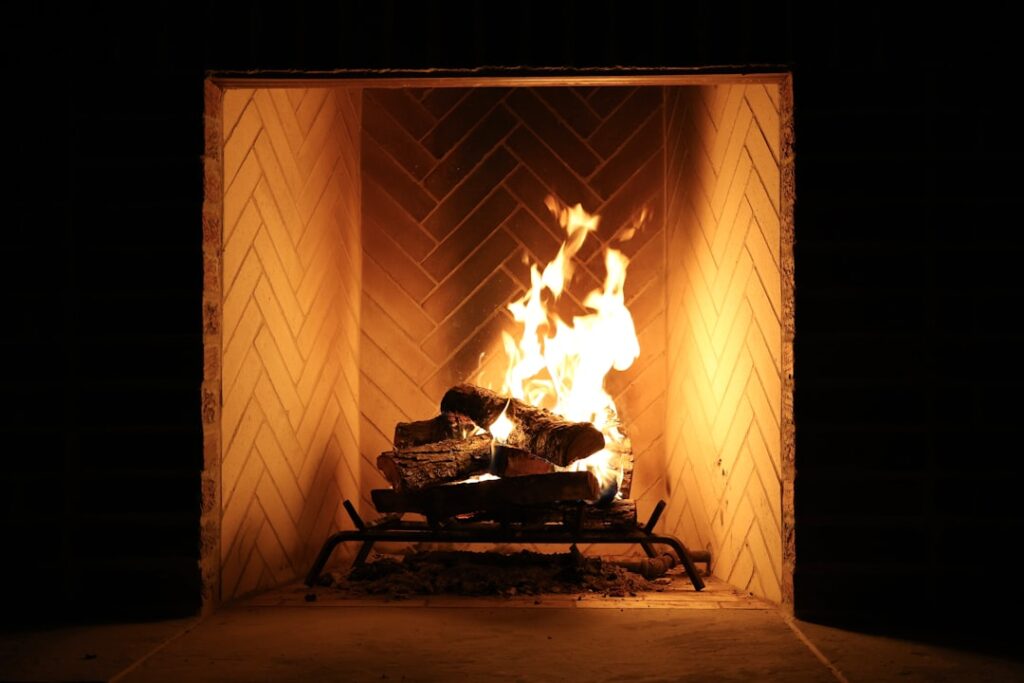
Installing gas logs for a fireplace turns a wood-burning firebox into a clean, instant fire you light with a switch — no splitting, no hauling, no ash. They are the most popular way to keep the look of a real hearth without the work. But gas logs involve a live gas line and, in some configurations, combustion inside your living space, so getting the type, sizing, and safety right matters. Always have gas connections done or verified by a qualified technician.
- What Gas Logs Are
- Vented vs. Ventless: The Key Decision
- Which Type Should You Choose?
- Sizing Gas Logs to Your Fireplace
- Ignition Options
- Installation and Costs
- Safety Rules You Must Follow
- Natural Gas vs. Propane
- Maintenance
- Gas Logs vs. Inserts vs. Fireplaces
- Realistic Flame: Getting the Look Right
- The Bottom Line
What Gas Logs Are
Gas logs are a set of ceramic or refractory-cement logs arranged over a burner in your existing fireplace, fed by natural gas or propane. Unlike a gas insert (a sealed firebox unit) or a gas fireplace (a complete built-in appliance), gas logs drop into a masonry or prefab fireplace you already have. They deliver realistic flames and, depending on type, real radiant heat. The logs themselves do not burn — the gas flame does — so a good set lasts for many years.
Vented vs. Ventless: The Key Decision
This is the choice that shapes everything else. Gas logs come in two fundamentally different types:
Vented gas logs
Vented logs burn with a tall, yellow, realistic flame — the closest look to a real wood fire. They require the chimney damper to stay fully open so combustion byproducts, including any carbon monoxide, go up the flue. The trade-off is efficiency: most of the heat goes up the chimney with the exhaust, so vented logs are more about ambiance than heating. They typically run 60,000 to 90,000 BTU.
Ventless (vent-free) gas logs
Ventless logs burn a cleaner, more efficient blue-tipped flame designed to release almost no carbon monoxide, so they can run with the damper closed and put nearly all their heat (up to 99 percent) into the room. That makes them effective heaters, usually 20,000 to 40,000 BTU. The catch: they burn inside your living space, release water vapor and trace combustion gases into the room, and are banned or restricted in some states and municipalities (notably California and parts of the Northeast). They require an oxygen depletion sensor (ODS) that shuts the burner off if oxygen drops too low.
Which Type Should You Choose?
- Want the most realistic flame and a working chimney, mainly for looks? Choose vented.
- Want real supplemental heat and maximum efficiency, and your local code allows it? Choose ventless.
- Have a fireplace with no chimney or a non-functional flue? Only ventless can work — but confirm it is legal where you live first.
- Sensitive to indoor air quality or humidity? Vented is the safer bet since all byproducts exit the flue.
Sizing Gas Logs to Your Fireplace
Logs must fit your firebox with proper clearance. Measure carefully:
- Front width of the firebox opening at the floor.
- Back width (fireboxes taper, so the back is narrower).
- Depth from front to back.
- Height of the opening.
Log sets are sold by size (18, 24, 30 inches, etc.). The set should leave the manufacturer’s required clearance to the sides and back so flames do not impinge on the firebox walls. When in doubt, size down — a set that is too big is a hazard, while a slightly smaller set is fine.
Ignition Options
Gas logs come with different control systems, priced accordingly:
- Match-lit: the cheapest, you turn a key valve and light with a long match or lighter. Simple and reliable.
- Manual safety pilot: a standing pilot with a valve, lit once and left on, with a thermocouple safety.
- Electronic ignition / remote: light with a remote, wall switch, or thermostat; some add a battery or standing pilot backup. The most convenient and the priciest.
Installation and Costs
Gas log installation involves connecting to a gas supply line, which is where safety and code come in:
- The log set itself costs $200 to $1,000+ depending on size, realism, and ignition.
- If you already have a gas line to the fireplace, professional installation runs $150 to $500.
- Running a new gas line adds $300 to $1,000+ depending on distance to the meter.
- Total projects commonly land at $500 to $2,000.
While placing the logs on the burner is something a handy homeowner can do, the gas line connection should be made or inspected by a licensed plumber or gas technician. A leaking connection is a fire and explosion risk, and improper installation can void insurance. Many jurisdictions require a permit.
Safety Rules You Must Follow
Gas logs are safe when installed and used correctly. Take these seriously:
- Install a carbon monoxide detector in the room and on each floor. This is non-negotiable with any gas appliance.
- Vented logs: keep the damper fully open whenever they burn. Closing it forces combustion gases into the room. Consider a damper clamp so it cannot be shut accidentally.
- Ventless logs: verify local code before buying — they are prohibited in some areas — and never exceed the recommended run time or room size. Follow the manufacturer’s minimum room-volume rating.
- Have the system serviced annually by a professional to check for leaks, clean the burner, and confirm the safety pilot and ODS work.
- Arrange logs exactly per the manual. Misplaced logs cause sooting and can produce dangerous carbon monoxide with vented sets.
- Keep the flame the right color. A vented set is meant to be yellow; a ventless set should burn blue with only slight yellow tips. Heavy yellow flame and soot on a ventless set signals incomplete combustion — shut it off and call a pro.
- Never leave ventless logs burning unattended overnight.
Natural Gas vs. Propane
Gas logs are made for one fuel or the other and are not interchangeable without a conversion kit. Natural gas connects to your utility line and is convenient if you already have service. Propane runs off a tank and delivers more BTU per cubic foot, making it common in rural homes without natural gas. Buy the log set matched to your fuel, and have the tech confirm the correct orifice is installed.
Maintenance
Upkeep is light but important. Once a year, have a professional inspect the gas connection for leaks, clean the burner ports, vacuum dust and cobwebs from the logs and burner, and test the pilot and safety sensors. Between services, gently dust the logs when cold, check the CO detector batteries, and watch for any change in flame color or a gas smell — if you ever smell gas, shut off the supply valve, ventilate, and call your gas company.
Gas Logs vs. Inserts vs. Fireplaces
Shoppers often confuse gas logs with the pricier options, so here’s the distinction that guides the right buy:
- Gas logs sit in your existing open firebox and cost the least ($200 to $2,000 total). Great for looks and easy conversion, but vented sets waste most of their heat up the chimney.
- Gas insert is a sealed unit that slides into the firebox and vents through the chimney, hitting 70 to 85 percent efficiency and 20,000 to 40,000 BTU. Best when you want real heat, at $3,000 to $7,000 installed.
- Gas fireplace is a complete built-in appliance framed into a new wall — the most flexible for placement and the most expensive.
If you already have a masonry fireplace and mainly want the look with minimal cost, gas logs win. If you want that fireplace to actually heat the room, step up to an insert.
Realistic Flame: Getting the Look Right
Half the appeal of gas logs is how convincing they look, and small details make the difference. Vented sets produce the tallest, most yellow, most wood-like flame because they’re allowed to burn “dirty” up an open flue. Adding glowing embers (small pieces of mineral wool placed on the burner pan per the manual) and platinum or vermiculite accents fills in the base with realistic orange coals. Arrange the ceramic logs exactly as the diagram shows — random placement not only looks wrong but can cause sooting and, on vented sets, dangerous carbon monoxide. Ventless sets burn a shorter, bluer flame by design for cleaner combustion, so if maximum realism is your goal and you have a working chimney, vented is the way to get it.
The Bottom Line
Gas logs for a fireplace give you a real-looking fire at the flip of a switch: choose vented for the most realistic flame and a working chimney, or ventless for efficient heat where local code allows. Measure your firebox carefully, buy the set matched to your fuel, and have the gas line connected or inspected by a licensed pro. Add a carbon monoxide detector, keep the damper open on vented sets, and schedule annual service — do that, and you get years of clean, convenient firelight.