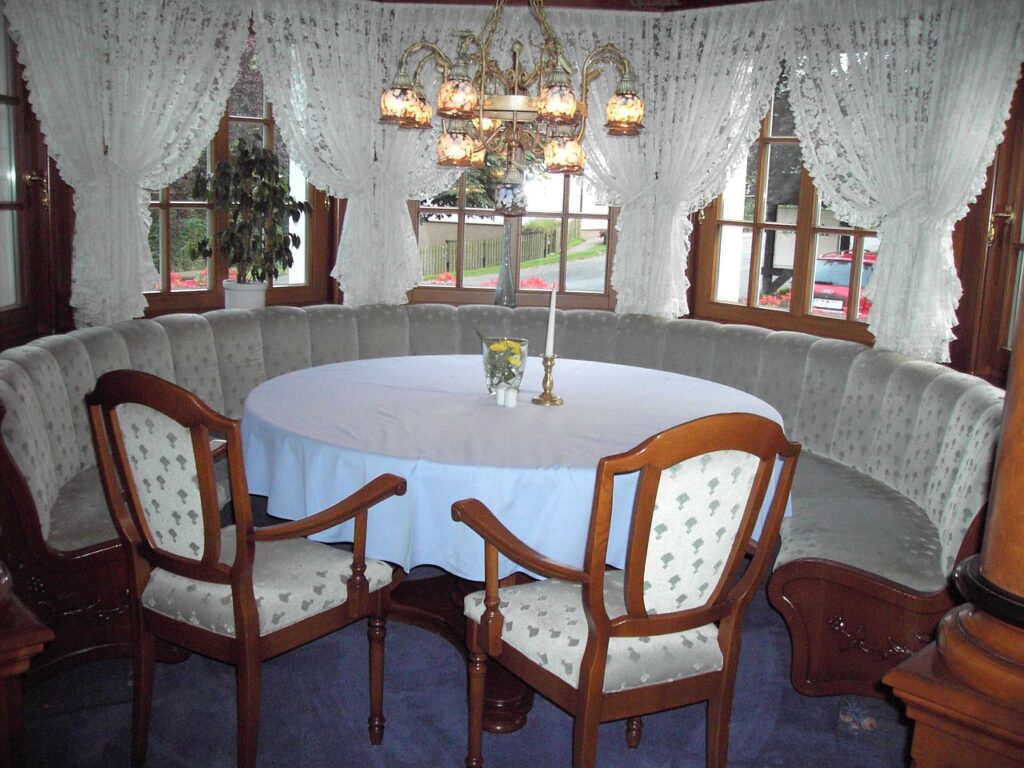
Strip away the Pinterest interpretations and actual Victorian curtains followed surprisingly specific rules. Heavy fabrics, multiple layers, ornate trim, and a willingness to block out daylight for the sake of drama defined window treatments between 1837 and 1901. Recreating the look in a modern home does not require a museum budget. It does require understanding what the Victorians actually did, because most “Victorian-style” curtains sold online are closer to 1990s bridal boutique than to authentic period design.
The Three-Layer Victorian Window
A proper Victorian window treatment was never one set of curtains. It was three layers, each with a specific job:
- Glass curtains (sheer layer): Thin lace, muslin, or net panels closest to the glass. Filtered light and obscured the view from outside.
- Sub-curtains (middle layer): Usually silk or light cotton in a solid color. Drawn at night, tied back during the day.
- Portieres (heavy drapes): Velvet, brocade, or damask outermost panels with elaborate trim. The dramatic show layer.
Modern interpretations often collapse this to two layers (sheers plus heavy drapes) which still reads distinctly Victorian. Three layers reads as museum-grade authentic.
Fabrics That Define the Look
Period-correct Victorian fabrics came in specific families. Stay within these for authenticity:
- Velvet: Cotton velvet for middle-class homes, silk velvet for wealthy households. Deep jewel tones (garnet, emerald, sapphire, aubergine).
- Damask: Reversible patterned weaves with botanical or heraldic motifs. Typically silk or wool.
- Brocade: Raised patterns woven in contrast threads, often with gold or silver.
- Chintz: Glazed cotton with floral prints. Extremely popular in cottages and secondary rooms.
- Lace: Nottingham lace, Brussels lace, and machine-made imitations for inner glass curtains.
- Moreen and mohair: Workhorse heavy wool fabrics for everyday Victorian households.
Avoid polyester velvet (reads artificial), pale pastels (not period), and anything with modern geometric patterns.
Colors the Victorians Actually Used
Aniline dyes invented in 1856 opened up a color palette Victorians embraced enthusiastically:
- Crimson and garnet reds
- Deep emerald and forest greens
- Bronze, ochre, and mustard golds
- Peacock teal and sapphire blues
- Aubergine and plum purples
- Rich browns (chocolate, walnut, mahogany)
The muted pastel “Victorian” palette commonly shown online is actually Edwardian or early 1900s taste. True Victorian interiors were darker and more saturated than most people remember.
Hardware and Mounting Styles
Rods and hardware did as much styling work as the fabric. Authentic options:
- Brass rods with decorative finials: Pineapples, urns, spears, or acorn shapes
- Wooden rods with turned finials: Often gilded, painted, or stained walnut
- Cornice boards: Covered wooden box valances topped with fabric, often padded and upholstered
- Lambrequins: Ornate shaped valances extending down the sides of the window frame
- Swag and cascade arrangements: Draped top treatments with vertical fabric cascades at each side
Height matters. Victorian rods typically mounted 4 to 8 inches above the window trim or at ceiling height in rooms with tall ceilings. Rods positioned high create the draping room height the Victorians loved.
Trim and Passementerie
Victorian curtains were loaded with trim. A panel without fringe, tassels, or cord reads as an early draft, not a finished window treatment. Common elements:
- Bullion fringe: Heavy twisted cord fringe along the bottom hem, 4 to 8 inches deep
- Gimp trim: Narrow woven trim edging along leading edges
- Tassels: Applied at tiebacks and bottom corners
- Rope tiebacks: Heavy twisted cord with oversized tassels
- Appliqued borders: Contrasting fabric strips along edges
Passementerie (the umbrella term for decorative trim) adds the craftsmanship Victorians valued. Even a plain velvet panel becomes unmistakably Victorian when edged with 6-inch bullion fringe.
Where to Buy Victorian Curtains
Very few mainstream retailers sell authentic Victorian window treatments. Your sourcing options:
- Custom drapery workrooms: Local fabric shops and drapery specialists. Expect $200 to $600 per panel with fabric, plus labor.
- Calico Corners and Fabric Guru: Decorator fabrics by the yard. Pair with a workroom.
- Ballard Designs and Ethan Allen: Higher-end retailers with some period-inspired options.
- Etsy: Surprising selection of custom Victorian-style drapes. Verify the maker’s reviews.
- Estate sales and antique shops: Original period curtains occasionally surface at $100 to $800 per panel.
- Restoration Hardware: Heavy velvet and damask panels that pass as transitional Victorian.
Budget for full window treatment (three layers, heavy fabric, hardware, trim): $800 to $2,500 per window for a proper job. DIY using ready-made velvet panels from Pottery Barn with added fringe runs closer to $300 per window.
Making Victorian Work in a Modern Home
Full period drama overwhelms most modern floor plans. Scale back with these adjustments:
- Use heavy drapes only, skip the layered look
- Pick one Victorian color, pair with otherwise neutral room
- Simplify trim to edge banding rather than full bullion fringe
- Ceiling-mount rods to emphasize height without adding visual weight
- Keep the hardware ornate; simplify the fabric
A single pair of emerald velvet panels with a brass rod and carved finials reads as Victorian influence without overwhelming a contemporary room. Full three-layer treatments work best in period homes or rooms with tall ceilings (9 feet plus).
Care and Maintenance
Heavy period fabrics need dry cleaning or professional hand cleaning. Do not machine wash silk damask, cotton velvet with glued trim, or anything with passementerie. Vacuum panels monthly with a brush attachment on low suction. Professional cleaning every 3 to 5 years extends life significantly.
The Bottom Line
Well-executed Victorian curtains transform a room more than almost any other design element. Heavy fabric, rich color, ornate trim, and proper hardware stack up to drama modern minimalism cannot touch. Invest in the right materials, even on one window, and the result feels decades earned rather than store-bought.