Bathrooms demand a floor that can handle constant moisture, splashes, humidity, and the occasional flood from an overflowing tub. Vinyl flooring in bathroom spaces has become the go-to solution for homeowners who want a waterproof surface that looks great and costs far less than tile.
But not all vinyl is created equal. In this guide we compare the three main types of bathroom vinyl, luxury vinyl plank (LVP), luxury vinyl tile (LVT), and sheet vinyl, and explain why SPC-core products are the best choice for wet environments in 2026.
- Can You Use Vinyl Flooring in a Bathroom?
- LVP vs LVT vs Sheet Vinyl for Bathrooms
- Why SPC Vinyl Is the Best Choice for Bathrooms
- SPC vs WPC for Bathrooms
- How to Install Vinyl Flooring in a Bathroom
- Vinyl Flooring vs Tile in Bathrooms
- Best Vinyl Flooring Brands for Bathrooms (2026)
- Maintenance Tips for Bathroom Vinyl Floors
- Cost to Install Vinyl Flooring in a Bathroom
- Frequently Asked Questions
Can You Use Vinyl Flooring in a Bathroom?
Yes. Vinyl is one of the most bathroom-friendly flooring materials available. The vinyl surface itself is 100 percent waterproof, meaning water that sits on top of the floor will not damage it. The real question is what happens when water gets beneath the surface, and that depends on the core construction.
LVP vs LVT vs Sheet Vinyl for Bathrooms
| Feature | LVP (Luxury Vinyl Plank) | LVT (Luxury Vinyl Tile) | Sheet Vinyl |
|---|---|---|---|
| Look | Wood-look planks | Stone or tile-look squares | Various patterns (sheet form) |
| Waterproof surface | Yes | Yes | Yes |
| Seams | Click-lock joints (many seams) | Click-lock joints (many seams) | Few or no seams |
| Water penetration risk | Moderate (seams can allow water through over time) | Moderate | Very Low (seamless sheet) |
| Core options | SPC or WPC | SPC or WPC | Fiberglass or felt-back |
| Comfort underfoot | Good (WPC is softer) | Good | Good (with cushion backing) |
| DIY difficulty | Easy (click-lock) | Easy (click-lock) | Moderate (requires precise cutting) |
| Cost per sq ft | $2.50 – $7 | $2.50 – $7 | $1 – $4 |
Why SPC Vinyl Is the Best Choice for Bathrooms
SPC stands for stone polymer composite (sometimes called stone plastic composite). It is a rigid-core vinyl with a core layer made of limestone powder and PVC. Here is why SPC outperforms other vinyl constructions in bathrooms.
- 100 percent waterproof core: Unlike WPC, which uses a foamed core that can theoretically absorb trace moisture over decades, SPC’s stone-based core will never swell, warp, or degrade from water exposure.
- Dimensional stability: SPC does not expand or contract with temperature changes, making it safe for bathrooms with radiant floor heating.
- Dent resistance: The rigid core resists indentation from heavy vanities, toilets, and dropped items.
- Thinner profile: SPC planks are typically 4 to 6 mm thick, making them easier to fit under door jambs and existing toilet flanges.
For LVP in the bathroom, always choose an SPC core product with a minimum 12-mil wear layer for residential use or 20-mil for heavy traffic.
SPC vs WPC for Bathrooms
| Property | SPC | WPC |
|---|---|---|
| Core material | Limestone + PVC | Wood plastic composite (foamed) |
| Waterproof | Yes (core and surface) | Surface yes, core is water-resistant |
| Comfort | Firmer (add underlayment for softness) | Softer, warmer underfoot |
| Dent resistance | Excellent | Moderate |
| Temperature stability | Excellent | Good |
| Best for bathrooms | Yes (recommended) | Acceptable but not ideal |
How to Install Vinyl Flooring in a Bathroom
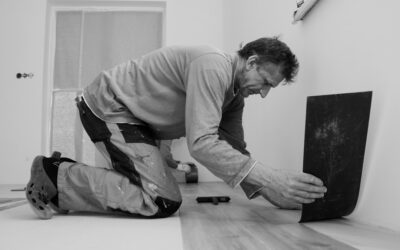
Click-lock LVP and LVT are among the easiest bathroom floors to install yourself. Here is a condensed installation guide.
Preparation
- Remove the toilet. It is far easier (and looks far better) to install flooring under the toilet rather than around it. Turn off the water supply, flush, disconnect the supply line, remove the mounting bolts, and lift the toilet off the flange.
- Check the subfloor. The subfloor must be flat within 3/16 inch over 10 feet. Use a self-leveling compound to fill low spots. Make sure plywood subflooring is dry and free of rot.
- Acclimate the planks. Leave the vinyl in the bathroom for 48 hours so it adjusts to the room’s temperature.
- Undercut door jambs. Lay a plank on the floor against the jamb and use an oscillating multi-tool to cut the jamb flush so the plank slides underneath.
Installation
- Start at the longest wall. Place 1/4-inch spacers along the wall to allow an expansion gap.
- Click the planks together. Angle the long side of the second plank into the first at roughly 20 degrees and press down until it clicks. Use a tapping block (never strike the plank directly) to close end joints.
- Stagger end joints. Offset seams by at least six inches from row to row to prevent a grid-like pattern and improve structural integrity.
- Cut around the toilet flange. Measure and mark the flange location on the plank. Use a jigsaw or oscillating tool to cut the curve. The toilet base will cover minor imperfections.
- Reinstall the toilet. Place a new wax ring on the flange, lower the toilet into position, press down firmly, and tighten the bolts. Reconnect the water supply.
Finishing Touches
- Install baseboards or quarter-round to cover the expansion gap.
- Apply a bead of 100 percent silicone caulk where the floor meets the tub or shower base. This provides an extra moisture barrier at the most vulnerable transition.
Vinyl Flooring vs Tile in Bathrooms
Tile has been the traditional bathroom floor for decades, but vinyl is closing the gap. Here is an honest comparison.
| Factor | Vinyl (SPC LVP/LVT) | Porcelain Tile |
|---|---|---|
| Waterproof | Yes (surface and core) | Yes (but grout can absorb moisture) |
| Comfort | Warmer and softer | Cold and hard |
| Slip resistance | Good (textured options available) | Varies (choose rated tile) |
| Installation cost | $3 – $7/sq ft installed | $8 – $15/sq ft installed |
| Durability | 15 – 25 years | 30 – 50+ years |
| Resale value | Good | Excellent |
| DIY friendly | Yes | Moderate to difficult |
For most homeowners, vinyl wins on cost, comfort, and ease of installation. Tile wins on longevity and luxury perception. If budget is a priority, waterproof vinyl delivers outstanding bathroom performance.
Best Vinyl Flooring Brands for Bathrooms (2026)
- COREtec Pro Plus: SPC core with a 20-mil wear layer and attached cork underlayment. One of the most trusted brands in the LVP market.
- Shaw Floorte Elite: Features an SPC core and exclusive Armor Flex wear layer for scratch and stain resistance.
- LifeProof (Home Depot exclusive): Budget-friendly SPC option with a lifetime residential waterproof warranty.
- Mohawk RevWood: Combines wood-fiber technology with a waterproof surface. Good for homeowners who want a wood feel.
- MSI Everlife: Wide range of styles, SPC construction, and competitive pricing for budget-conscious projects.
Maintenance Tips for Bathroom Vinyl Floors
- Wipe up standing water promptly. While the surface is waterproof, water that sits in seams for extended periods can work its way underneath over time.
- Use bath mats. Place mats outside the shower and tub to catch drips before they pool on the floor.
- Clean with vinyl-safe products. Use a damp mop with a pH-neutral cleaner. Avoid abrasive scrubbers, ammonia, and bleach.
- Check caulk annually. Replace any cracked or peeling caulk along the tub and shower surround to maintain the moisture seal.
- Use felt pads. Place felt pads under vanity legs and any furniture to prevent denting.
Cost to Install Vinyl Flooring in a Bathroom
A standard bathroom ranges from 40 to 75 square feet. Here is what you can expect to pay.
| Expense | DIY Cost | Professional Cost |
|---|---|---|
| Materials (SPC LVP, 60 sq ft + 10%) | $200 – $460 | $200 – $460 |
| Underlayment (if not attached) | $30 – $60 | $30 – $60 |
| Transition strips and trim | $20 – $40 | $20 – $40 |
| Labor | $0 (your time) | $180 – $450 |
| Total | $250 – $560 | $430 – $1,010 |
Visit our bathroom flooring guide for more options and cost comparisons.
Frequently Asked Questions
Is vinyl flooring waterproof enough for bathrooms?
Yes. SPC-core luxury vinyl plank and tile are 100 percent waterproof on the surface and through the core. They are specifically designed for moisture-heavy rooms like bathrooms, kitchens, and laundry rooms.
Will vinyl flooring warp in a humid bathroom?
SPC vinyl will not warp because its stone-based core is dimensionally stable. WPC vinyl has slightly more risk in extremely humid conditions but still performs well in most residential bathrooms.
Can I install vinyl plank over bathroom tile?
Yes, as long as the existing tile is flat, firmly bonded, and in good condition. Use a self-leveling compound to fill deep grout lines if needed. The click-lock vinyl floats over the tile without adhesive.
How long does vinyl flooring last in a bathroom?
Quality SPC vinyl with a 20-mil wear layer typically lasts 15 to 25 years in a residential bathroom. Entry-level products with thinner wear layers may last 10 to 15 years.
Is sheet vinyl better than LVP for bathrooms?
Sheet vinyl has fewer seams, which theoretically reduces water penetration risk. However, modern SPC LVP with tight click-lock joints and proper caulking at transitions performs just as well for most bathrooms. LVP also looks more realistic and is easier to install.
Do I need underlayment for vinyl in a bathroom?
Many SPC products come with an attached underlayment. If yours does not, add a thin vinyl-compatible underlayment for comfort and minor subfloor imperfection correction. Do not use a thick foam underlayment, as it can cause the click-locks to separate.
Prefer to explore on your own?
See how new flooring looks in your actual room in seconds — free, no signup.
Try the free Floor Studio →