If you’ve found a puddle under your water heater or you’re running out of hot water, you’re probably wondering whether water heater tank repair is even possible. Here’s the straight answer most homeowners need to hear up front: a true water heater tank repair on a rusted-through steel tank is not a thing you can reliably do. But plenty of problems that look like a dead tank are actually cheap, fixable parts. The trick is knowing which is which before you spend a dime.
I’ve replaced and repaired hundreds of these units. Below I’ll walk you through what’s worth fixing, what means it’s time for a new heater, and where you absolutely need a licensed plumber instead of a YouTube video.
Safety First: This Appliance Can Hurt You
Before you touch anything, understand what you’re dealing with. A water heater combines several real hazards in one steel box.
- Gas: Gas units have a live burner and a gas supply line. A gas leak or improper relight can cause fire or explosion. Carbon monoxide is also a risk if venting is bad. Gas work belongs to a licensed pro.
- Electric: Electric units run on 240 volts. That’s enough to kill you. Always shut the breaker off and verify it’s dead before opening any panel.
- Pressure: The tank holds pressurized hot water. The temperature and pressure relief (T&P) valve is a critical safety device. If pressure builds with nowhere to go, a tank can rupture violently.
- Scald risk: Water stored at 120°F and above causes serious burns fast. At 140°F a child can be scalded in seconds. Assume any water coming out is hot enough to injure you.
The golden rule before any work: shut off the power (breaker) or gas (set the control to “off” or “pilot”), close the cold water supply valve on top of the tank, and let things cool. For most repairs you’ll also need to drain some or all of the tank.
Is It Really the Tank? What Leaks Are Actually Fixable
This is the most important section. A water heater that “looks like it’s leaking from the tank” is often leaking from something you can fix for under $40. Track down the exact source before you panic.
Things that look like a tank leak but are repairable
- Loose drain valve: The plastic or brass valve at the bottom drips. Often it just needs tightening, or a $10 replacement valve or hose cap.
- T&P valve discharge: Water dripping from the discharge pipe usually means the valve is doing its job (releasing excess pressure) or the valve itself is worn. That’s a valve or pressure issue, not a dead tank.
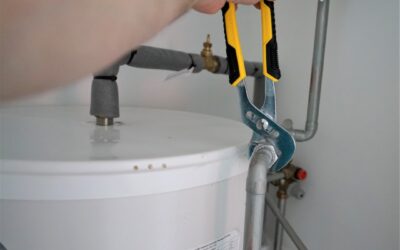
- Loose fittings or nipples: The hot and cold connections on top can weep. Often fixed by tightening or resealing with fresh thread tape.
- Condensation: A new unit, very cold incoming water, or high humidity can leave water on the outside that mimics a leak. Dry it off and watch where fresh water actually appears.
The one leak you cannot repair
If water is seeping from the body of the tank itself, or pooling from underneath with no traceable fitting, the inner steel tank has rusted through. There is no patch, sealant, or epoxy that holds against pressurized hot water on corroded steel. Once the tank wall is breached, the unit is at end of life and needs to be replaced. Don’t let anyone sell you on “sealing” a tank leak. It will fail again, usually worse.
Repairs You Can Reasonably Do Yourself
DIY here is limited to swapping minor parts, and only with the power or gas off and the cold water supply closed first. If any of this feels beyond you, stop and call a plumber. These are the realistic homeowner jobs.
Thermocouple (gas units)
If your gas pilot won’t stay lit, the thermocouple is the usual culprit. It’s a small sensor that tells the gas valve the pilot is burning. A replacement runs about $20. Shut off the gas first.
Heating element (electric units)
No hot water or not enough on an electric unit often points to a burned-out element. Elements cost roughly $20 to $50. This means shutting the 240V breaker off, confirming it’s dead with a tester, draining the tank, and pulling the old element. If you’re not comfortable working around live electrical panels, hire it out.
Anode rod
The anode rod is a sacrificial metal rod that corrodes so your tank doesn’t. Replacing it every few years (around $20 to $50 for the rod) genuinely extends tank life. It takes a breaker bar and some muscle, but it’s the single best maintenance move for longevity.
T&P valve
If the T&P valve drips constantly or fails a test, the valve itself can be swapped for about $20 to $40. But here’s my caution: a T&P valve that keeps releasing often means a real pressure problem in your system (failing expansion tank, too-high incoming pressure, thermal expansion). Don’t just cap it or ignore it. If you replace the valve and it keeps discharging, call a licensed plumber to diagnose the pressure. That valve is the last line of defense against a tank rupture.
When to Call a Licensed Plumber
I’m all for saving money, but some jobs are not casual DIY. Call a pro for any of these:
- Anything involving the gas line, gas valve, burner assembly, or venting.
- A T&P valve that keeps discharging, or any sign of excessive system pressure.
- You smell gas. Leave the house and call your gas utility first, then a plumber.
- Discolored, rusty hot water that doesn’t clear, or rumbling that persists after flushing.
- Any leak you can trace to the tank body itself.
- Full unit replacement, especially gas, which involves connections, venting, and code requirements.
A licensed plumber carries the tools, the testing gear, and the liability coverage. Gas and pressure mistakes don’t just cost money; they cost lives.
How Long Should a Water Heater Last?
A standard tank water heater lasts about 8 to 12 years. If your unit is in that range and the tank is leaking, repair almost never makes financial sense. You’d be putting parts into a unit whose tank is on borrowed time. Knowing the age helps you decide fast: check the serial number sticker, which usually encodes the manufacture date.
Signs the end is near include rusty water, popping or rumbling from sediment, water that never gets hot enough, and of course any moisture from the tank body. Flushing sediment yearly and replacing the anode rod can push a unit toward the longer end of that range.
Repair vs. Replace: The Cost Breakdown
Here’s how the numbers usually shake out, so you can make a clear-eyed decision.
- Thermocouple: about $20 for the part.
- Heating element: roughly $20 to $50.
- Anode rod: roughly $20 to $50.
- T&P valve: about $20 to $40.
- Full replacement, installed: typically $1,000 to $2,500 depending on type, size, and local labor.
My rule of thumb: if the fix is a cheap part and the tank is sound and under about 8 years old, repair it. If the tank is leaking, the unit is past 8 to 10 years, or the repair would run hundreds of dollars on an aging unit, put that money toward replacement. A new heater is more efficient and resets the clock on a problem that’s only going to get worse.
The Bottom Line
Most jobs people call “water heater tank repair” are really part swaps: a thermocouple, an element, an anode rod, or a relief valve, all doable for a homeowner who shuts off power or gas and the cold water supply first and respects the scald and pressure hazards. What you can’t repair is a tank that’s rusted through. When the steel itself fails, the only fix is a new unit. And anytime gas, persistent pressure, or anything beyond your comfort enters the picture, get a licensed plumber on the phone. It’s the cheapest insurance you’ll ever buy.