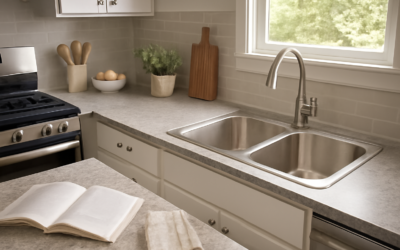
Most people who rule out laminate countertops are remembering the flat, obviously printed patterns of decades past. Wilsonart HD laminate is the manufacturer’s High Definition line, built to make stone, wood and abstract patterns look far more convincing up close, and it pairs those prints with a tougher surface technology called AEON. It is still high-pressure laminate glued to a particleboard or plywood core, so it keeps the low cost and easy installation that made laminate popular in the first place.
The short answer for shoppers: Wilsonart HD is the premium tier of Wilsonart laminate. It comes standard with AEON enhanced scratch and scuff resistance and built-in antimicrobial protection, it is sold as the 0.039 inch thick Type 376 sheet used for horizontal work surfaces, and it is offered in premium textured finishes, one of which (Mirage) is exclusive to the line. Colors change often, so the current pattern list lives on the manufacturer’s website and in physical sample chips.
Wilsonart HD Laminate Specs at a Glance
The figures in this table come from the manufacturer’s HD technical data sheet. Data sheets get revised, so treat this as a starting point and confirm against the current version before you order sheets or sign off on fabricated tops.
| Spec | Value | What it means |
|---|---|---|
| Grade | Type 376 (HGP, horizontal general purpose) | Rated for counters, islands, vanities, desks and tables |
| Thickness | 0.039 inch, plus or minus 0.005 inch | Standard countertop thickness; also postformable for rolled edges |
| Standard sheet sizes | 48 x 96, 60 x 96, 60 x 120 and 60 x 144 inches | Longer sheets reduce seams on long runs and islands |
| Surface technology | AEON enhanced scratch and scuff resistance | Up to 5 times more scuff and scratch resistant and up to 3 times more wear resistant than competitive laminates with similar finishes, per the maker |
| Antimicrobial | Built in, standard | Inhibits odor and stain causing bacteria, mold and mildew on the surface; not a substitute for cleaning |
| HD premium finishes | #35 Mirage, #55 Glaze, #57 Aligned Oak | Textured finishes with an upcharge; Mirage is exclusive to the HD line |
| Use limits | Interior only; avoid prolonged heat above 275 degrees F | Use trivets for pans; keep out of intense direct sun |
The composition is classic high-pressure laminate: a decorative printed paper saturated with melamine resin, pressed over kraft paper layers saturated with phenolic resin at more than 1,000 pounds per square inch and temperatures approaching 300 degrees F. What sets the HD line apart is the print quality on that top paper and the finish texture pressed into it, not a different core.
What “High Definition” Actually Means
Standard laminate patterns are printed with a repeat that your eye catches after a few feet, and the colors can look slightly flat. High Definition designs use larger, more detailed images with more color depth, which matters most for stone looks. Marble veining reads as continuous movement rather than a tile-like repeat, and granite looks show crystal-like flecks instead of a speckled print.
The other half of the realism is texture. A glossy print on a perfectly flat sheet gives itself away when light skims across it. Wilsonart HD laminate uses finishes that vary the sheen or follow the pattern, so light breaks up the way it would on honed stone or brushed wood. That is why the finish you choose is as important as the color.
Wilsonart HD Finishes Compared
Finish numbers appear on sample chips and order forms. The manufacturer publishes a nominal gloss reading for each premium finish, measured at a 60 degree angle; a higher number means more shine.
#35 Mirage
Mirage combines matte and glossy areas across the sheet, mimicking stone that is partly polished and partly weathered. It carries a nominal gloss reading of 50, which is the shiniest of the three HD premium textures. The manufacturer lists it as exclusive to the HD line. Mirage tends to suit marble and quartz-look patterns where you want a polished impression without a mirror-like surface that shows every fingerprint.
#55 Glaze
Glaze layers matte features over a semi-gloss base for a time-worn effect, with a nominal gloss reading of 25. It suits soapstone, slate and concrete looks, and anything where a softer, lived-in surface fits the room. A lower sheen also hides fine scratches and water spots a little better than a glossy finish does.
#57 Aligned Oak
Aligned Oak is a synchronized texture: the grain you feel lines up with the grain printed on the sheet. Its nominal gloss reading is 7, so it is essentially matte. This finish is meant for aged oak designs on islands, desks and tables where people touch the surface constantly and a mismatched texture would feel fake.
Other Wilsonart finishes, such as gloss and textured gloss options, may be available on some HD designs, but availability depends on the pattern. Check the finish code printed on the sample chip before you order, since the same design can look quite different in two finishes.
Choosing a Wilsonart HD Color
The HD collection leans heavily toward stone looks: white and gray marbles, warm beige granites, dark speckled granites, soapstone and concrete effects. There are also wood grains and some solid or near-solid designs. Because the lineup changes, the most reliable way to shop is to request full-size samples or view large sheets at a fabricator, not just a two-inch chip.
- Look at a large sample under your own lighting. Veining that looks dramatic on a chip can feel busy across a 10-foot run.
- Match cabinet undertones. Warm wood cabinets pair better with cream and beige stone looks; white or gray painted cabinets pair with cooler marbles.
- Think about seams. Busy granite patterns hide seams better than clean white marble patterns with long veins.
- Pick the edge early. Postformed rolled edges carry the pattern around the front; square edges usually use a matching laminate strip, which shows a thin dark line on stone looks.
- Consider maintenance. Very dark solid colors and high-gloss finishes show crumbs, dust and scratches more than mid-tone patterns with texture.
Many shoppers specifically search for Wilsonart high definition countertops in marble looks because a real marble top is expensive and etches easily. A good HD marble pattern on a textured finish delivers most of the look for a fraction of the price, with none of the etching from lemon juice or wine.
How Wilsonart HD Countertops Are Made and Installed
You can buy HD laminate in two main ways: as prefabricated countertops cut to your layout by a fabricator, or as loose sheets you or a cabinetmaker bond to a substrate. Prefabricated postformed tops are the most common route for kitchens because the rolled front edge and integral backsplash come ready made.
If you are laminating sheets yourself, the general process looks like this:
- Build or prepare a flat substrate, typically 3/4 inch particleboard or MDF, often doubled at the edges for a 1-1/2 inch look.
- Let the laminate and substrate acclimate in the same room for at least 48 hours so they reach the same moisture level.
- Cut the sheet slightly oversize with a laminate blade or scoring tool, supporting it fully so it does not crack.
- Apply edge strips first if you are using square edges, trim them flush, then do the top.
- Apply contact cement to both surfaces per the adhesive maker’s directions, let it flash off, and use dowels or slip sheets to position the sheet before contact.
- Roll the entire surface firmly from the center out with a J-roller to remove air and bond fully.
- Trim edges with a flush-trim or bevel bit and file sharp corners smooth.
Wilsonart HD laminate is not structural and must be bonded to a suitable substrate. The manufacturer also notes it should not go directly over plaster, concrete walls or gypsum board. For sink cutouts, round inside corners with a drilled radius rather than cutting square corners, which tend to crack.
Cost Ranges
HD designs sit at the upper end of laminate pricing, and finishes like Mirage, Glaze and Aligned Oak are listed as premium finishes with an upcharge. Exact pricing varies by region, fabricator and design.
- Loose sheets: generally a modest premium over standard laminate sheets of the same size.
- Prefabricated laminate countertops installed: commonly about $25 to $60 per square foot depending on edge profile, backsplash and complexity.
- Compared with stone: granite and quartz commonly run several times that, so HD is often chosen for rentals, budget remodels and secondary spaces like laundry rooms.
Expect extra charges for custom edge profiles, undermount-style edge treatments, long runs without seams that require 12-foot sheets, and removal of an old top.
Care and Cleaning
The AEON surface resists scuffs and wear better than standard laminate, but it is still laminate. A few habits keep it looking new for years:
- Clean daily with warm water and mild dish soap, or a laminate countertop cleaner that is free of abrasives.
- Skip scouring powders, abrasive pads and harsh chemicals, which dull the finish texture.
- Always use a cutting board. Scratch resistance is not knife resistance.
- Set hot pans, slow cookers and air fryers on trivets. Prolonged heat can blister or discolor the surface.
- Wipe spills promptly, especially near seams and around the sink cutout, where water can swell the particleboard core.
The built-in antimicrobial protection helps against odor and stain causing bacteria on the surface, but it is not a cleaning shortcut. Normal kitchen hygiene still applies.
Troubleshooting Common Problems
Bubbles or loose spots after installation: usually a contact cement problem, such as too little adhesive or bonding before it flashed off. A heat gun on low and firm rolling can sometimes reactivate the bond; larger areas need the section relaminated.
Swelling at the sink or seam: water has reached the core. Reseal the sink rim and seam with silicone once it dries, and replace badly swollen sections.
Visible seam line: seams are normal on laminate. A tight seam with color-matched seam filler is less noticeable on busy granite patterns. Planning seams away from the sink helps.
Dull spots: often caused by abrasive cleaners. They rarely polish back out, so switch cleaners before the damage spreads.
When to Call a Pro
Simple straight runs of prefabricated top are a reasonable DIY job for a handy homeowner. Call a fabricator or installer for L-shaped and U-shaped kitchens that need mitered corners, long islands that need 12-foot sheets, undermount sink setups and any job where you are laminating your own sheets for the first time on an expensive design. Sink and faucet hookups that go beyond swapping like for like belong with a plumber.
Frequently Asked Questions
Is Wilsonart HD laminate worth the upgrade over standard laminate?
For kitchens, usually yes. You get more realistic stone and wood prints, AEON scratch and scuff resistance and antimicrobial protection as standard. For a closet shelf or utility room, standard laminate is often enough.
How thick is Wilsonart HD laminate?
The Type 376 sheet is 0.039 inch thick, plus or minus 0.005 inch. The finished countertop thickness depends on the substrate, typically 1-1/2 inches with a built-up edge.
What sheet sizes does Wilsonart HD come in?
The technical data sheet lists 48 x 96, 60 x 96, 60 x 120 and 60 x 144 inches. Availability can vary by design and finish, so confirm with your supplier.
Can you put hot pans on Wilsonart HD countertops?
No. The maker advises against prolonged temperatures above 275 degrees F. Use trivets or hot pads under pots, pans and heat-producing appliances.
Can Wilsonart HD laminate be used outdoors?
No. It is rated for interior use only and should be kept away from intense, continuous direct sunlight.
Which Wilsonart HD finish hides scratches best?
Lower-gloss textures such as #55 Glaze and #57 Aligned Oak tend to hide fine scratches and water spots better than higher-sheen finishes. Check samples under your own lighting before deciding.
Prefer to explore on your own?
See how new flooring looks in your actual room in seconds — free, no signup.
Try the free Floor Studio →