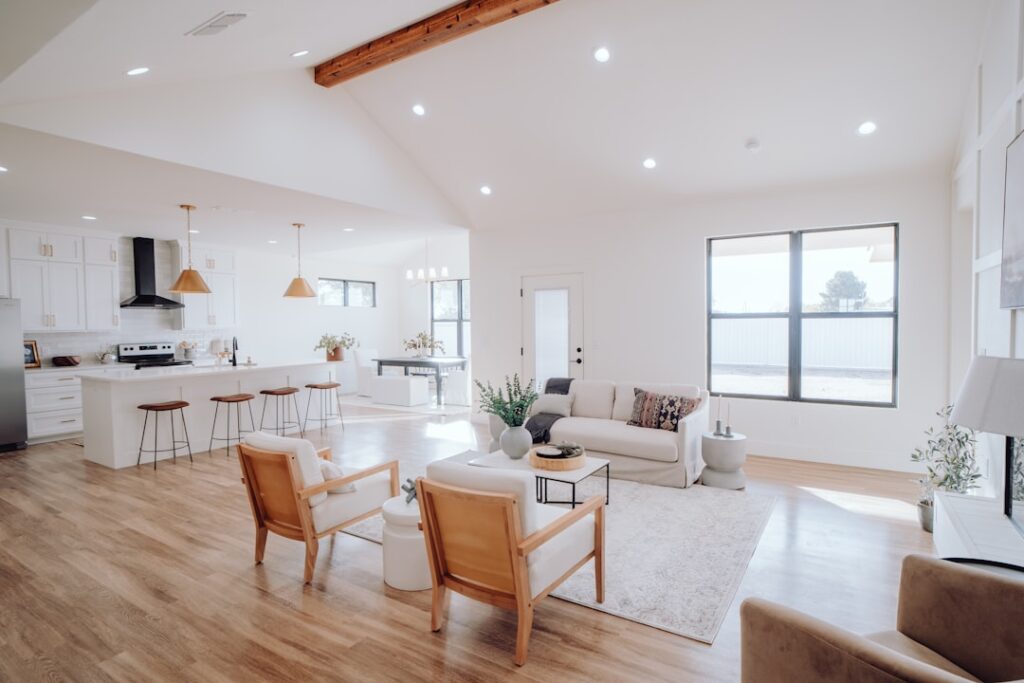
The difference between a general handyman and a true craftsman shows up most clearly in a sand-and-refinish job. A wood floor specialist brings calibrated moisture meters, dustless sanding equipment, NWFA training, and an eye for grain matching that a generalist simply does not. Hiring one costs more upfront, but it usually saves money against the alternative — paying twice when a botched refinish has to be ripped out.
What a Specialist Actually Does
A wood floor specialist focuses on installation, sanding, refinishing, board replacement, and color matching across solid and engineered hardwood. They typically do not chase tile, vinyl, or carpet work, which is why their results outperform jack-of-all-trades flooring contractors on hardwood-specific jobs.
Specific services include site-finished installs, dustless sanding with HEPA containment, water-based and oil-based finish application, custom stain matching, and gap filling on older floors. Many also handle parquet restoration and herringbone pattern repairs that off-the-shelf contractors won’t touch.
When You Need a Specialist vs a Generalist
A floating engineered floor in a single bedroom is fine for a competent generalist. But the moment you’re dealing with site-finished oak, antique parquet, water damage on a 75-year-old maple floor, or anything involving stain matching, you need someone whose entire business is hardwood.
The cost premium is usually 15-30% over a general flooring contractor. On a $4,500 refinish job, that’s maybe $700-$1,300 extra — small money against the $8,000-$12,000 you’d spend ripping out a bad job and starting over.
Credentials That Actually Matter
The National Wood Flooring Association (NWFA) runs the most respected certification programs in North America. Look for these specific designations:
- CP (Certified Professional): Entry-level installer or sand-and-finish credential
- CI (Certified Installer): Verified installation competence
- CSF (Certified Sand and Finish): Specialized refinishing training
- CWFI (Certified Wood Flooring Inspector): Independent inspection work, separate from installers
State licensing varies. California, Florida, and Arizona require contractor licenses for jobs over set thresholds — $500 in California, $2,500 in Arizona. Always verify the license number on the state board’s website rather than trusting what’s on a business card.
Typical Costs for Specialist Work
Sand and refinish runs $3-$8 per square foot depending on your region, with three coats of water-based polyurethane like Bona Traffic HD pushing the high end. Solid oak installation lands between $8 and $14 per square foot installed for site-finished work. Custom stain matching adds $0.50-$1.50 per square foot.
Specialty repairs price separately. Replacing eight to ten damaged boards in a heritage maple floor typically costs $400-$900 depending on board availability and how aggressive the weave-in needs to be. Patching parquet runs higher — often $1,200-$2,500 for a small bathroom doorway transition because each tile must match grain direction.
Questions to Ask Before Hiring
Three questions separate real specialists from pretenders. First, ask what moisture meter they use and what reading triggers them to delay an install. A competent answer cites a specific pin or pinless model (Delmhorst, Wagner, Tramex) and a number between 6% and 12% depending on species and region.
Second, ask about dust containment. Modern dustless systems like Bona Atomic DCS or Festool extractors capture 90%+ of fines. If the answer is “we cover everything in plastic,” walk away.
Third, ask for two references on jobs at least three years old. New work always looks good. The real test is whether the finish has held up through three winters of heating-season dryness and three humid summers.
Red Flags to Watch For
Verbal-only quotes are a major warning sign. Anything over $2,000 should come with a written scope including product names, finish coats, and a workmanship warranty separate from the manufacturer warranty.
Demands for more than 30% deposit on residential work are another red flag. Material costs rarely exceed a third of the total job, so a 50% deposit usually means cash-flow problems on the contractor’s end. Bona, DuraSeal, and Pallmann finishes are stocked locally — they don’t require massive upfront payment.
Pressure to skip the moisture test or the screen-and-recoat conversation also signals trouble. A specialist will always discuss whether your floor needs a full sand or just a maintenance coat, because the difference is $1,500-$3,000 on a typical home.
What Specialists Wish Homeowners Knew
Hardwood needs 65-75°F and 35-55% relative humidity during install. Skipping acclimatization to save two days causes cupping and gapping that no amount of finish work can hide. A good specialist will refuse to start until conditions are stable, even if it pushes the timeline by a week.
Water-based polyurethane is the right choice for 90% of modern homes. It dries fast, smells less, ambers far less than oil-based, and Bona Traffic HD now matches the durability of old-school oil products. Oil-based still has a place for deep amber tones on white oak, but it’s not automatically the “better” finish many homeowners assume.
Final Hiring Checklist
Confirm NWFA certification, state license, and active general liability insurance with at least a $1 million policy. Get the quote in writing with product SKUs listed. Verify two long-term references and check their work in person if possible. Pay no more than 30% upfront, the next third at material delivery, and the balance only after final inspection of the cured finish — typically seven days after the last coat for water-based products.
What to Expect During the Job
A typical 1,200 square foot whole-house sand and refinish takes 4-6 days from sanding through final coat. Day one is rough sanding with 36-grit, day two is medium sanding at 60-80 grit, day three is fine sanding and edging at 100-120 grit. Stain (if used) goes on day four. Three coats of water-based polyurethane follow on days four through six with light screening between coats.
Plan for the home to be unusable during the project. Dust containment helps but doesn’t fully prevent fines from migrating. Pets need boarding, anyone with respiratory sensitivities should stay elsewhere, and the HVAC system should be off or running on recirculation with filters changed afterward.
The finish needs 7-14 days to fully cure even though it’s walkable in 24-48 hours. Furniture goes back after seven days. Rugs stay off until 21-30 days have passed. Putting rugs down too early traps solvent vapors and can leave permanent marks where the rug pad contacts the floor.
Prefer to explore on your own?
See how new flooring looks in your actual room in seconds — free, no signup.
Try the free Floor Studio →