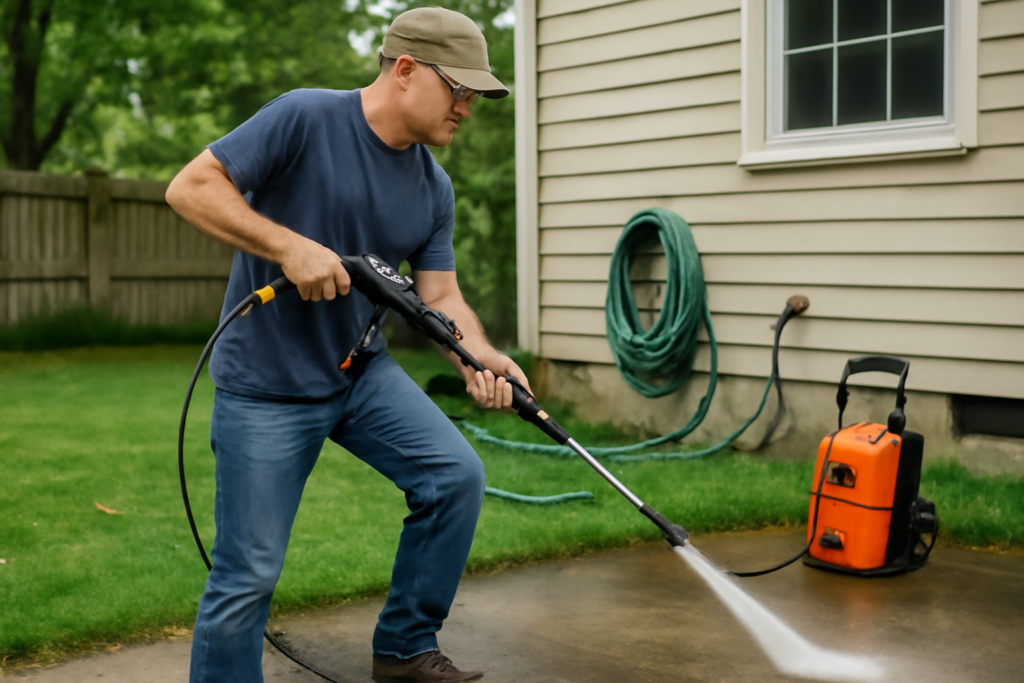
A Worx pressure washer is the tool you reach for when a garden hose isn’t cutting it but you don’t want to drag out a screaming gas unit. Worx splits its lineup into two useful families: the cordless 40V Hydroshot line that draws water from any source, and corded electric washers that push around 2000 PSI for driveways and siding. A Worx pressure washer won’t out-blast a 3300 PSI gas machine, but for most homeowner jobs it hits a sweet spot of portability, weight, and price between $100 and $250.
I’ve put these through decks, patio furniture, muddy mountain bikes, and vinyl siding. Here’s what each model actually does, where it excels, and the tricks that squeeze more cleaning out of them.
- The Hydroshot: A Cordless Washer That Goes Anywhere
- Corded Worx Washers for Bigger Jobs
- PSI vs. GPM: Why Both Numbers Matter
- Nozzles, Tips, and Getting the Most Punch
- Batteries, Runtime, and the Power Share Ecosystem
- Maintenance and Off-Season Storage
- Real Jobs and How the Worx Handles Each
- Is a Worx Pressure Washer Right for You?
The Hydroshot: A Cordless Washer That Goes Anywhere
The flagship is the WG644 Hydroshot, running on Worx’s 40V Power Share platform (two 20V batteries clicked together). Its headline feature isn’t raw pressure, it’s independence: the Hydroshot can siphon water from a bucket, lake, rain barrel, or pool through an included suction hose, so you don’t need a spigot within reach.
Realistic specs on the WG644: about 725 PSI of pressure at the nozzle and roughly 0.53 gallons per minute of flow. That’s a fraction of a big washer’s PSI, but the flow and a tight nozzle give it enough punch for real cleaning. Runtime lands around 10 to 20 minutes of continuous spray on a 4.0Ah pack, longer if you trigger in bursts. The older WG629 and WG630 kits bundle different battery and accessory combinations; the wand and pump are broadly similar.
Where the Hydroshot earns its keep: rinsing a muddy mountain bike at the trailhead, washing salt off a truck, cleaning patio furniture, spraying down kayaks, and knocking cobwebs off eaves. It weighs only a few pounds with the battery and you can run it one-handed. For a lightweight, go-anywhere rinse tool, few things beat it.
Corded Worx Washers for Bigger Jobs
When you need to strip a driveway or blast green algae off north-facing siding, the corded electrics step up. Worx corded models generally run in the 1600 to 2000 PSI range with flow around 1.2 to 1.5 GPM, plugging into a standard 120V outlet. That extra pressure and roughly double the flow of a Hydroshot make a real difference on flat, caked-on grime.
These units use an axial cam pump, a 14-amp motor on the higher models, and a hose reel or wand storage on the cart. They ship with a set of quick-connect nozzles, usually a 0-degree pencil tip, a 25-degree cleaning tip, a soap applicator, and sometimes a turbo nozzle. For a homeowner washing a car, a deck, a fence, and a concrete patio a few times a year, a 2000 PSI corded model in the $150 to $200 window covers nearly everything without gas maintenance.
PSI vs. GPM: Why Both Numbers Matter
Buyers fixate on PSI and ignore GPM, then wonder why cleaning feels slow. Pressure breaks the bond holding dirt to a surface; flow carries that dirt away and covers area. A useful shorthand is Cleaning Units, or CU, which is PSI multiplied by GPM.
- Hydroshot WG644: roughly 725 PSI x 0.53 GPM = about 384 CU. Great for spot rinsing, light for large flat surfaces.
- Corded 2000 PSI model: roughly 2000 PSI x 1.4 GPM = about 2,800 CU. Real driveway and siding capability.
- Typical gas unit: 3000 PSI x 2.5 GPM = 7,500 CU, for comparison and context.
Match the tool to the job. The Hydroshot is a precision rinse gun; the corded washer is a surface cleaner. Neither is a gas replacement for stripping paint or cleaning a 1,000-square-foot lot fast.
Nozzles, Tips, and Getting the Most Punch
The nozzle does more for cleaning power than most owners realize. On the Hydroshot, the adjustable tip goes from a wide fan to a tight 0-degree jet. Use the tight setting for stubborn spots and the fan for rinsing, but never aim the 0-degree jet at soft wood, window screens, or bare skin; that concentrated stream can gouge cedar and break the skin.
A few field-tested tips to boost results:
- Get closer: Pressure drops fast with distance. Working 6 to 12 inches from the surface roughly doubles the effective impact versus arm’s length.
- Let detergent dwell: Apply soap with the low-pressure applicator, wait 3 to 5 minutes so it lifts grime, then rinse. Chemistry does the work pressure can’t.
- Keep the inlet filter clean: If you’re siphoning from a bucket, screen the water. Grit destroys pump seals faster than anything else.
- Use fresh, warm batteries: The Hydroshot sags in cold weather. A 40-degree pack delivers noticeably less runtime than one stored at room temperature.
Batteries, Runtime, and the Power Share Ecosystem
The smartest reason to buy a Hydroshot is if you already own Worx 20V or 40V tools. Power Share means the same batteries run your drill, trimmer, and washer, so you’re only buying the bare tool. If you’re starting from scratch, factor in $80 to $150 for a decent battery-and-charger kit on top of the tool price.
For sustained cleaning, keep two 40V pairs in rotation on a dual-port charger. One set cleans while the other charges, which turns a 15-minute-per-charge limit into a full afternoon of intermittent work. High-capacity 5.0Ah packs stretch runtime meaningfully over the base 2.0Ah cells.
Maintenance and Off-Season Storage
Electric washers are low-fuss, but a few habits keep them alive for years:
- Flush after every use: Run clean water through the pump for 30 seconds, especially after siphoning from a bucket or using detergent.
- Never run dry: Dry-firing the pump for more than a few seconds cooks the seals. Confirm water is flowing before you squeeze the trigger.
- Winterize: In freezing climates, run pump-saver antifreeze through the unit or blow it out with low-pressure air, then store indoors. A cracked pump from ice is the most common death for a stored washer.
- Store batteries warm and partial: Around 40 to 60 percent charge in a spot above freezing preserves lithium capacity through winter.
Real Jobs and How the Worx Handles Each
Specs only matter in context, so here’s how these tools actually perform on the chores homeowners throw at them:
- Washing a car or truck: The Hydroshot excels here. Its lower pressure won’t strip wax or dent panels, the fan tip rinses soap cleanly, and drawing from a bucket of warm soapy water means no hose reeling. This is arguably its best single use.
- Concrete driveway and patio: A job for the corded 2000 PSI model. Pair it with a surface-cleaner attachment if the threads match, apply a concrete detergent, let it dwell, then work in overlapping passes. The Hydroshot is too weak here and will frustrate you.
- Vinyl and fiber-cement siding: The corded model at 25 degrees, kept moving and angled slightly downward, lifts algae and pollen without driving water behind the boards. Never blast straight up under lap siding.
- Wood decks and fences: Dial pressure down and keep the fan wide. Both machines can etch soft wood if you park a tight jet in one spot, so keep the wand moving.
- Outdoor gear, bikes, and grills: The Hydroshot’s portability wins. Take it to the trailhead, the campsite, or the dock and rinse mud, salt, and grime anywhere there’s a water source.
The honest takeaway: the Hydroshot is a rinse-and-detail specialist, and the corded unit is your surface workhorse. Owning both covers nearly every residential scenario for less than the cost of one mid-tier gas washer, and neither needs winter fuel stabilizer, oil changes, or pull-starting on a cold morning.
Is a Worx Pressure Washer Right for You?
Buy the Hydroshot if you want a light, portable rinse tool for bikes, cars, gear, and off-grid spots, or if you’re already in the Power Share family. Buy a corded 2000 PSI Worx if you have real driveway, deck, and siding jobs and want to skip gas upkeep. Look elsewhere, toward a gas unit, only if you’re stripping large flat areas regularly or need to run commercial hours. For the typical homeowner, a Worx pressure washer delivers 90 percent of the results at a fraction of the weight, noise, and maintenance, and that’s exactly why they’ve become such a common pick.