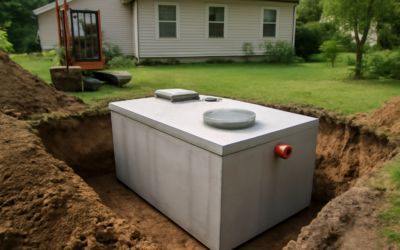
The tank itself is the cheap part — that surprises almost everyone pricing a septic replacement. A typical 1 000 gallon concrete septic tank cost runs $900 to $1,800 for the tank alone, yet installed totals land between $2,500 and $6,000, and a full new system with a drain field can pass $15,000. Knowing where the money actually goes lets you compare bids intelligently and spot the line items with room to negotiate. This guide breaks down 2026 tank prices, delivery and excavation charges, the permit and inspection fees nobody mentions, and the handful of decisions that swing the total by thousands.
Why 1,000 Gallons Is the Standard Size
Most state codes key tank size to bedrooms, not occupants, because bedrooms predict peak load. A 1,000-gallon tank is the common minimum for 3-bedroom homes (2-bedroom homes can sometimes use 750 gallons; 4-bedroom homes typically step up to 1,250, and 5-bedroom to 1,500). The tank’s job is to hold wastewater long enough — ideally 24 to 48 hours — for solids to settle and grease to float before clarified effluent moves to the drain field. Undersizing shortens that retention time and pushes solids downstream, which is how drain fields die young, so if you are between sizes or planning an addition, buy the bigger tank; the upgrade from 1,000 to 1,250 gallons usually adds only $200 to $400 at purchase.
A standard 1,000-gallon precast concrete tank measures roughly 8 feet long by 5 feet wide by 5 feet tall and weighs 8,000 to 9,000 pounds — a figure that explains much of the delivery cost below. Modern tanks are two-compartment by code in most states, with the first compartment taking about two-thirds of the volume.
The Tank Itself: $900 to $1,800
Precast yards price 1,000-gallon tanks regionally, and the spread reflects concrete strength, wall thickness, and options:
- Standard single- or two-compartment tank: $900 to $1,400
- Heavy-duty or traffic-rated tank (for placement under driveways): $1,500 to $2,500
- Monolithic (one-piece cast) tank: $1,200 to $1,900 — fewer seams to leak than top-seam two-piece tanks
- Add-ons: outlet effluent filter $50 to $150 (cheap insurance for the drain field), riser and lid kits $100 to $300 per opening, tank sealant/butyl joint wrap usually included
Concrete costs more up front than plastic (poly tanks run $600 to $1,200) but wins on durability and ballast: a concrete tank will not float out of the ground in a high water table the way an empty poly tank can, needs no special backfill, and routinely lasts 40 or more years against 20 to 30 for plastic. Fiberglass splits the difference at $1,200 to $2,000. Most county health departments approve all three, but a few jurisdictions still require concrete — ask before you shop.
Delivery and Setting: $150 to $600
A 4.5-ton tank arrives on a boom truck that lifts it directly into the excavation, and yards charge $150 to $600 depending on distance, with many including the first 20 to 30 miles in the tank price. The boom reaches 15 to 25 feet from where the truck can park, so tight backyards, soft ground, overhead wires, and septic locations far from the driveway can force a crane rental at $500 to $1,200 — worth flagging to the installer during the site visit rather than on delivery day.
Excavation, Installation, and the Real Installed Total
Labor and machine time carry the rest of the budget. A straightforward tank replacement — dig, set, connect, inspect, backfill — bills out at $1,000 to $2,500 in most markets. Add the supporting line items and a realistic 2026 project stacks up like this:
- Tank with filter and risers: $1,100 to $1,900
- Delivery and setting: $150 to $600
- Excavation and backfill: $500 to $1,500 (more in rocky ground or deep-bury sites)
- Pumping and removal or abandonment of the old tank: $300 to $1,000 — old tanks are usually crushed and buried in place or pumped, filled with sand, and abandoned per code
- Permits and health department inspection: $100 to $600 depending on county
- Inlet/outlet plumbing, baffles, misc. materials: $150 to $400
Typical installed total: $2,500 to $6,000 for a like-for-like tank swap using the existing, healthy drain field. If the drain field has failed too — the usual reason systems get replaced — a conventional gravel leach field adds $5,000 to $15,000, and engineered or mound systems for poor soils run $15,000 to $30,000-plus. A percolation test ($300 to $1,500) and possibly a designer’s plan are required before any new field.
Cost Factors That Swing Your Quote
Three site realities move septic bids more than anything on the tank spec sheet. Depth: sewer lines exiting the house deep, or frost-depth burial requirements up north, mean a deeper hole, shoring considerations, and taller risers. Access: if a mini excavator cannot reach the tank site, hand-digging or long-reach equipment inflates labor fast. Groundwater and rock: a wet hole needs dewatering and possibly anti-flotation measures even for concrete, and ledge rock can turn a half-day dig into a hammer-attachment week. Regionally, expect the Northeast and West Coast to price 20 to 40 percent above the national ranges and the rural South and Midwest to sit below them. Winter installs sometimes earn a discount in slow season — but not where frozen ground fights the excavator.
Signs You Actually Need a New Tank
Before spending $4,000, confirm the tank — not a clog or a tired drain field — is the problem, because tanks get blamed for failures they did not cause. Genuine tank-replacement triggers include visible structural damage found at pump-out (a collapsed baffle is repairable for $150 to $500, but cracked walls or a sagging lid are terminal), groundwater seeping into the tank between pump-outs (the pumper will note a tank that refills with clear water), sewage surfacing directly over the tank rather than over the field, and pre-1975 steel or homemade block tanks, which are past any reasonable service life. A concrete tank with sound walls and lids, by contrast, routinely justifies new baffles, a filter retrofit, and riser upgrades instead of replacement.
The diagnostic worth paying for is a proper inspection with the tank pumped — $250 to $600 including the pump-out — because an empty tank shows its walls, seams, and baffle condition honestly. Ask the inspector to run water from the house while watching flow at the inlet, and to probe the field for saturation. Slow drains throughout the house with a healthy tank usually point at the line between house and tank ($150 to $400 to jet or auger); lush green stripes over the leach lines point at the field. Matching the fix to the actual failure is the single biggest cost lever in the whole septic world.
Where to Save and Where Not To
Smart savings exist. Get three itemized bids, since installer margins on the same precast tank vary widely. Schedule the health inspection and any drain-field work in the same mobilization to avoid duplicate machine charges. Buy the effluent filter and risers up front — risers that bring lids to grade cost a couple hundred dollars now and save $150 of digging at every future pump-out, which you will do every 3 to 5 years at $300 to $600 a visit. And if regrading or landscaping is planned anyway, coordinate it with the septic excavation.
Do not economize on the two-compartment design, the filter, tank strength ratings if any vehicle might ever cross the tank, or permits. An unpermitted tank surfaces at home sale, and title companies and buyers’ inspectors treat it as a defect that costs more to legalize retroactively than the permit ever would have. Skipping the traffic-rated tank and then parking a truck over a standard lid is how tanks collapse — a genuine safety hazard, not just a repair bill.
Budgeting Bottom Line
For planning purposes, carry $4,000 as a solid middle estimate for a 1,000-gallon concrete tank replacement in average conditions — roughly $1,500 in tank and materials, $2,000 in labor and machine work, and $500 in fees and contingency. Protect that investment with the boring habits that stretch a concrete tank to its 40-year potential: pump on schedule, keep grease and wipes out of the drains, and never route water softener backwash or sump discharge into the system. The cheapest septic dollar you will ever spend is the one that keeps solids out of the drain field.