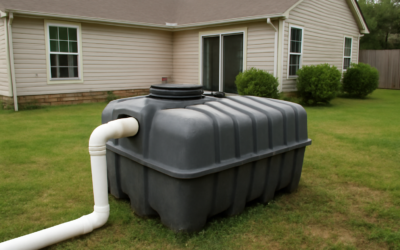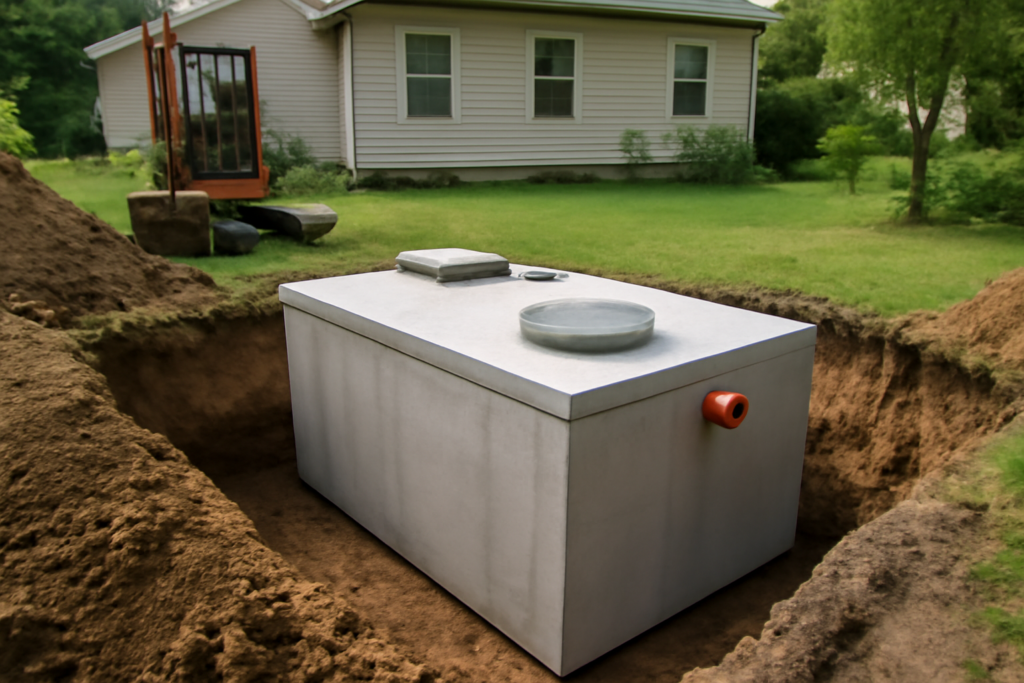
Roughly one in five American homes treats its own wastewater, and the buried workhorse doing the job is usually made of concrete. A concrete septic tank is a precast, steel-reinforced vault — typically 1,000 to 1,500 gallons for a family home — that separates solids from wastewater before the liquid moves on to the drain field. Precast concrete has dominated the septic market for seventy years because it solves the two problems that sink other materials: it’s heavy enough to stay put in wet ground, and tough enough to last 40 years or more. Here’s what to know about sizes, lifespan, costs, and the inspection points that decide whether an old tank is an asset or a liability.
- How a Septic Tank Actually Works
- Standard Sizes and How Tanks Are Sized
- Why Concrete Beats the Alternatives Underground
- Lifespan: 40 Years, With Two Enemies
- What a Concrete Septic Tank Costs
- Inspection: What the Probe and the Camera Look For
- Repair or Replace an Aging Tank
- Living With One: The Short Rulebook
How a Septic Tank Actually Works
The tank is a settling chamber, not a treatment plant. Household wastewater enters through an inlet baffle, and physics does the sorting: solids sink into a sludge layer, greases float into a scum layer, and the relatively clear liquid in between — effluent — exits through an outlet baffle or effluent filter to the drain field, where soil does the real treatment. Anaerobic bacteria slowly digest the sludge, but never completely, which is why every tank needs pumping on a 3- to 5-year cycle. Most modern precast tanks are two-compartment designs: a second interior wall gives solids a second chance to settle before effluent leaves, and many states now require it for new installs.
Standard Sizes and How Tanks Are Sized
Sizing runs on bedroom count — a proxy for occupancy — and local code sets the minimums. Typical requirements:
- 750 – 1,000 gallons — 1 to 2 bedrooms (many states no longer permit below 1,000 for new construction)
- 1,000 gallons — 3 bedrooms; the standard residential tank
- 1,250 gallons — 4 bedrooms
- 1,500 gallons — 5 to 6 bedrooms, or homes with garbage disposals and high-flow fixtures
A 1,000-gallon precast tank measures about 8.5 feet long, 5.75 feet wide, and 5 feet tall, and weighs close to 9,000 pounds. That mass is delivered on a boom truck and set in one lift — part of why precast installation is quick, and why site access for the truck is one of the first questions any installer asks. Oversizing one step is cheap insurance ($150 to $300 more) if you run a disposal, host guests often, or may add a bedroom.
Why Concrete Beats the Alternatives Underground
Polyethylene and fiberglass tanks exist, cost less upfront, and have a real niche — sites where a crane can’t reach. Everywhere else, concrete’s advantages compound. Weight keeps the tank anchored: plastic tanks can float out of the ground when a high water table meets a freshly pumped (empty) tank, a failure mode concrete essentially never has. Strength permits burial under deeper cover and near (never under) traffic areas without deflection; plastic tanks can bow inward under backfill pressure. And regulators trust it — every state approves precast concrete, while some restrict plastic tank placement. The one structural caveat: quality varies by producer. Look for a National Precast Concrete Association (NPCA) certified plant, vacuum or water testing for water-tightness, and 4,000+ PSI concrete with proper rebar cover.
Lifespan: 40 Years, With Two Enemies
A well-made concrete tank in neutral soil routinely serves 40 years, and inspectors regularly find 1970s tanks still sound. Two threats shorten that. The first is hydrogen sulfide corrosion: gases above the waterline convert to sulfuric acid on the concrete surface and slowly eat the crown, baffles, and the top few inches of wall — the reason inspections focus above the waterline, and the reason modern tanks use plastic baffle tees instead of cast concrete baffles. The second is acidic groundwater or aggressive soils, which attack from outside; in known problem soils, installers spec coated or higher-cement-content tanks. Poorly made mid-century tanks with thin walls and scant rebar are the ones that fail at 25 to 30 years; certified modern precast should outlive its drain field, which typically taps out at 20 to 30 years.
What a Concrete Septic Tank Costs
Budget in two layers — the tank and the hole:
- Tank only: $800 – $1,500 for a 1,000-gallon precast; $1,200 – $2,200 for 1,500 gallons; two-compartment and traffic-rated versions at the top of each range.
- Installed (tank, excavation, setting, plumbing connections, permits): $3,000 – $7,000 for a straightforward replacement into an existing system.
- Full new septic system (tank plus new drain field, design, and soil testing): $10,000 – $25,000+ depending on soil percolation and system type.
Add-ons worth taking: an effluent filter on the outlet ($30 to $80, protects the drain field from suspended solids), riser lids that bring access to grade ($100 to $300 per riser — nobody should dig 2 feet of lawn to pump a tank), and a traffic-rated lid if a driveway will ever pass near it.
Inspection: What the Probe and the Camera Look For
Tanks get evaluated at pumping time and during real-estate inspections, and the checklist is consistent. The inspector measures sludge and scum depth (pump when combined layers hit a third of tank volume), checks that inlet and outlet baffles are present and intact — missing baffles are the most common defect in older tanks and let grease flow straight to the drain field — and examines the crown and upper walls for the soft, exposed-aggregate surface of sulfide corrosion. A sound tank rings solid under a probe; corroded concrete flakes and crumbles. They’ll also look for water-tightness clues: effluent level above the outlet invert suggests a drain-field backup, while a level below it suggests the tank is leaking outward. Hairline surface crazing is cosmetic; through-cracks, active infiltration, or a corroded-through crown mean repair or replacement.
Repair or Replace an Aging Tank
Not every defect condemns a tank. Replaceable components — baffles, effluent filters, lids, and risers — are the most common failures and the cheapest fixes: a plastic baffle tee retrofitted into a tank that lost its concrete baffle runs $150 to $400 installed, and a new concrete or polymer lid $100 to $500. Minor crown corrosion caught early can be patched with hydraulic cement or a cementitious coating for a few hundred dollars. Joint leaks at the mid-seam of older two-piece tanks are sealable from inside with butyl and mortar when access allows.
Replacement becomes the answer when the structure itself is spent: a crown soft enough to crumble under a probe (a collapse hazard, and inspectors treat it as one), through-wall cracks actively exchanging water with the soil, or a tank that predates baffles and modern sizing entirely. Budget $3,000 to $7,000 for a swap into the existing footprint. One transitional note for buyers: many jurisdictions require a point-of-sale septic inspection, and an undersized or failing tank discovered then typically becomes a negotiated credit — worth far more to you documented before closing than discovered after.
Living With One: The Short Rulebook
Additives deserve one debunking sentence: the bacterial packets and monthly flush-in treatments sold as tank boosters are unnecessary in a normally used system — household waste supplies all the biology a tank needs, and several state extension services warn that some additives actually harm performance by suspending solids that then flow to the drain field. Save the $15 a month; spend it on the pump-out schedule instead.
Concrete tolerates a lot, but the biology inside doesn’t. Pump every 3 to 5 years, keep grease, wipes, paint, and solvents out of the drains, spread laundry loads across the week, and never park or build over the tank or field. Mark the lid location before you need it in February. Treat the tank as the 40-year appliance it is — a few hundred dollars of pumping each cycle is what keeps the five-figure drain field alive, and the drain field, not the concrete, is almost always what fails first.