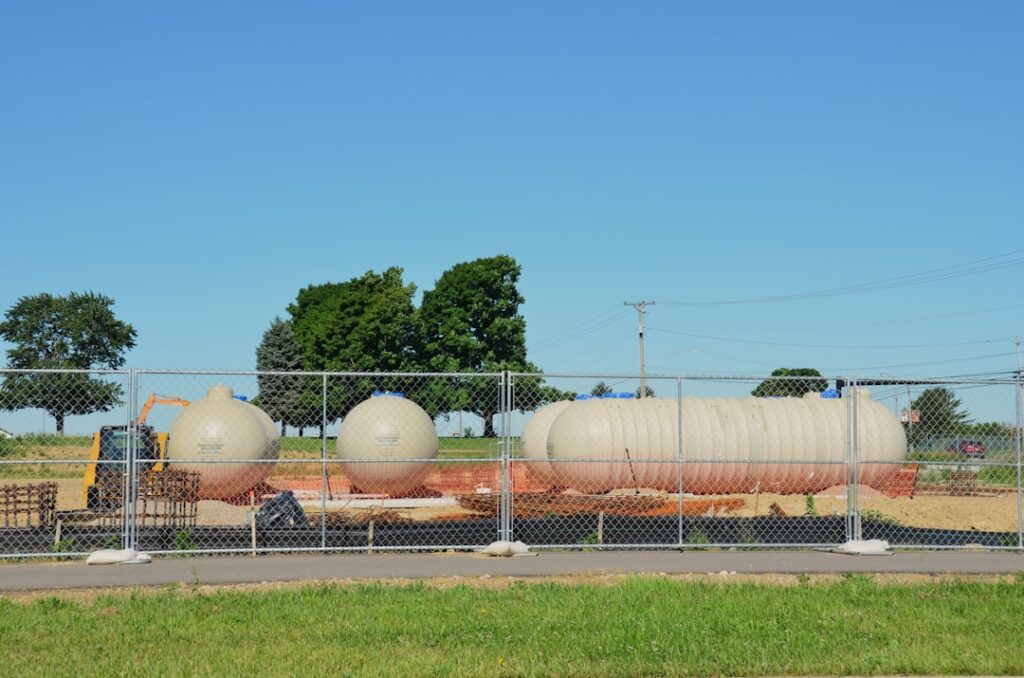
A septic tank installation is one of the largest single systems you can add to a rural property, and it runs $3,000 to $12,000 for most homes. If you’re building on a lot with no municipal sewer line, or your 40-year-old cesspool finally quit, this is the project that determines whether the house is even livable. Get the septic tank installation wrong and you’re looking at sewage backing up into the basement, a failed inspection, or a drain field that dies in five years instead of thirty.
- Why This Isn’t a Weekend Project
- Step One: The Perc Test and Soil Evaluation
- Step Two: Permits and System Design
- Step Three: Choosing the Tank and System Type
- Step Four: Excavation and Setting the Tank
- Step Five: Inspection Before Backfill
- Total Cost Breakdown
- What Affects Your Final Price
- Tank Sizing by Household
- Repair vs. Full Replacement
- Timeline and Lifespan
Let me be blunt up front: this is not a DIY job. Nearly every county in the U.S. requires a licensed installer, a permit, and a passed inspection before the trench gets backfilled. I’ll walk you through what actually happens, what it costs, and where the money goes.
Why This Isn’t a Weekend Project
People underestimate what’s buried in their yard. A complete system is a tank plus a drain field (also called a leach field or absorption field), and the field is where the real engineering lives. Size it too small or put it in the wrong soil and the effluent has nowhere to go. Most states, following EPA guidance, require the system to be designed by a licensed engineer or soil evaluator and installed by a certified contractor. Doing it yourself typically voids the permit and can make the property impossible to sell or insure.
The excavation alone involves moving 15 to 40 cubic yards of soil, setting a 1,000-gallon tank that weighs 8,000 to 12,000 pounds empty, and laying 300 to 1,000 linear feet of perforated pipe in gravel trenches. You need an excavator, a laser level for grade, and someone who knows how to read a soil report.
Step One: The Perc Test and Soil Evaluation
Before anyone digs, the soil gets tested. A percolation (perc) test measures how fast water drains through your ground. The installer or a soil scientist digs several test holes 2 to 4 feet deep, saturates them, and times how many inches the water drops per hour. Sandy, fast-draining soil might perc at 5 minutes per inch; heavy clay might take 60 minutes or more. If your soil percs slower than about 60 minutes per inch, a conventional gravity system won’t work and you’ll need an alternative.
A perc test costs $150 to $1,500 depending on your county and how many holes are required. This test controls everything downstream: it sets the size of your drain field, the type of system, and whether the lot is buildable at all. Never buy raw land for a home without a passing perc test in hand.
Step Two: Permits and System Design
The permit application goes to your county health department or environmental office. They review the soil data, the number of bedrooms in the house (which is how they estimate daily wastewater flow), setbacks from wells, property lines, and any surface water. A 3-bedroom home is typically rated at 300 to 450 gallons per day, which drives a 1,000-gallon tank as the minimum in most codes.
Permit fees run $250 to $1,000. Add another $500 to $2,000 if an engineered design is required for difficult sites. Setbacks matter: most codes demand the tank sit at least 5 to 10 feet from the house, 50 to 100 feet from any drinking-water well, and 10 feet from property lines.
Step Three: Choosing the Tank and System Type
Concrete tanks are the workhorse. A 1,000-gallon concrete tank costs $700 to $1,800 for the tank alone and lasts 30 to 40 years. Plastic (polyethylene) and fiberglass tanks run $900 to $2,000, weigh far less, and resist corrosion but can float if the water table is high and the tank isn’t anchored.
System type depends on your perc results:
- Conventional gravity system: The cheapest, $3,000 to $7,000 installed. Works when soil drains well and there’s enough downhill slope.
- Pressure distribution / pump system: $5,000 to $10,000. Uses a pump to push effluent evenly across the field when gravity alone won’t do it.
- Mound system: $10,000 to $20,000. Builds an engineered sand mound above grade for high water tables or shallow bedrock.
- Aerobic treatment unit (ATU): $10,000 to $20,000 plus an annual service contract. Required on tight lots or poor soil where you need cleaner effluent.
Step Four: Excavation and Setting the Tank
Installation day starts with the excavator digging the tank hole and the drain field trenches. The tank sits on a level bed of gravel or compacted sand so it won’t settle unevenly. The inlet has to sit slightly higher than the outlet so waste flows by gravity and solids settle out. A crane or the excavator boom lowers the tank in; a 1,000-gallon concrete unit needs real lifting capacity.
The drain field trenches, usually 18 to 36 inches deep and filled with washed gravel, receive the perforated distribution pipe. Everything gets checked with a laser level because the pipe needs a precise, gentle slope, roughly 1/4 inch per foot or dead level in a pressurized system.
Step Five: Inspection Before Backfill
This is the step homeowners try to skip and always regret. Before any soil goes back over the pipe, the county inspector comes out to verify the tank size, pipe layout, gravel depth, and setbacks against the approved plan. If it’s covered before inspection, they can make you dig it all back up. Once it passes, the crew backfills, grades the site, and often seeds the disturbed ground.
Total Cost Breakdown
For a standard 3-bedroom home with decent soil, budget in this range:
- Perc test and soil evaluation: $150-$1,500
- Permits and design: $500-$2,500
- Tank: $700-$2,000
- Excavation and labor: $1,500-$4,000
- Drain field materials (gravel, pipe, fabric): $1,000-$3,000
- Site restoration: $300-$1,000
That’s why a straightforward job lands around $3,000 to $7,000, while a difficult lot needing a mound or aerobic system pushes $12,000 to $20,000. Rocky ground, a high water table, or a long distance from the house to the field all add cost fast.
What Affects Your Final Price
Soil is the single biggest variable. Fast-draining sand keeps you in a cheap gravity system; clay or ledge rock forces an engineered design and doubles the bill. Bedroom count sets the daily flow rating and therefore tank and field size. Access matters too, if the excavator can’t reach the site without tearing up a finished driveway, expect an upcharge. And in some counties, hooking up an existing house means abandoning the old system properly, which is its own line item.
Tank Sizing by Household
Codes size the tank off bedroom count because bedrooms predict occupancy better than square footage. The rough national baseline looks like this:
- 1-2 bedrooms: 750-1,000 gallon tank
- 3 bedrooms: 1,000-1,250 gallon tank
- 4 bedrooms: 1,250-1,500 gallon tank
- 5+ bedrooms: 1,500-2,000 gallon tank
Undersizing is a false economy. A tank that’s too small doesn’t give solids enough settling time, so grease and sludge carry into the drain field and clog the soil. That’s the fastest way to kill a field and face a $10,000-plus replacement. When you’re on the fence, size up, the cost difference between a 1,000 and a 1,250-gallon concrete tank is usually only $200 to $400.
Repair vs. Full Replacement
Not every septic problem means a new system. If the tank itself is sound but the drain field has failed, you may be able to replace just the field for $5,000 to $10,000 while keeping the existing tank. A cracked tank baffle is a $300 to $900 fix. A failed effluent pump runs $500 to $1,500. But once a concrete tank cracks structurally or the field is saturated beyond recovery, you’re back to a full septic tank installation and the numbers reset. A licensed inspector can tell you which camp you’re in after a dye test and a tank pump-out.
Timeline and Lifespan
Once the permit is approved, the physical septic tank installation takes 1 to 3 days of work. The bottleneck is almost always the paperwork, the perc test and permit review can stretch the whole project to 4 to 8 weeks. A well-installed and maintained system lasts 25 to 40 years. Pump the tank every 3 to 5 years, keep vehicles off the drain field, and don’t plant trees over it, and you’ll get the full life out of what you paid for.
Hire a licensed installer, insist on the perc test before you commit, and never let the trench get covered before the inspector signs off. Do those three things and this expensive, buried system will quietly do its job for decades.