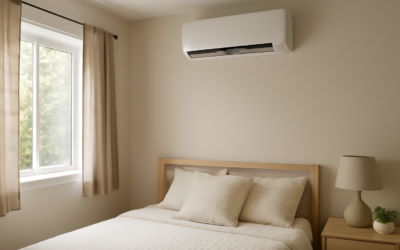
A 12k BTU mini split is the workhorse size of the ductless world, and for good reason. Twelve thousand BTU per hour, roughly one ton of capacity, hits the sweet spot for the single rooms and small additions homeowners most often want to condition. It is the most commonly installed size, and below is exactly what it will and will not do, what it costs, and how to size one correctly.
What Square Footage Does 12,000 BTU Actually Cool?
The lazy answer floating around online is “one ton cools 400 to 600 square feet,” and it is close enough to be dangerous. A 12k BTU mini split comfortably handles 450 to 650 square feet in most modern, reasonably insulated homes. But square footage alone is a rough proxy. Real sizing depends on:
- Insulation and air sealing: A tight 2015-built room needs far less capacity than a drafty 1950s sunroom of the same size.
- Windows and orientation: A west-facing room with big glass gains serious afternoon heat and may max out a 12k unit at 450 square feet.
- Ceiling height: Vaulted ceilings add volume the rating never accounted for.
- Heat load: A kitchen or a home office packed with electronics runs hotter than a bedroom.
A common field rule for cooling is roughly 20 to 25 BTU per square foot for average construction. That math puts a 12,000 BTU unit at about 480 to 600 square feet. Oversize it and you get a system that short-cycles, never pulls humidity, and leaves the room clammy. Undersize it and it runs flat-out and still loses on the hottest days.
The oversizing mistake deserves more attention because it is the most common one. Homeowners assume bigger is safer, so they jump from a 9k to a 12k or a 12k to an 18k for a small bedroom. What actually happens is the unit blasts the room to temperature in ten minutes, then shuts the compressor down before it has run long enough to wring moisture out of the air. You end up with a cold, damp, clammy room and an inverter that never gets to run at the efficient low speed it was designed for. A correctly sized unit runs long, gentle cycles that both hold temperature and dehumidify. When in doubt at a size boundary, lean toward the smaller unit for a well-sealed room and the larger one only for a sun-blasted or leaky space.
Heating Capacity Matters Too
Do not forget these are heat pumps. A 12k unit typically delivers 12,000 to 16,000 BTU of heating, and cold-climate models hold that output well below freezing. If you are counting on the mini split as your primary winter heat in the North, buy a cold-climate variant and size it against your heating load, which is often the larger of the two numbers in a cold state.
Standard, non-cold-climate 12k units lose capacity as the temperature drops. A basic model rated at 12,000 BTU of heat at 47 degrees might only deliver 7,000 or 8,000 BTU when it is 5 degrees out, right when you need it most. Cold-climate versions use a larger compressor and a flash-injection or vapor-injection circuit to hold rated output far lower, some to minus 5 or minus 13 Fahrenheit. In a heating-dominated climate, that difference decides whether the mini-split carries the room alone or needs a backup electric heater on the coldest nights. Check the manufacturer’s extended-capacity table, not just the headline BTU number, before you buy.
What a 12k BTU Mini Split Costs
Here are realistic 2026 numbers. The bare equipment, a 12k single-zone system, runs $700 to $2,200 depending on brand and efficiency. Professional installation lands the total at:
- Budget brand, simple install: $2,800 to $4,000.
- Mid-tier (Mitsubishi, Fujitsu, Daikin), standard install: $4,000 to $6,000.
- Cold-climate model, difficult routing: $5,500 to $7,500.
DIY kits with pre-charged linesets exist for $900 to $1,800, and a handy homeowner can hang one. Just understand you give up the compressor warranty on many pro-grade brands, and you will never get the efficiency of a properly vacuumed, field-charged system.
How the Installation Goes
A clean single-zone install takes an experienced crew four to six hours. The sequence looks like this:
- Mount the indoor head high on an exterior-facing wall, studs located and backing plate leveled.
- Bore a 3-inch pass-through for the lineset, control wire, and condensate drain, pitched slightly downhill for gravity drainage.
- Set the outdoor condenser on a pad or wall bracket, keeping it 12 inches off the ground for airflow and snow clearance.
- Flare and connect the copper lineset, then pull a deep vacuum to 500 microns and hold it to prove the joints are tight.
- Release the factory refrigerant charge, wire the disconnect, and commission the unit.
The vacuum step is where corners get cut. Moisture left in the lines turns to acid inside the compressor and shortens its life. Watch for the gauge; a legitimate installer will show you the micron reading.
A couple of placement details separate a good install from a mediocre one. Indoors, the head should sit six to eight inches below the ceiling with a few inches of clearance on each side so the return airflow is not choked. Aim it down the long axis of the room rather than straight at a facing wall, and never mount it directly above a bed where the airflow blows on someone all night. Outdoors, keep the condenser out of the prevailing afternoon sun if you can, give it two feet of clearance in front of the coil, and set it on rubber isolation feet to keep the faint compressor hum from transmitting into the house. These small choices are the difference between a unit you forget is there and one that annoys you every day.
Best Brands for a 12k Unit
Reliable choices at this size, roughly ordered by price:
- Mitsubishi Electric MSZ/MUZ: The benchmark for reliability and cold-climate performance. Premium price, premium dealer network.
- Fujitsu AIRSTAGE: Nearly matches Mitsubishi, sometimes quieter, strong sub-zero output.
- Daikin: Excellent engineering, competitive efficiency, wide availability.
- LG and Gree: Solid value tier with good efficiency numbers.
- Mr. Cool DIY: The go-to for homeowners installing their own, pre-charged and approachable.
Efficiency and Running Cost
A modern 12k mini split posts a SEER2 anywhere from 19 to 33. On the electric bill, a mid-efficiency unit cooling a bedroom eight hours a day in summer costs most homeowners $15 to $35 a month. The inverter compressor is the reason: instead of cycling on and off, it modulates its speed to match the load, which sips power and holds a rock-steady temperature. That variable-speed behavior also strips humidity far better than a window shaker.
Efficiency is also where the federal and utility incentives come in. A 12k unit that hits the CEE efficiency tier can qualify for the 25C federal tax credit worth 30 percent of the project up to $2,000, and many state and utility rebates stack on top. Pull your utility’s rebate sheet and confirm the specific model number qualifies before you sign, because the incentive often requires a certified efficiency rating and a licensed installer.
Pro Tips Before You Buy
Get a load calculation, even a quick Manual J estimate, rather than guessing from square footage. Position the indoor head so its airflow sweeps across the room, not straight into a wall. Budget for a proper condensate plan; in a finished space a small condensate pump beats hoping gravity does the job. And register the warranty the day the unit is commissioned. Do those things and a 12k BTU mini split will quietly heat and cool your problem room for 15 to 20 years.
Maintenance is minimal but real. Pull and rinse the washable indoor filters every four to six weeks during heavy use, because a clogged filter chokes airflow and can even ice the coil. Once a year, hose down the outdoor coil, check that the condensate line runs clear, and have a technician verify the refrigerant charge is still correct. Neglected coils and dirty filters are behind most of the mid-life efficiency complaints, and both are things a homeowner can stay ahead of in fifteen minutes a month. Treat the unit well and it will reward you with two decades of cheap, quiet comfort.