
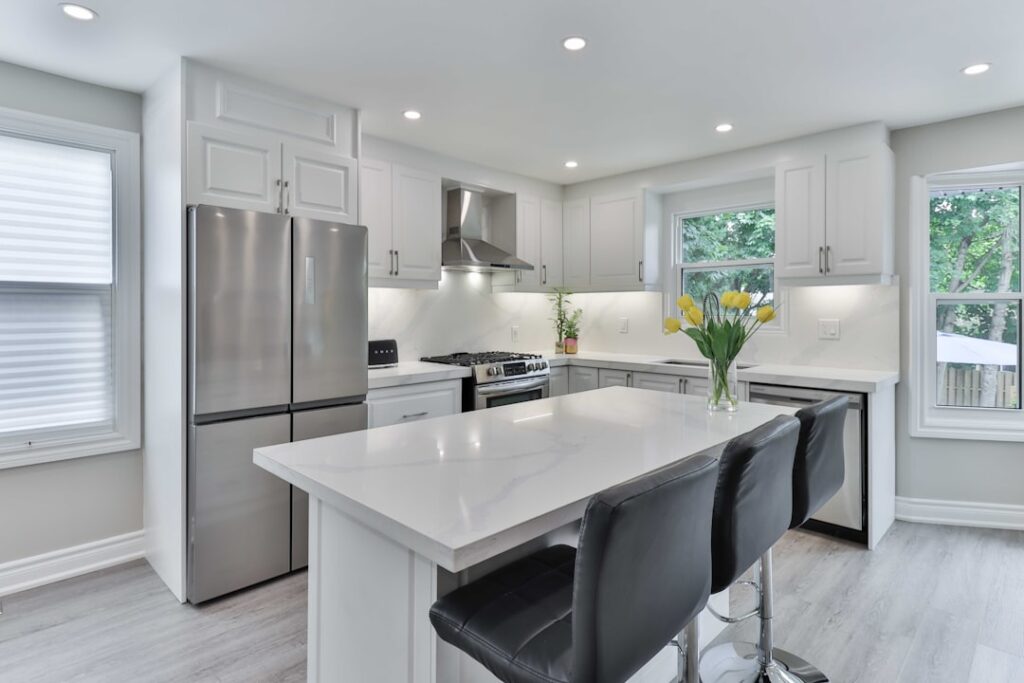
If you bought a house built between 1990 and 1999, odds are you walked into oak cabinets, off-white laminate countertops, and a builder-grade fluorescent box light flickering overhead. A 1990s kitchen rarely deserves the full gut treatment people assume it does. The bones are often solid — sturdy plywood boxes, real wood doors, and layouts that actually work for cooking. The dated parts are usually the surfaces, lighting, and hardware, all of which can be refreshed for a fraction of a full renovation.
Part of our Kitchen Remodeling guide — explore the full guide →
- What 1990s Kitchens Got Right
- The Telltale Signs of a 1990s Kitchen
- Decide What to Refresh vs. Replace
- Cabinet Strategies That Actually Work
- Countertop and Backsplash Swaps
- Flooring Updates Without a Full Tear-Out
- Appliance Refresh Strategy
- Lighting Is the Cheap Showstopper
- What Not to Skip
- Final Word on Modernizing
What 1990s Kitchens Got Right
The decade introduced larger refrigerator alcoves, dedicated microwave shelves, and the rise of the kitchen island as a daily-use feature rather than a luxury add-on. Cabinet construction in this era was often better than what builders ship today. Many 1990s cabinets are 3/4-inch plywood boxes with solid wood face frames and dovetailed drawers — a build quality that costs $800 to $1,200 per linear foot to replicate in 2026 dollars.
Layouts from this era also tend to honor the working triangle. Sink, stove, and fridge usually sit within reasonable reach of each other. Before you rip everything out, walk the room and ask whether the layout actually frustrates you, or whether the surfaces just look tired.
The Telltale Signs of a 1990s Kitchen
Honey-oak or golden-oak cabinets dominate the era, paired with cream or almond appliances, beige laminate countertops with the rolled front edge, and a 4-inch backsplash made from the same laminate. White or almond ceramic tile floors with sand-color grout were common. Lighting was almost always a single fluorescent fixture with a yellowed acrylic diffuser, plus undercabinet halogen pucks that burn out every six months.
Other markers include arched valances over the sink, recessed-panel oak doors with rounded edges, and cathedral arches on upper cabinet doors. Recognize any of these? You have textbook 1990s.
Decide What to Refresh vs. Replace
Start with a tier system. Tier one — cosmetic — covers paint, hardware, and lighting. Tier two — surface — covers countertops, backsplash, and flooring. Tier three — structural — covers cabinets, layout, and appliances. Most 1990s kitchen updates only need tiers one and two, which can land between $8,000 and $20,000 instead of $50,000 to $100,000 for a full remodel.
Be honest about cabinet condition. Open and close every door. Pull every drawer fully out. If the boxes are square, the hinges still hold, and the doors aren’t warped, paint or reface them. If multiple drawers sag and the boxes feel spongy, it’s time to replace them.
Cabinet Strategies That Actually Work
Painting oak cabinets is the highest-leverage move in any 1990s kitchen update. The challenge is the open grain — without filling it, paint sinks into the texture and the oak pattern still ghosts through. Use a grain filler like Aqua Coat Clear Wood Grain Filler, sand to 220 grit, prime with Stix or BIN, then spray two coats of Benjamin Moore Advance or Sherwin-Williams Emerald Urethane in your chosen color. Expect a five-day project for an experienced DIYer.
Refacing — keeping the boxes, replacing doors and drawer fronts with new shaker-style fronts, plus a fresh wood veneer on the face frames — runs $4,000 to $9,000 for an average kitchen and skips the prep nightmare of painting oak. New cabinets cost $15,000 to $40,000 for the same footprint.
Countertop and Backsplash Swaps
Laminate counters with rolled edges scream 1990s louder than almost anything else. Quartz now starts at around $55 per square foot installed, with mid-grade options at $70 to $90. For a 30-square-foot kitchen, that’s roughly $2,100 to $2,700 — a transformative change for the budget. Butcher block from IKEA or Lumber Liquidators ranges $200 to $600 for the same footprint and pairs beautifully with painted shaker cabinets.
Demo the 4-inch laminate backsplash with a pry bar and patch the drywall before tiling. A simple white subway in 3-by-12 or 4-by-12 with a warm gray grout updates the room without locking you into a trend. Allow $300 to $700 in materials for a typical run.
Flooring Updates Without a Full Tear-Out
The almond ceramic tile in a 1990s kitchen is usually thinset directly to plywood, which makes removal a project. The fastest fix is luxury vinyl plank floated over the existing tile if the surface is reasonably flat. SPC LVP from brands like CoreTec, Shaw, or Mannington runs $3 to $6 per square foot, installs in a long weekend, and tolerates the dropped sippy cup or wet dog without flinching.
If you prefer hardwood, engineered planks work over tile too with a thin foam underlayment. Avoid solid hardwood over old tile — the height difference at transitions becomes a stubbed-toe problem at every doorway.
Appliance Refresh Strategy
Almond appliances date a kitchen instantly. Stainless or matte black sells the modernization. Stick to one finish — mixing slate, stainless, and black creates the same scattered look you’re trying to escape. A bundled appliance set from Whirlpool, GE, or LG typically runs $2,800 to $5,000 for a fridge, range, dishwasher, and microwave at solid mid-tier specs.
If the existing appliances are still fully functional, consider waiting a year and replacing them as they fail rather than all at once. The 1990s GE Profile fridge that still cools after 30 years has earned a few more seasons.
Lighting Is the Cheap Showstopper
Yank the fluorescent box and replace with three to five 6-inch LED recessed cans on a dimmer. Add an island pendant or two — Schoolhouse Electric, Hudson Valley, and CB2 all sell options between $80 and $300. Switch undercabinet halogens to plug-in or hardwired LED strips. Total budget: $400 to $1,500 in materials. The transformation is dramatic, and homeowners consistently underestimate how much old lighting was making their kitchen look tired.
What Not to Skip
Update the outlets and switches to white decora style. Swap the old phone jack for a USB outlet near the coffee station. Replace the dingy white plastic vent hood with a stainless or painted-metal model. These are $300 to $800 in details that elevate the entire room.
Final Word on Modernizing
A 1990s kitchen rewards the homeowner who works with what’s there. Solid cabinets, solid layouts, and solid bones get a new life with paint, lighting, hardware, counters, and a backsplash. Save the gut renovation for kitchens with real structural problems — and put that money toward better appliances and finishes you’ll touch every day for the next 20 years.


