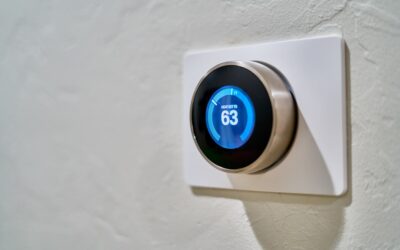
Pull an old thermostat off the wall and find only two wires, and you have probably learned that many smart thermostats will not work. That is normal for heat-only systems such as hot-water boilers, older gas furnaces without air conditioning, and some wall and floor furnaces. A programmable two wire thermostat is built for exactly this setup: it runs on batteries or harvests tiny amounts of power, and it simply closes the circuit between the two wires to call for heat.
The good news is that the wiring is the easiest in the thermostat world. The catch is that you need to confirm which type of system you have first, because a 24-volt boiler control, a millivolt gas wall heater, and a 120/240-volt electric baseboard look similar at the wall but need completely different thermostats. Get that right and the swap takes about 20 minutes.
- What a Programmable Two Wire Thermostat Does
- Which Thermostat Types Work With Two Wires
- Millivolt vs 24V vs Line Voltage: Check Before You Buy
- How to Install a Two-Wire Programmable Thermostat
- Adding Power Without a C Wire
- Troubleshooting a Two-Wire Thermostat
- When to Call a Licensed Professional
- Frequently Asked Questions
What a Programmable Two Wire Thermostat Does
In a typical heat-only system, the two wires are labeled R (power from the transformer) and W (heat call). When the thermostat wants heat, it connects R to W, the boiler or furnace control senses the closed loop, and heat starts. When the room reaches the set temperature, the thermostat opens the connection. There is no fan wire (G), no cooling wire (Y), and no common wire (C) to power a display continuously.
That missing C wire is the whole story. A basic programmable model powers its screen and schedule from AA or AAA batteries, so two wires are all it needs. Many Wi-Fi smart thermostats need steady 24-volt power, which is exactly what a C wire supplies. Some smart models try to “power steal” by trickling current through the heat circuit, but on certain boilers and zone valves that causes clicking, short cycling, or heat that will not shut off.
Which Thermostat Types Work With Two Wires
| Type | Works on 2 wires? | Notes |
|---|---|---|
| Battery-powered programmable | Yes | Most reliable choice; 7-day or 5-2 schedules |
| Battery smart/Wi-Fi model | Yes, some | Look for models designed for heat-only, no C wire needed |
| Power-stealing smart model | Sometimes | Can misbehave with boilers and zone valves |
| Smart model with C-wire adapter | Yes | Adapter or added wire supplies 24V power |
| Millivolt-rated thermostat | Yes | Required for millivolt gas wall and floor heaters |
When shopping, check the packaging for “compatible with 24V heat-only, 2-wire systems” or “millivolt compatible.” If the box lists hydronic or boiler compatibility, that is a good sign for hot-water systems.
Millivolt vs 24V vs Line Voltage: Check Before You Buy
This is the step people skip, and it matters. Three very different systems can present two wires at the wall.
- 24-volt low-voltage systems: Most boilers and central furnaces. Thin, bell-type wires (18 or 20 gauge) connect to a small transformer at the equipment. Standard low-voltage programmable thermostats work here.
- Millivolt systems: Gas wall furnaces, floor furnaces and some fireplaces with a standing pilot generate their own tiny current from a thermopile, around 750 millivolts. Many electronic thermostats cannot switch reliably at such low power. Buy a model specifically rated for millivolt use.
- Line-voltage systems: Electric baseboard heaters and some wall heaters run 120 or 240 volts through the thermostat itself. You will usually see thick wires, often with wire nuts, and a thermostat marked with a voltage rating. A low-voltage thermostat on a line-voltage circuit is a fire and shock hazard. These need a line-voltage thermostat, and if you are not comfortable working with household wiring, a licensed electrician.
Look at the old thermostat’s label and the equipment manual. If the heater has a standing pilot and no electrical connection to the house, it is likely millivolt. If the old thermostat is large, marked 120V or 240V, and controls a baseboard directly, it is line voltage.
How to Install a Two-Wire Programmable Thermostat
These steps cover a 24-volt or millivolt heat-only system. Tools: a small screwdriver, a drill with a small bit for anchors if needed, a level, your phone camera, and a non-contact voltage tester.
- Turn off power. Switch off the furnace or boiler at its service switch and at the breaker. For line-voltage systems, stop and use a line-voltage thermostat instead. Confirm power is off with a non-contact voltage tester.
- Photograph the old wiring. Remove the cover and take a clear picture of which wire goes to which terminal before disconnecting anything.
- Label and disconnect. Tag the wires R and W (or the terminals they were on, sometimes marked RH, TH, or 4 and 5 on older units). Wrap the wire bundle around a pencil so it cannot fall into the wall.
- Mount the new base. Feed the wires through, level the base plate, and fasten it with the supplied anchors.
- Connect the wires. Put one wire on R (or Rh) and the other on W (or W1). On a two-wire heat-only system, polarity generally does not matter, but follow the new thermostat’s diagram.
- Set the system type. Install batteries and choose “heat only,” then select hot water/boiler or gas furnace so the cycle rate matches your equipment. Boilers usually want fewer cycles per hour than forced-air furnaces.
- Restore power and test. Turn the equipment back on, raise the setpoint a few degrees, and confirm the boiler or furnace fires. Lower it and confirm heat stops.
- Program the schedule. A 7- to 10-degree setback while you sleep or are away is where the energy savings come from.
Once it is running, a programmable two wire thermostat pays off through its schedule. On a boiler system, program the morning warm-up to start 30 to 60 minutes before you wake, since hot-water radiators respond slowly. Forced-air furnaces recover faster, so 20 to 30 minutes is usually enough.
Adding Power Without a C Wire
If you want a Wi-Fi model that requires steady power, you have three routes to add c wire thermostat power. First, check behind the wall plate and at the equipment for an unused conductor tucked in the cable jacket; many installers ran more wires than they connected. Second, use a C-wire power adapter kit, which installs at the furnace or boiler control and converts the existing two wires into a powered circuit. Third, run a new thermostat cable from the equipment to the wall. On boilers with zone valves or a separate switching relay, the 24-volt transformer may be in a different location than you expect, so this job is often best handled by an HVAC technician. Never try to connect a C wire to a millivolt system; it has no transformer to draw from.
Troubleshooting a Two-Wire Thermostat
If the heat will not come on, check the batteries first, then confirm the thermostat is set to heat mode and the equipment switch is on. If a fresh-battery thermostat set well above room temperature still gets no response, the fault is more likely at the equipment, such as a tripped limit switch, a failed zone valve, or an ignition problem, and that is a job for an HVAC technician. If heat will not shut off, the thermostat may be power stealing on a boiler control or the wires may be shorted together. Rapid clicking or short cycles usually point to the wrong cycle-rate setting or a thermostat not rated for millivolt use. A blank display after a week often means low-quality batteries; use fresh alkaline or lithium cells.
When to Call a Licensed Professional
Call a licensed HVAC technician or electrician if the old thermostat is line voltage and you are unsure of the circuit, if you need a new C wire run through finished walls, if the boiler control or zone valve wiring is unclear, or if the equipment still will not respond after a correct install. Gas-fired boilers and furnaces with ignition, pilot or gas valve problems are strictly licensed-pro work; if you smell gas, leave the house and call your utility. Any new circuit or change to line-voltage wiring should go to a licensed electrician, and local permit rules may apply.
Frequently Asked Questions
Can I use a smart thermostat with only two wires?
Some battery-powered smart models work on two wires. Others need a C wire, a power adapter kit, or a new cable to supply steady 24-volt power.
Does it matter which wire goes on R and W?
On most two-wire heat-only systems it does not, because the thermostat simply closes the circuit. Still, match the labels from your photo and follow the new model’s diagram.
How do I know if my heater is millivolt?
Millivolt systems are usually gas wall or floor furnaces with a standing pilot and no household power connection. The old thermostat or heater manual often says “millivolt” or “750 mV.”
Will a programmable two wire thermostat save energy?
Yes. Scheduling a 7- to 10-degree setback at night and while you are away can cut heating energy by up to about 10 percent a year.
Can I install a low-voltage thermostat on an electric baseboard?
No. Baseboard heaters usually run on 120 or 240 volts and need a line-voltage thermostat. Using the wrong type creates a shock and fire hazard.