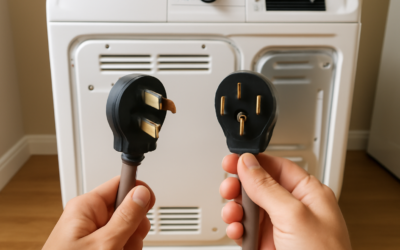
Open up the back of any electric dryer made in the 1980s and you will find a stout black cord with three flat blades. A 3 prong dryer plug is the older NEMA 10-30 standard, replaced by the four-prong NEMA 14-30 in the 1996 National Electrical Code update. Millions of homes still have the older receptacle on the wall, and the rules around keeping it, swapping it, or replacing the whole circuit are not always clear from a single online article.
What the 3 Prong Dryer Plug Actually Carries
The two angled flat blades carry 120 volts each from opposite legs of the home’s split-phase service. Combined, they deliver 240 volts to the heating element. The third L-shaped prong is the neutral, used for the 120-volt timer, motor, and control board. There is no separate ground wire in this design.
That last detail is the safety concern. In a 3-prong setup, the dryer chassis is bonded to the neutral inside the appliance. If the neutral fails or loosens, the metal cabinet can become energized at 120 volts. Anyone touching the dryer and a grounded surface like a metal sink completes the circuit. The 4-prong version solved this by separating ground from neutral entirely.
When You Can Legally Keep a 3-Prong Outlet
The NEC grandfathered existing 3-prong dryer outlets installed before the 1996 code change. As long as the original receptacle was code-compliant when installed, you are not required to upgrade it. You can buy and install a new dryer with a matching 3-prong cord, and most major brands like Whirlpool, GE, and LG sell both 3 and 4-prong cord kits separately for $25 to $40.
The exception is any major rewire, panel upgrade, or new construction. Once an electrician opens the wall or pulls a permit on the circuit, code requires upgrading to a 4-prong outlet with a separate ground conductor. This is not optional and most jurisdictions inspect for it.
Switching the Cord on a New Dryer
Most new dryers ship without a power cord because the manufacturer cannot know which outlet you have. Match the cord to the outlet, not the other way around. Swapping a cord takes 15 minutes with a screwdriver and a nut driver:
- Unplug the dryer: Always cut power at the breaker first as a backup.
- Remove the small access panel: Usually held by 2 to 4 screws on the back upper edge.
- For 3-prong: Connect the L-shaped neutral to the center terminal, the two outer wires to the outer terminals, and install the bonding strap from neutral to the chassis ground screw.
- For 4-prong: Remove the bonding strap entirely. Connect green or bare ground to the chassis ground screw, white neutral to the center, and the two hots to the outer terminals.
- Secure the strain relief: Tighten the cord clamp so no force can pull on the terminal screws.
The bonding strap step is the one DIYers most often miss. Leaving it in place on a 4-prong installation creates a parallel current path through the ground wire, which can trip GFCI breakers and is a code violation.
Upgrading a 3-Prong Outlet to 4-Prong
This is the right call during any kitchen, laundry, or panel remodel. The work involves running a fourth conductor from the outlet back to the panel, since the original cable usually contains only three wires plus the outer sheath. In modern conduit, the electrician can pull a single green wire alongside the existing conductors. In older homes with sheathed cable, the entire run typically needs replacement.
Costs vary widely based on accessibility. A simple swap with accessible conduit runs $250 to $450. A full cable replacement through finished walls and ceilings runs $600 to $1,500. Always hire a licensed electrician and pull a permit. Insurance carriers can deny claims on fires traced back to unpermitted electrical work.
Common Misconceptions
Plenty of bad advice circulates online. The two most dangerous myths are worth correcting directly. First, you cannot legally use a 3-to-4 prong adapter. These do not exist for code-approved residential dryer installations because there is no safe way to derive a separate ground from a 3-conductor circuit.
Second, you cannot run a separate ground wire from the dryer chassis to a nearby cold water pipe or grounding rod. This was permitted in some pre-1962 installations but is now explicitly prohibited because the dedicated ground must follow the same path as the supply conductors. Bootleg grounds create unsafe voltage differentials.
Signs Your Existing Outlet Needs Replacement
Even a grandfathered 3-prong outlet can wear out and become unsafe. Watch for these warning signs and address them quickly:
A loose or wobbling plug means the receptacle’s internal contacts have lost spring tension. Heat from arcing damages the plug face and surrounding wall. A burning or fishy smell when the dryer runs almost always means an overheated connection. A discolored or melted plug face is past the warning stage and into immediate fire risk territory.
Any of these calls for shutting off the breaker and replacing the outlet immediately. A new NEMA 10-30 receptacle costs about $12 at any home improvement store, but the labor portion of the job is the same as a full upgrade. If you are paying an electrician, this is the moment to spend the extra money on a 4-prong upgrade and be done with it for good.
Ground Fault and Arc Fault Protection
Some recent NEC updates require GFCI or AFCI protection on dryer circuits in certain jurisdictions. Check your local amendments. A GFCI breaker for a 30-amp 240-volt circuit runs about $130, considerably more than the standard $25 unit, but adds a layer of personal safety that the bare 3-prong installation lacks. AFCI protection is increasingly required in laundry rooms in newer construction.
Bottom Line
An existing 3-prong dryer outlet is not an emergency, but it is not the safest design either. Replace any worn or damaged receptacles immediately, swap the dryer cord rather than forcing a mismatched plug, and upgrade to a 4-prong setup whenever you have the walls open for any other reason. The math favors doing it right when convenience and code already line up.