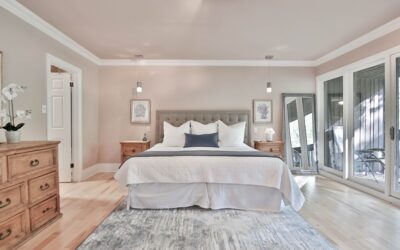
A king-size mattress measures 76 inches wide by 80 inches long, which means a 6-by-9 rug centered fully under the bed gets swallowed and looks like a bath mat from across the room. But that does not mean you wasted the money — a 6×9 rug under king bed works beautifully if you commit to one of three placements that designers have used for decades. The trick is matching the rug to the function instead of trying to cover the whole footprint.
This guide covers the three layouts that actually look intentional, the math behind each one, and when to layer two smaller rugs instead of forcing one to do too much.
The Sizing Problem in Plain Numbers
A 6-by-9 rug is 72 inches by 108 inches. A king bed alone is 76 inches by 80 inches. Slide that rug under the bed in standard orientation (long side parallel to the bed’s long side) and you get 0 inches of rug visible past the sides of the mattress, with 14 inches sticking out at the foot. That is not enough on the sides to read as a layered floor.
The standard recommendation for a “rug fully under the bed” look is 9 by 12 minimum. Below that size, you need to switch strategies.
Layout 1: Foot of the Bed (Most Common)
Place the 6-by-9 rug horizontally at the foot of the bed, with the long edge running parallel to the footboard. Slide it 6 to 12 inches under the foot of the mattress. This creates a defined seating or standing zone at the end of the bed and reads like an intentional anchor rather than a too-small rug.
What works:
- The rug extends about 6 to 7 feet beyond the foot of the bed, perfect for a bench or end-of-bed ottoman
- You see most of the rug from the doorway, which is where the design impact matters
- Side tables and nightstands sit on the bare floor, which simplifies cleaning
This layout pairs well with bedrooms 12 by 14 feet or larger, where the rug has room to breathe past the foot.
Layout 2: Sideways Under the Lower Two-Thirds
Rotate the rug 90 degrees and slide it sideways under the bottom two-thirds of the mattress. The 9-foot length now runs perpendicular to the bed’s long axis. You will see roughly 24 inches of rug exposed on each side of the bed at the foot, with the head of the bed sitting on bare floor.
This is the placement most designers default to in master bedrooms because:
- Your feet land on rug both sides when getting out of bed
- The headboard wall stays clean visually — no rug edge to compete with the bed frame
- It hides the typical lump where rug meets bed leg better than centered placement
Do leave 3 to 5 inches between the bottom edge of the rug and the wall behind the headboard. A rug crammed against the wall reads cramped.
Layout 3: Two Runners Down the Sides
If the bedroom is tight or the 6-by-9 you bought turns out to be wrong for the space, sell it and buy two 2.5-by-8 or 3-by-8 runners instead. Place one along each side of the bed, parallel to the long axis. This is a hotel-suite move that costs about the same as a single mid-grade 6-by-9 and solves the cold-floor problem on both sides without the centering issue.
Total cost runs $200 to $500 for two decent wool or wool-blend runners. Look at Loloi, Surya, and Safavieh for budget-friendly options under $300 each.
How Far Should the Rug Extend Past the Bed?
The rule of thumb across interior design schools is 18 to 24 inches of exposed rug on the sides of the bed. Less than 18 inches looks tight; more than 30 inches looks like the rug is too big. For a 6-by-9 placed sideways under a king, you naturally hit 24 inches per side, which is exactly in the sweet spot.
At the foot of the bed, the target is 24 to 36 inches of exposed rug if the rug starts under the bed. A 6-by-9 placed lengthwise at the foot gives you 84 inches past the footboard — too much for most rooms, which is why the horizontal foot placement (Layout 1) usually beats the lengthwise version.
Pad and Anchor Notes
Whatever placement you choose, use a non-slip rug pad cut to within 1 inch of the rug edge. The Mohawk Home dual-surface felt pad runs about $50 for 6-by-9 and adds enough cushion to make a low-pile rug feel like medium-pile underfoot. Without a pad, the rug will creep toward the door over weeks of bed-getting-out.
Bed legs sitting partially on the rug cause a lump unless the rug is dense and low-pile. High-pile shag rugs do not work under bed legs at all — the legs sink, the bed wobbles, and the pile crushes permanently. Stick to flat-weave, low-pile, or medium-pile constructions for any layout that involves the bed sitting on the rug.
Material Recommendations by Layout
- Wool low-pile: best for sideways and foot-of-bed placement, lasts 15+ years, $400 to $1,200 in 6-by-9
- Wool-cotton blend: softer, less expensive, $200 to $500
- Polypropylene flat-weave: budget option, kid- and pet-friendly, $80 to $200
- Jute or sisal: texture-heavy but rough underfoot — only works if you layer a smaller cotton rug on top at the foot
When to Skip 6-by-9 Entirely
If your bedroom is 14 by 16 feet or larger, save up for a 9-by-12. The proportions work better with a king, the bed sits fully on the rug with 24 inches exposed on three sides, and you avoid the visual gymnastics of off-center placement. A quality wool 9-by-12 runs $700 to $2,500. For smaller bedrooms (10 by 12 feet or less), runners on either side of the bed almost always look better than any single rug.
FAQ
Can a 6×9 rug fit completely under a king bed?
No, not in a way that looks intentional. The rug is 72 inches wide and the king bed is 76 inches wide, so the bed actually overhangs the rug. You need 9-by-12 minimum for full-coverage placement.
Is a 6×9 rug too small for a master bedroom?
Not necessarily. It depends on placement. Sideways under the lower two-thirds of the bed or at the foot, a 6-by-9 anchors the room well. It is too small only if you try to center it under the entire bed.
Should the rug pad be the same size as the rug?
Cut the pad about 1 inch shorter on each side, so the pad is 5 feet 10 inches by 8 feet 10 inches for a 6-by-9. This keeps the pad invisible at the rug edges and prevents tripping.
What is the cheapest way to get a rug look on both sides of a king bed?
Buy two 2.5-by-7 or 3-by-8 polypropylene runners. The pair costs less than one mid-grade 6-by-9 and gives you soft landing on both sides without the centering issue.